
3:30 Pace Bus - Tata Mumbai Marathon 2025
Pacer · Vijayraghavan Venugopal
This page is for the 3.30 hour TMM pace group. This page will be continuously updated and will have all the information about this pace bus.
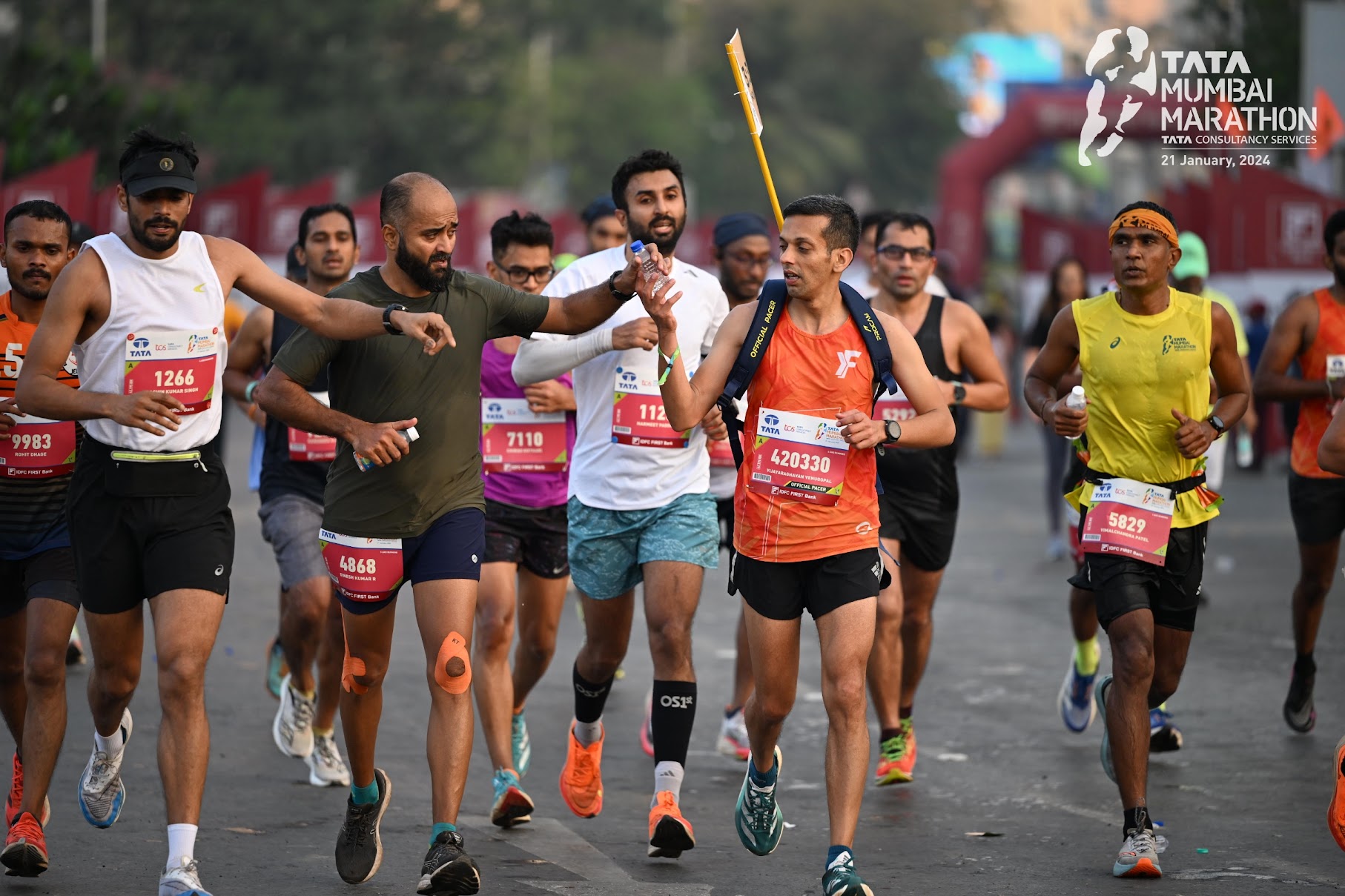
Quick intro to the pacer
1. I have been running since 2012 and currently based in Bengaluru.
2. 9 sub 3 hour full marathon finishes till date including that at Boston, Chicago, Berlin, Paris, Mumbai, Delhi and Tokyo
3. Personal best time of 2.51 hours in full marathon at the Tokyo Marathon 2024
4. First pacing experience at VDHM 2023 with the 1.30 hour bus
5. Paced TMM 2024 3.30 hour bus
A bit of my marathon journey to make sure that we are all in it together.
I did my first SCMM (then name), which is in fact my debut marathon in 2013 with a time of 4h:02m. In 2014, this went close to this pacing time and ended in 3.34. In 2015 managed to break the barrier and do a 3h:24m. I was DNF in 2016, followed by strong attempts in 2018 and 2019. The good thing is that breaking the 3.30 was considered a tough ask 10 years ago, but now with much better access to information, structured training, knowledge, and of course shoes, it is lot more doable. Possibly a pacer or a group too helps!
The following are my Garmin activity links to my earlier runs of 3h:34m and 3h:24m, which gives an idea of how differently the races were run. This year’s pacing strategy for the 3h:30m bus will be somewhere in between.
Pacing Approach
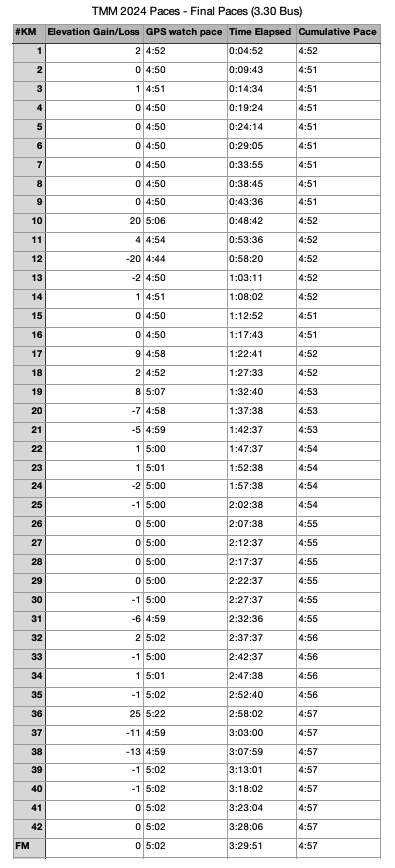
Following is the pacing approach. More thoughts will follow in the coming days. The idea will be to do a slightly faster first half, which means a positive split. Roughly a 1.42~1.43 first half and a 1.47 second half. There is enough data to say that Mumbai has typically been a positive split race for amateurs, and keeps it less risky. In terms of pace, we by and large need to be in the 4.50s-5:00s. Starting in the lower band and inching upwards as the marathon progresses. I would like to keep this fairly simple, and please don’t bother about 1-2 seconds here and there. That we will take care as a group!
The route elevations considered for pacing is primarily based on last year’s one, and we expect some changes between 22-27 km. But I do not think it will matter much in the larger scheme of things. So would request not to worry too much about this at this point in time.
Download the Pace Chart as PDF
Pacing group pointers – Enroute
The idea will be to stick to paces or strategy as laid out in the pacer band. Minor on the go tweaks are possible but by and large we will stick to the plan. Hence it is important to stick to the pacing group and pacer. The pacer may/ will do the following
- Be a time guidance for the group
- Will try to motivate the group
- May shout instructions on the go pertaining to need to moderate/speed up pace, hydrate etc
- Could act as an advisor on the way.
There is very little the pacer can do if one or a few runners drop off on the way, since the goal is to lead the majority/ or runners who are attempting the time.
The mantra of the group will be to stick together. There are points in the race like sea link where sticking to the group (drafting) will be of great help. I would welcome runners to take turn and be my co-leaders to navigate the group. The people in the front do put in an extra effort but if we are able to share the responsibility, the task of the 3.30 finish becomes easier for all.
We will try to stick to the shortest route possible, and hence run on tangents.
On the way back once the sun is hopefully out, we will be able to see more people cheering on the way including the Peddar road. Take energy from them, to use it for achieving your/our goal.
Team Work
I have in the past talked about the might of the team in getting the task done of achieving our goals. From the poll, we already know that there is a high likelihood of atleast 100 people aspiring to join the pack. So on 19th there would be 3 places where I would want you to pay special attention.
-
Around 10 K or so, after the Babulnath temple we have our first incline. Keep the morale high and close ranks to go over it without any waste of energy, and then enjoy the downhill post that. These are very early stages in our run, and should seem like a nice warm up done:-)
-
Worli Sea link - Close in ranks, and if possible form a V to have minimum affects of the wind. Take turns to go in the front, so that it is not the same people who are braving the front. For people who want to take it easy for a few Ks get back, lie low and enjoy the group.
-
Peddar Climb ~ 36 K - I am hoping we have as many people survive in the group as we come to this. This is a high energy moment, and we need all of us to re-group, start preparing and attack the climb for one last time:-) Again get together and leave little spaces in between.
At all times, please cheer the other person, share your Reloads and water bottles, and help each other.
Finding the pacer and start
I will be starting from Wave A and hope to be in the holding area by 4.30-4.40 am or so. Being there with the pacer flag should give runners time and opportunity to identify me. As we get to 5 am which is the start, typically everyone moves ahead towards the start point which is the CSTM station. I will try to be around 150 m behind the start line, when the marathon begins. This I believe will give an opportunity for maximum people to start with me, than if I were ahead at the start line. In case you want to move ahead between the start line and me, please do so since it will be a matter of seconds and also gives you more comfort to navigate. Further staying in sight of me, is fine, and not necessarily next to me. It also gives space for everyone.
The flip side is obviously traffic to navigate in the first 1 km. Do not get unsettled with the crowd or the fear of losing me. The first 1 km does not make or break your run. (more often it can tend towards getting you unsettled though).
In case you lose me in the first km, do not try to make up with a frantic rush but try getting towards, through incremental increase in the paces over a certain distance. For example, if I am going at 4.52 initially, u may push at say late 4.40s and not say at a sub 4.30:-)
Peddar Musings!
Today while running I was thinking about Peddar. As against 10-12 years back, the scare of Peddar has definitely come down. Most of the people I talk to now, are not that bothered about this climb. This could be due to to the training, the shoes, and also since there is so much of variety in terrains people run today, including ultras.
For the team running 3.30, I consider it as a joyous and high energy moment. A moment when the entire group climbs it with smiles intact. It is a tribute to the efforts and friendships made over the previous 30 odd kilometers in that race. Imagine attacking the climb as a group of 30 people as against one person. As we surmount and go over the decline and get on to the plains (marine drive), ensuring the team remains intact is the testimony to the hardwork done!
I look forward to the energy of Peddar on the 19th!
Navigating the 10k and 21 k runners around Marine Drive
By the time the bus comes into marine drive, I believe we should have some traffic from the slower half-marathon runners who started around 5.15-5.30 am. Last year around 83% of HM runners finished under 3 hours (geeksonfeet data)
Last year 95% of 10K runners finished under 1.50 hours which means before 8 am. (Geeksonfeet data) This should be good news for us.
If the roads are wide this shouldn’t be a problem at all. There was construction work last year which made some parts narrow.
In any case my suggestion would be to concentrate on your running, and be as efficient as possible if at all this happens…shouting, screaming and arguing at those times only adds to your energy expenditure and hence it is best to stay in your zone. If I am around, I will be happy to make way for the bus in such places!
Approximates Times at Key Land Marks
Folks, many of you in the 3.30 bus may have well wishers and friends cheering for you on the way. To give them an idea of when the bus will pass some vantage points, here are the tentative timings. I would give a +/-5 mins buffer in general. Hoping to see some cheers for you on the way!

Frequently Asked Questions
- How do I prepare in the last week?
(Not specific to achieving the 3.30 target though:-))- In general from a load point of view, last week is pretty light leading up to the marathon. We cut down the load to almost half or so for amateurs in general, which includes 42 K for the race. So possibly between 15-30 K from Monday to Saturday. Saturday is typically rest or a easy jog of say 30 minutes. In the last week, one quality session could be there on Tuesday or Wednesday, which is to help get the turnover in the legs. These will a 300~600 m repeats, but not too long…Overall the idea is to keep the legs fresh into the race. The work has all been done leading up to this Sunday! This is only a guidance since most of you have a detailed coaching plan.
- Some people tend to go in for a Massage say on Wednesday or Thursday, but ensure that this is not a new masseur or not to go into too deep to break your muscles too much and make it too sore that it doesn’t recover by Sunday.
- Sleep is of prime importance in this week, since that helps a lot in recovery. Ideally keep work at office light in the next week😊 Also keep Saturday as light on feet…
- Strength Training – If you are into it, last session is ideal before Wednesday, and take extra precaution not to injure oneself. Keep it light and work around areas which can fire you for the race Sunday! Sometimes in the past, I have skipped this due to fear of injuring myself!
- Eat Well and Hydrate well. Latter very important to make sure you arrive on Sunday morning well balanced in terms of water and electrolytes. One of the suggestions would be to start loading yourself with electrolytes and water right from Thursday through Saturday. This could be as much as 500 ml – 1 litre. In terms of eating more of carbo hydrates in the last week and also eating on time!
- Any walk breaks planned?
No walks are planned. For a 3.30 runner, consistent running between 4.50 ~ 5.05 paces should be very much possible. Once again I assuming that runners who attempt 3.30 are trained, and have been inching towards the goal in their training or maintaining equivalent paces. Walking in this race would mean the mind having given up over the body, and in my experience, in the last 10k of marathons, small walks lead to bigger ones, and one walk leads to multiple walks 🙂. - What should be the Hydration and Nutrition Plan?
(Please treat this as a guidance and not a rule)- Saturday Night – Would prefer what you would normally have and of course more of carbohydrates. Please don’t push your dinner too late into the night. 6 hours or more hours of sleep is ideal. Of course 8 hours better, but highly unlikely!
- Sunday early morning – Please pre-decide your schedule..When to get up, what to eat etc. Have a reasonable intake before the race…Ideally say +30~2 hours, but not sure if a 5 am race start is convenient for this😊 Options people have are bread, museli, banana and in some cases idlis, rotis and rice as well. Anything that you are used to. Kindly don’t hunt around for your coffee or breakfast in the morning…Plan! Whatever sits well with you and to ensure your tank is not empty. Continue to stay hydrated with electrolytes, say a Reload. Any other pre-workout drinks you may have is pretty personal.
- Race Day –
- Energy Gels – This is a good addition and normal protocol is one gel 10 mins before race and one around every 25~30 minutes. You can mix caffeine and normal, but would keep caffeine to 2-3. If someone is used to a different schedule please follow that. For someone who has not tried gels before, would leave it at your discretion, but if it aligns well with your stomach please take a positive view.
- Electrolytes and Water – Use every station to gulp a bit, since Mumbai is humid. You may miss out on one station but not having sips at multiple stations will be a red flag. Make sure you utilize the Fast&Up Reload stations enroute to the hilt. Please pass the bottles around if anyone else misses out. In case you have missed out, and want to have a sip give a shout and one of us may be able to help. Its ok to be slightly slow to pick up the drink or bottles, but we will not be walking. There will be ample time. The idea will be to delay the fatigue as much as possible. Gels and Electrolytes don’t help much once the body goes into a “wall” zone. So earlier and consistent use is always better.
- How will Fast&Up Reload be provided at TMM 2025? Cups or Bottles?
It will be served in bottles. If anyone wants to try it before the race day, it is available over all QC channels (Instamart, Zepto etc.,). - Will I be able to do 3:30 marathon?
Some of you ask me if you will be able to run a 3.30 marathon. It honestly becomes difficult for me to gauge whether you can/ will do a sub 3.30 or around, given very little information. Your coach or yourself can be the best judge.
While miracles do happen, a ball park estimate which would be good to follow is this. You are capable of doing a 3.30 hour full marathon if in the last 2-3 months you have run a half marathon in 1.41~1.42 hours or run a 10 K in 45~46 min on similar route/weather as TMM. Other factors you would like to consider are the mileage or endurance you have developed or done, and also any injury limitations.
- What shoes or gadgets should I use?
It will be difficult for me to put my personal brand preferences regarding gadgets, shoes or otherwise, since it is a very personal approach. However again happy to give my thoughts or what I use in a personal message. - Why don’t you open the group for people to message?
I had opened the conversation yesterday for some time, but realized it can become a busy weekend. I would love to open it again, since it gives some meaningful info and queries, but if we can refrain from personal achievements or creative replies. - What do I do if the marathon is not going my way? May be I am off pace, or cramped a bit or hitting the wall etc.,\
-
In the first 20 odd kilometers you are highly likely to know if the marathon is going your way. If you are labouring too much for the first half, then it is normally going to get only tougher. So please do re-assess and think if you want to go a little slower. In some cases, everything would be ok, till you hit a rough patch, say a bit of a niggle or a cramp. In such cases too, do re-assess, but it may just be a passing phase, where you need to step back and operate within yourself. Say cut down your stride length by a bit or ease off for say 500 m, and then get back.
-
In most other cases, if you are well prepared and it is the mental side of things hang around with the bus or the group like there is no other day, especially in the last 15K or so. In many cases once you fall off, due to mental fatigue, it is highly unlikely to join back. Not a bad call if you have re-assessed and decided to jump to a lower bus, but if that’s not the case, ease off to the back of the pack but still be in it.
-
If you are coming into the race start with an injury or a bad stomach or a bad night of sleep, please do re-assess your approach. At times you can even take a call 5-10 k into the race of having an alternate strategy.
-
- What is your strategy for pre-race warm-up?
Dynamic stretches are normally done. Also it is preferable to do a 1-2 k easy jog as warm up. But please stick to ur normal routine for this race. - TMM distance on GPS watch tends to be upwards of 42.2kms. I’m sure you would have catered for it. Just wanted to know how, as adjusting at the last stage, as you would appreciate, can be problematic?
Yes, it is factored in, and for example we will cross the Half-marathon marker around 1.43. - How are the hydration stations, do we need to carry along?
Will be updated closer to the race day. - Why we would employ a positive split strategy since we see slight inclines in the first half too?
In my view Mumbai is not a PR course, though you could improve your timing here or do your best as on date here. (in other words, I think you will go on to do far better times elsewhere). It’s a course which needs a conservative approach in some ways.
It is also a race which starts at 5 am and the weather gets slightly warmer as the hours pass by which means that the second half is going to be slightly warmer than the first half.
Along with a bit of fatigue, we also need to navigate some inclines like Peddar in the second half.
Last but not the least the data clearly shows that a dominant majority of people do a positive split across various finish times. (see data from geeksonfeet) Hence from experience this strategy works.
We will be doing a 1.43 first half and a 1.47 second half. The difference can be debated but in my opinion, I believe it gives a fair chance for many of us to hit the target given the parameters. I see it as a gradual shift in paces starting with say a 4.51 and go all the way upto a cumulative pace of around 4.57 to end with!
13. Where are the gel stations?
3 gel stations are planned 12km, 21km, and 30km, apart from the energy and water stations.
Subscribe to India's largest newsletter for runners by runners.
Workouts, running news, tips, shoe reviews, race calendar and more, delivered to your inbox every week.