Marathon training is unlike anything else. 16-18 weeks (or 20, or 24, take your pick) of a steady, relentless grind, all for a few hours on race day when you hope it all comes together. This time, it did. At the Cognizant New Delhi Marathon (CNDM) 2026, I had what I can only describe as a magical race day—one where execution, conditions, and body all aligned (I’ve written about the race itself in detail here).
Looking back over the 4-6 months of my training cycle, the defining feeling is this: I was recovering better, holding fitness longer, and stringing together weeks & then months of training with far less friction than the previous year’s build for the same race. There was less soreness carrying over. Fewer niggles threatening to derail things. And a much deeper sense of readiness between sessions.
This wasn’t really about the running itself, but everything that happened around the running. Recovery. Injury minimisation. Small, repeatable habits that don’t show up on Garmin or Strava, but quietly determine how your season unfolds. Especially us older runners, the hard truth is: if you want to improve your running, you don’t just train harder - you recover better, and you stay available to train.
Here are the specific tweaks that I think made a tangible difference: drawn from my experience during the last season, supported by what the science tells us about how older endurance athletes adapt, recover, and stay injury-free. I hope that readers find something useful in these useful for your own training.
One of the more useful mental shifts I’ve made in recent years is this: recovery is not what happens after training. It is training. And like any other part of training, it responds to intent.
My daily diet is largely vegetarian. While I was aware about the need for adequate protein to aid recovery, for this cycle, I became intentional about getting it right. I targeted ~1.6 grams of protein per Kg of body weight, which is what research suggests for endurance athletes looking to optimise recovery and adaptation. More importantly, for older runners, there’s the additional reality of anabolic resistance, where the body needs more protein than when you were younger, to trigger the same level of muscle repair and recovery.
What changed wasn’t just the focus on the number, but the consistency. A protein supplement—either whey or plant-based, along with 3-5g of Creatine monohydrate—became a daily item of consumption, instead of only after hard sessions. Meals were no longer carb-dominated by default; they carried a deliberate protein component. Tofu salads, eggs at breakfast or as a snack, high-protein yoghurt (Milky Mist Skyr) , Tru-Nativ Everyday protein mixed into the chappati atta found their way into a daily rhythm that was sustainable without being obsessive.
Also included a monthly 60000 IU dosage of Vitamin D supplementation during the 4 months preceding race day.
The most interesting addition to my recovery protocol this season was sauna use—something I approached initially with curiosity rather than conviction. I am lucky to have easy access to a sauna in our community itself, which makes it easy to commit to a regular weekly rhythm .
4-5 sessions a week, about twenty minutes each, at 88 - 90°C, became the routine. What I noticed first was better sleep. Then, a quicker turnaround between hard sessions. And eventually, a kind of generalised sense of recovery that’s hard to quantify but easy to recognise once you feel it.
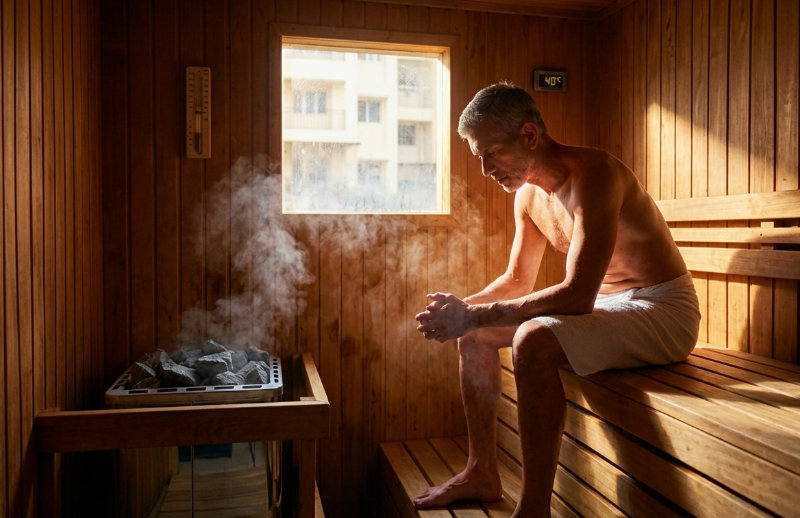
The science here is compelling. Studies have shown that post-exercise sauna exposure can increase plasma volume, which in turn improves cardiovascular efficiency—an adaptation endurance athletes spend months trying to build. There’s also evidence suggesting improvements in time to exhaustion after a few weeks of consistent sauna use. Add to that population-level data linking regular sauna bathing with improved cardiovascular health, and it begins to look less like indulgence and more like a legitimate tool.
If sauna felt like a new discovery, walking felt like rediscovering something hiding in plain sight.
I made it a point to walk at least 30-45minutes every day, often broken into shorter segments—especially 12-15 mins after meals. This started as a general health habit, but quickly revealed itself as a recovery multiplier. After long runs, those easy walks seemed to keep the legs from stiffening up. Blood flow improves, the body keeps moving without additional stress, and the transition from effort to rest becomes smoother.
There’s also a metabolic angle. Research has shown that even brief walks after meals can significantly reduce blood glucose spikes. For masters athletes, that’s not a trivial benefit. Stable energy levels, better metabolic health, and improved recovery are all part of the same ecosystem.
This season, I didn’t do anything heroic. I just became more disciplined about a few key practices.
I’ve never been someone who enjoys spending long stretches in the gym. So the goal wasn’t to become a strength athlete—it was to become a more resilient runner.
The work focused on the usual suspects: glutes, hips, calves, and core. Exercises like monster walks, clamshells, hip drops, step-ups, and kettlebell swings formed the backbone. For the upper body, farmer’s carry, rowing, and lat pulldowns helped maintain posture and balance. Nothing here is revolutionary. But done regularly, it adds up.
Two smaller additions made a disproportionate difference. The first was daily dead hangs. I had been dealing with a persistent piriformis/SI joint issue early in the cycle, and almost by accident, I started incorporating daily, short hangs – 60 secs, moving up to 100-110 secs. Over weeks, that discomfort receded. Whether through spinal decompression or improved alignment, something was clearly working.
The second was stair climbing. Twelve to fifteen flights a day, broken into manageable chunks. I live on the 4th floor, so an easy way to include this into my daily pattern was to use the stairs and avoid using the elevator. A great way to build incremental strength and durability without the impact cost of additional running.
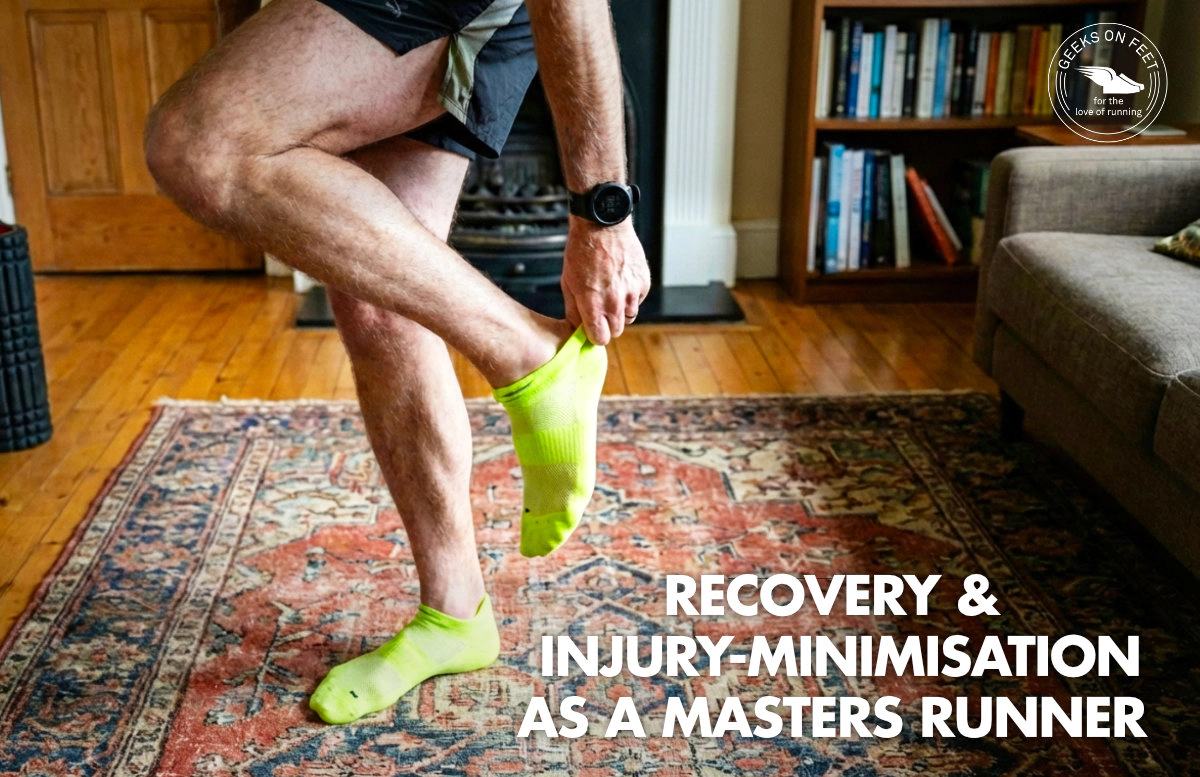
Another micro-routine: standing upright while removing shoes/socks after a run, instead of sitting down. Can use a support initially, you will gradually be able to do it without - very effective practice to improve proprioception/ balance - areas that tend to weaken or become imbalanced with age.
In my mid 50s, the body needs a conversation first. Pre-run routines became a small but non-negotiable ritual. Leg swings, hip openers, and some light activation, nothing elaborate, but enough to wake the system up. Post-run, I made time for static stretching, focusing on the usual tight spots: calves, hamstrings, hip flexors, glutes.
The real change wasn’t in what I did, but in how consistently I did it. Day after day, without waiting for a problem to appear. There’s a line that stayed with me through this cycle:
be great at being consistent, rather than trying to be consistent at being great.
You don’t need the perfect routine. You need one you’ll actually follow.
None of what I have said above is dramatic or revolutionary. There’s no single insight here that will transform your running overnight. In fact, most of it is almost disappointingly straightforward.
But that’s also the point. For older runners, the edge rarely comes from doing more. It comes from doing the right things, repeatedly, with a degree of care that compounds over time.
Your future performance is less about how much you can push in a given week, and more about how consistently you can train over a season. And consistency, more often than not, is built in the margins—in the protein you don’t skip, the walk you almost didn’t take, the stretch you felt too lazy to do, the recovery you chose to prioritise. It’s the work no one sees, but the work that shows up when it matters.

Satish took to running in his 40s and believes that it has been the most transformative experience of his life. Over the last 15 years, he has run many marathons/HMs/10Ks and ultras like Comrades. Satish is a passionate advocate of running as a lifetime activity. He mentors other runners as his way of giving back to this beautiful sport that has filled his life with joy and meaning.