
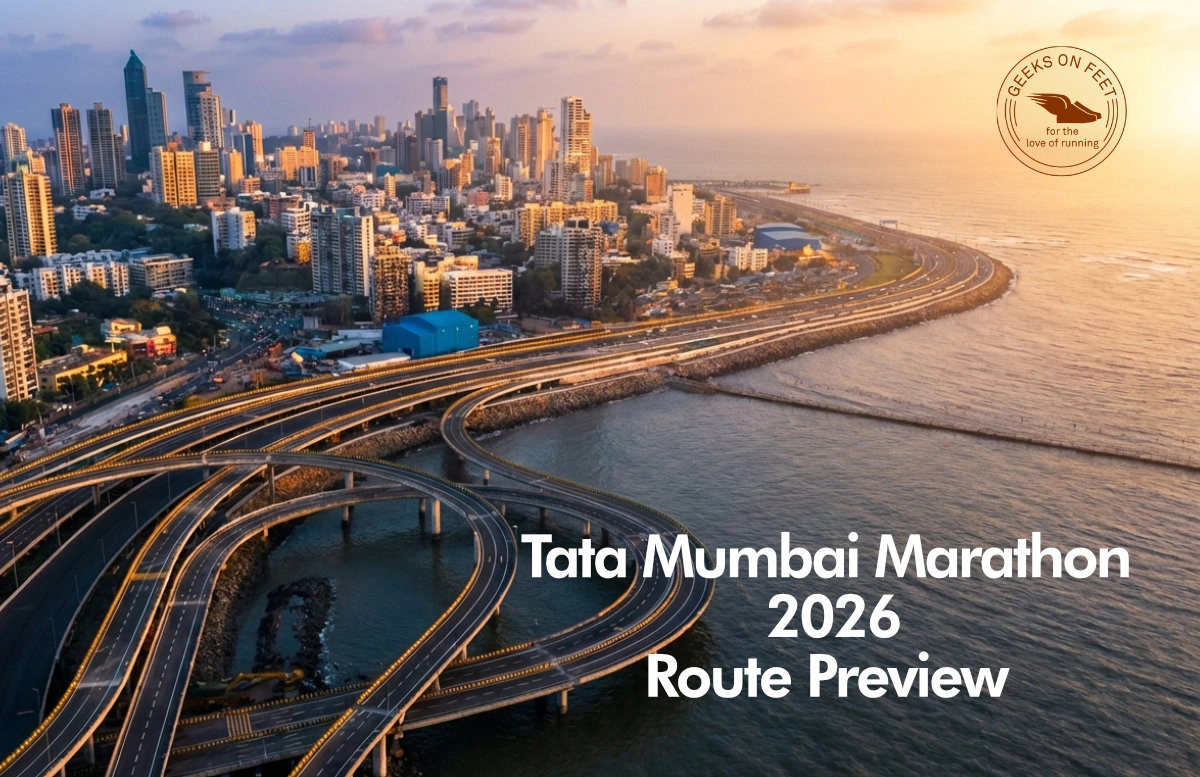
The third Sunday of January is not just a date; it is an annual pilgrimage for the Indian running community. Whether you are chasing that elusive BQ, aiming for a sub-4, or simply looking to finish strong, the Tata Mumbai Marathon (TMM) is where the rubber meets the road. This year, a staggering 14,000 runners will toe the line at CSMT to tackle the full 42.2km, while an equally massive number lines up at Mahim to conquer the half-marathon distance.
Every year, we talk about the “Beauty and Beast of Mumbai”. The Beauty of this race is synonymous with the “Spirit of Mumbai.” It is the roar of the crowds that greets you through the course. It is the music bands, the enthusiastic young & old handing out oranges at Peddar road, and the rows of strangers screaming your name on Marine Drive. The Beast, however, demands your respect. It is the humidity that rises with the sun, inclines interspersed across the course, the deceptive winds on the Bandra-Worli Sea Link and the newly introduced Coastal Road. Yes, Coastal Road is now part of this year’s edition.
Weather
January typically shows off Mumbai’s best side, with historical data placing race-day temperatures in the 23°C–25°C range. While we have seen odd years dip below 20°C, the 2026 forecast looks consistent with the warmer trend. However, as every runner knows, the temperature doesn’t tell the full story in Mumbai.
The Humidity Factor: Being a coastal city, the moisture in the air prevents sweat from evaporating efficiently. Even at 23°C, the high humidity increases your perceived exertion.
Pro Tip: Do not rely on thirst alone. By the time you feel thirsty, you are already dehydrated. Plan for a higher sweat rate than your Bengaluru or Delhi runs. Electrolytes are non-negotiable from Hour 1.
The Wind Factor: A significant portion of the race (approx. 11km for Marathon) is now on the exposed Coastal Road and Sea Link. January mornings in Mumbai often feature a North/North-East breeze. You might face a headwind or stiff crosswind on the way to Bandra. The Return Leg (North to South), should get you a helpful tailwind, pushing you back towards the city when your legs are tiring.
Pro Tip: Tuck in behind a pace bus or runners with similar pace to save energy. Drafting here can save you a few seconds per km in effort.
Air Quality: With recent AQI trends, the air might feel heavy. If you have sensitive lungs, consider a buff or mask for the crowded start holding area, removing it after the race starts.
The big change in the route in this edition is the inclusion of Coastal road sections between Haji-Ali and Sea-Link bridge. However, the route continues to have all of Mumbai’s old world charm. The marathon starts from Chatrapati Shivaji Maharaj Terminus, and the Half-Marathon starts from Reti Bandar/Mahim Dargah Urus Ground. Both races run past Bandra-Worli Sea-link, Coastal Road, Mahalaxmi Racecourse, Haji Ali, Mahalakshmi Temple, Peddar Road, Babulnath Temple, Girgaon Chowpatty, Marine Drive, Wankhede Stadium, and eventually end at Azad Maidan.
Choose your race to view distance-specific route details
The race starts right outside the iconic Chatrapati Shivaji Maharaj Terminus and the Municipal Corporation Building. The historic vibe of the city starts right here. Nervousness, heart beats, hands on watch to start, and focus on the run will push the adrenaline high. You start the run through some more iconic landmarks like the Flora Fountain, Hutatma Chowk Memorial, and then you go towards the Oval Maidan, reach Church Gate station, Brabourne Stadium, enter Marine Drive towards the Air India building, enjoy the vastness of the sea, reflect and breathe easy, the race is yet to begin :). Then take a left turn into Madam Cama road and then a ‘U’ turn to come back to Marine Drive. Go further south till NCPA and then a ‘U’ turn. This will complete your first 5 kms.
From here continuing on Marine Drive, the flat course will extend until the next 5 kms up to Babulnath Temple. Enjoy the vastness of Marine Drive, also known as the Queen’s Necklace. On your left will be the Girgaon Chowpatty beach at the end of this stretch.
You will turn right towards Babulnath Temple on your 10th km towards Peddar Road. The 10th and 11th km have quite a bit of elevation. You will see a glimpse of what the route has to offer, and one thing to keep in mind is you will also come back on the same route and you will experience this elevation again around 36/37 kilometers. The 13th kilometer is downhill towards Haji Ali;
Pacing Guidance:
Key Land Marks:
Trivia
Do you know that Kemp’s Corner Flyover is India’s First Flyover? It opened on April 14, 1965, it was the first flyover ever built in independent India. Although it was officially opened by state dignitaries, its “soft opening” occurred in November 1964 for a very special guest: Pope Paul VI. The “Popemobile” was the first official vehicle to traverse the bridge during his historic visit to Mumbai for the Eucharistic Congress.
Coastal Road is the new addition to the route in this edition. For the first time ever, Mumbai marathon runners are going to experience one of the recent infrastructure engineering marvels. From Haji Ali instead of continuing towards Mahalaxmi race course and Worli Dairy, the route now takes the north-bound ramp of Coastal road (second exit/entry to the Coastal Road). While the coastal Road is largely flat, the sections which connect the entry and exit ramps have quite a bit of elevation.
You will continue on the coastal road for about 4km, before joining the iconic Worli Sea Link, which has been a regular feature of the course for many years. You will cross a wave of slower half marathoners on the right, who have completed their stretch of Sea Link and are running towards INS Trata. Look out for your friends running the HM race and wave out to them.
You’ll feel a gradual elevation once you get into the sea-link. It’s a dream run, the real one. The view of the tall cables and the sound of the waves will keep you mesmerized. You will find good hydration here and be careful of the water spillage from the early pack of runners at the Sea Link. Be prepared for a good camera pose since you’ll see a lot of race photographers here.
You will now take the ramp-down from Sea-link towards Mahim. Most runners will see the day breaking here. You’ll be running through the uber cool promenade, overlooking the Mumbai skyline, it is quite poetic on a normal day, when adrenaline is not as high as on race day :).
Pacing Guidance:
Key Land Marks:
Trivia
Do you know? Large parts of the Mumbai Coastal Road are built on about 90 hectares of reclaimed land that did not exist until a few years ago. The project stretches roughly 10.6 km, with nearly 75 percent of it built over the sea through reclamation, bridges, and tunnels. What runners pass today is Mumbai’s newest geography, created using millions of cubic metres of rock and sand. In a city over 400 years old, it is rare to run alongside a coastline that has been physically redrawn within a single decade.
By now the sun will be up, bring in all your training, mind muscle connection and mental focus to play. This is a beautiful stretch of the route with tree cover passing through Shivaji Park, Siddhivinayak Temple (say a little prayer to enjoy the rest of the route) all the way till Worli. This section is largely flat. You will start to see the people from the neighborhood gathering and cheering for you
You’ll reach Worli seaface and continue further down on the side of Costal road till Worli Dairy. Here is the twist in the tale for this year’s route. You will now take a ‘U’ turn back to Worli interchange, instead of continuing towards Annie Besant road as with earlier editions.
Pacing Guidance:
Key Land Marks:
Once you take the ‘U’ turn to Worli interchange, you will enter the Coastal Road again. There is a mild elevation gain as you enter, but not much to notice. The coastal road section this time can be even more challenging. A wide and empty road with bright sunshine can test your mettle. Make friends with the tail wind, and gentle breeze from the sea.
You will take a steep ramp down as you exit the Coastal Road, and after negotiating a quick ‘U’ turn you reachHaji Ali again. Here comes the true test of the Mumbai Marathon: The Notorious Peddar Road Climb. There comes a moment in almost every endurance race when we ask ourselves, “why am I doing this?” It’s our mind’s way of checking in with our soul to determine whether continuing to push toward the finish line is worth our present suffering, not to mention the pain to come (The Comeback Quotient by Matt Fitzgerald) . But don’t worry, the crowd support will help you sail through the 36th/37th km of the climb (here GeeksOnFeet is saying a little prayer for each one of you); stop by or slow down to have some fruits, biscuits offered by the crowds and wave back to them. Thereafter it’s a downhill to the 38th km, put your best foot forward as you are inching towards the finish line.
Pacing Guidance:
The magnum opus!! Now is a test of your patience, every inch of your body will misbehave, it will try to trick you in ways you never thought but you know what they say, “Your body will do what your mind says”, play it in your favor. You cross the Wankhede stadium around the 41st KM. When you see Wankhede Stadium, don’t surge, don’t celebrate, don’t bargain. Just run. Remember this is a flat part of the course and the sun is generously shining. The music bands and crowd at Marine Drive will be cheering you, think of all the Long training Runs, smile and carry on.
Pacing Guidance:
If you feel great, you are probably lying to yourself. If you feel terrible, congratulations, you are right on schedule. Focus on one job only: Count steps, lock onto the runner ahead. Ignore negative thoughts. They are all fake news. The road is flat, the finish is real, and every step forward is non-negotiable.
Elevation Map:
The following elevations are measured using a Garmin GPS watch with Baroemetric Altimeter. Scroll down for GPX file.
| KM | Gain | Loss | Net | KM | Gain | Loss | Net |
|---|---|---|---|---|---|---|---|
| 1 | 1 | 2 | -1 | 23 | 0 | 5 | -5 |
| 2 | 2 | 3 | -1 | 24 | 3 | 1 | 2 |
| 3 | 1 | 1 | 0 | 25 | 1 | 1 | 0 |
| 4 | 1 | 2 | -1 | 26 | 1 | 1 | 0 |
| 5 | 0 | 0 | 0 | 27 | 1 | 1 | 0 |
| 6 | 3 | 3 | 0 | 28 | 1 | 1 | 0 |
| 7 | 0 | 0 | 0 | 29 | 5 | 4 | 1 |
| 8 | 0 | 0 | 0 | 30 | 1 | 1 | 0 |
| 9 | 1 | 2 | -1 | 31 | 0 | 0 | 0 |
| 10 | 1 | 0 | 1 | 32 | 5 | 2 | 3 |
| 11 | 26 | 0 | 26 | 33 | 3 | 2 | 1 |
| 12 | 2 | 24 | -22 | 34 | 10 | 1 | 9 |
| 13 | 2 | 5 | -3 | 35 | 2 | 13 | -11 |
| 14 | 12 | 0 | 12 | 36 | 3 | 1 | 2 |
| 15 | 1 | 10 | -9 | 37 | 25 | 0 | 25 |
| 16 | 1 | 0 | 1 | 38 | 1 | 25 | -24 |
| 17 | 4 | 1 | 3 | 39 | 2 | 8 | -6 |
| 18 | 7 | 1 | 6 | 40 | 1 | 1 | 0 |
| 19 | 2 | 0 | 2 | 41 | 0 | 1 | -1 |
| 20 | 8 | 0 | 8 | 42 | 0 | 1 | -1 |
| 21 | 0 | 14 | -14 | 42.6 | 0 | 0 | 0 |
| 22 | 1 | 6 | -5 |
(All elevations are in meters)
Half marathoners can paint a picture about the route, only if you can wander your eyes around. This is one of my favorite routes in Mumbai.
You will start from Mahim Dargah towards Mumbai Promenade, which will be on your left after crossing the Mahim Causeway. The sea, fishing boats, and skyscrapers await you. There is a small change here from last year’s route. Instead of going under the western expressway and then joining the ramp, you will take left onto the Western Expressway towards Sea Link right away. You will avoid the narrow underpass, the serpentine loops, and sharp climbs around Bandra Reclamation Park. Instead, you head straight towards the Sea Link toll gate.
Enjoy the cool breeze and vastness of the city while it lasts. You will complete 2 kms by the time you reach the Sea Link toll booth. As you enter the sea-link bridge Be careful of the water spillage from the runners who would have crossed this area. The sea-link bridge also has a few dark sections mind your step. Thankfully, you will have tail winds to help you on the sea link. Keep yourself hydrated, stay calm, and get the best out of the sea link.
You will get out of the Sea Link and turn left before taking a “U” at INS Trata towards Worli Seaface. Here is another important change in the route this time which simplified things a bit for halfers. Two left detours (and u turns) have been eliminated - left onto RG Thadani Marg, and left onto Dr Annie Besant Road. Instead, you continue straight on from Worli-seaface to Worli dairy.
Here is another twist in the tale for this year’s route. At World dairy, you will now take a ‘U’ turn back to Worli interchange.
Pacing Guidance:
Once you take the ‘U’ turn towards Worli interchange, you will enter the Coastal Road again. There is a mild elevation gain as you enter, but not much to notice. The coastal road section this time can be even more challenging. A wide and empty road with bright sunshine can test your mettle. Make friends with the tail wind, and gentle breeze from the sea.
You will take a steep ramp down as you exit the Coastal Road, and after negotiating a quick ‘U’ turn you reachHaji Ali again. Here comes the true test of the Mumbai Marathon: The Notorious Peddar Road Climb. There comes a moment in almost every endurance race when we ask ourselves, “why am I doing this?” It’s our mind’s way of checking in with our soul to determine whether continuing to push toward the finish line is worth our present suffering, not to mention the pain to come (The Comeback Quotient by Matt Fitzgerald) . But don’t worry, the crowd support will help you sail through the 15th/16th km of the climb (here GeeksOnFeet is saying a little prayer for each one of you); stop by or slow down to have some fruits, biscuits offered by the crowds and wave back to them. Thereafter it’s a downhill to the 17th km, put your best foot forward as you are inching towards the finish line.
Pacing Guidance:
The magnum opus!! Now is a test of your patience, every inch of your body will misbehave, it will try to trick you in ways you never thought but you know what they say, “Your body will do what your mind says”, play it in your favor. You cross the Wankhede stadium around the 20th KM. When you see Wankhede Stadium, don’t surge, don’t celebrate, don’t bargain. Just run. Remember this is a flat part of the course and the sun is generously shining. The music bands and crowd at Marine Drive will be cheering you, think of all the Long training Runs, smile and carry on.
Pacing Guidance:
This is the section to put your best. Hit your threshold pace, and feel the power in your stride. The real race has started. Lock the person in front of you, and your only goal is to cross them. Derive the energy from the cheering squads and crowd.
Elevation Map:
| KM | Gain | Loss | Net |
|---|---|---|---|
| 1 | 5 | 1 | 4 |
| 2 | 18 | 2 | 16 |
| 3 | 4 | 8 | -4 |
| 4 | 0 | 6 | -6 |
| 5 | 0 | 7 | -7 |
| 6 | 2 | 5 | -3 |
| 7 | 0 | 0 | 0 |
| 8 | 0 | 0 | 0 |
| 9 | 2 | 1 | 1 |
| 10 | 4 | 2 | 2 |
| 11 | 1 | 1 | 0 |
| 12 | 10 | 1 | 9 |
| 13 | 2 | 12 | -10 |
| 14 | 3 | 1 | 2 |
| 15 | 22 | 1 | 21 |
| 16 | 8 | 10 | -2 |
| 17 | 0 | 22 | -22 |
| 18 | 1 | 1 | 0 |
| 19 | 1 | 1 | 0 |
| 20 | 0 | 0 | 0 |
| 21 | 0 | 1 | -1 |
| 21.26 | 0 | 0 | 0 |
(All elevations are in meters)
GPX file
We have mapped the 2026 route to help you visualize the elevation and turns on your device. You can download the GPX file below to load onto your Garmin, Coros, or Apple Watch.
Download TMM 2026 -Marathon GPX File
Download TMM 2026 -Half-Marathon GPX File
⚠️ A Note on Data Accuracy (Read Before Loading):
Important: Cut Offs will be enforced
Official rules:
The “Bus” vs. The Footpath: If you miss a cut-off, you have two choices: board the official sweeper bus or move to the footpath and continue at your own risk (DNF anyway). Our advice? Respect the volunteers. If the road is opening to Mumbai traffic, it is no longer safe to race.
Happy Racing to all the participants!!!

Aditi Pandya is a life long athlete. She was born to run and play sports. Aditi is the co-founder of geeksonfeet.com.

Karthik is an insurtech product manager and a long-time volunteer contributor to Wikipedia. He is active in India’s running community on Twitter (now X) and is the co-founder of Mumbai-based Tilaknagar Running Club. Beyond running, he closely follows urban mobility and infrastructure projects.
Kartik Iyer is a conversationalist, news junkie, AvGeek, running geek, techie, marathoner, strength & conditioning junkie, and a music aficionado in no particular order. He loves striking random conversations with people just about anywhere and on just about anything. He can be reached at @kartikiyer2007 on Insta and on Strava
Aravind is a technologist, marathoner, and self-confessed running shoe geek. He’s passionate about the intersection of technology and running, with a keen interest in running mechanics. Aravind is also the co-founder of GeeksOnFeet, a platform dedicated to helping runners train smarter through data, technique, and community. Find him on Twitter: @imgeeksonfeet
Cover image is edited with Nano Banana Pro