
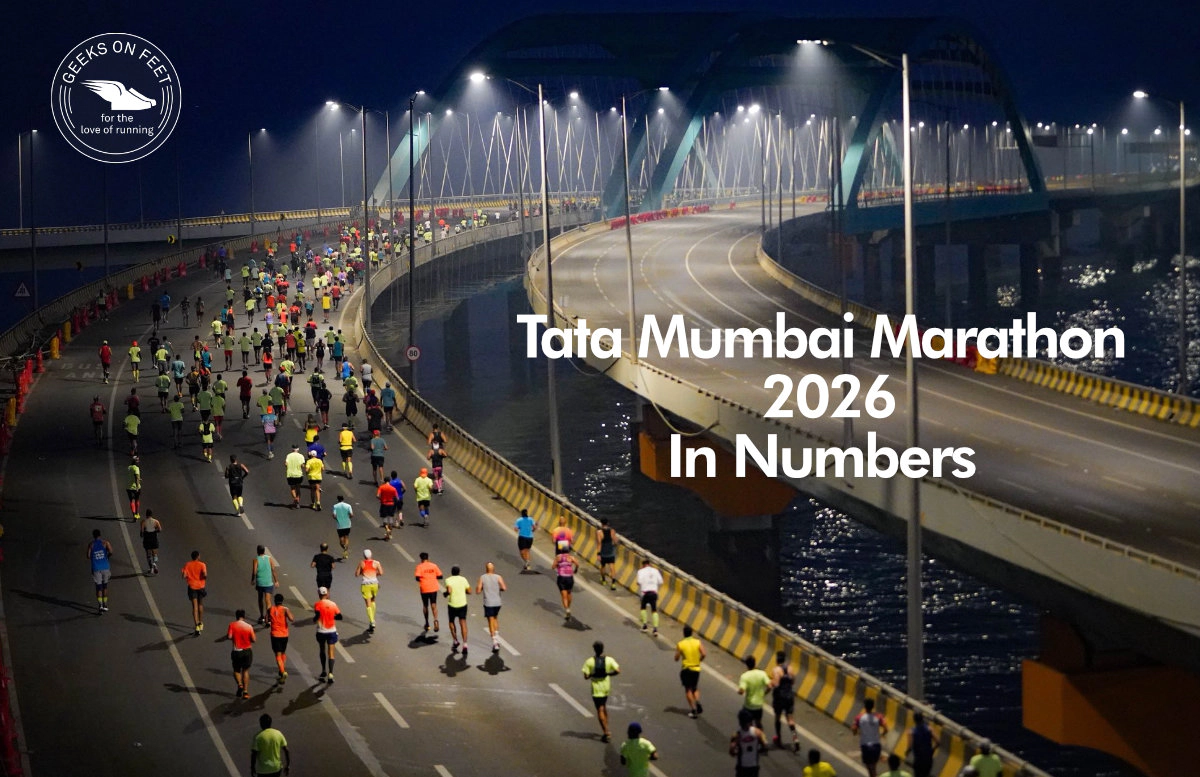
The third Sunday of January is a ritual for Mumbai, and the 2026 edition of the Tata Mumbai Marathon (TMM) did not disappoint. While the elites battled for course records, thousands of amateurs took on the humidity and the infamous Peddar Road and newly introduced Coastal Road.
As always, obtaining granular data for Indian races remains a challenge. The official results are often gated or difficult to aggregate. However, true to our name, we have crunched the numbers available to us to give you a definitive look at how the Indian running community performed this year.
Here is TMM 2026 in numbers.
Before we dive in: The data below is derived from public finisher lists. While we strive for accuracy, slight variances may exist compared to the final official certificates.
If 2025 was about recovery, 2026 is about stabilization and growth. We saw a distinct increase in the Full Marathon category, signaling that more runners are graduating from the Half to the Full distance.
22% increase from 2025)11% increase from 2025)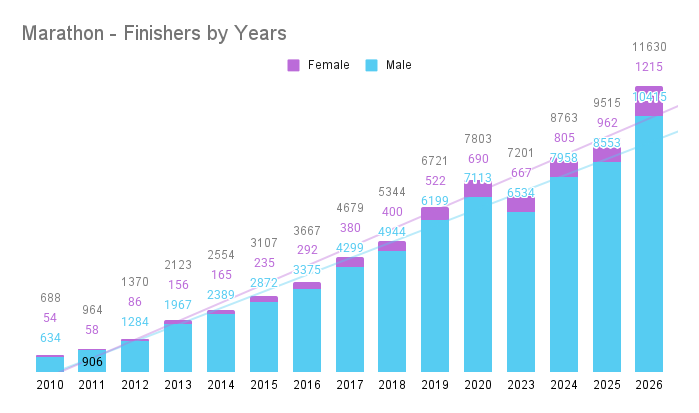
The Half Marathon numbers have stabilized, likely due to registration caps, but the Full Marathon field grew. This year-on-year growth in the marathon category is a healthy sign for Indian distance running.

One of the most interesting data points this year highlights the “Frequent Flyers” of the Indian running circuit - The Procam Slam.
We analyzed the field to see how many “Slammers” from previous cycles returned to TMM 2026.
The “Sticky” Distance: This 35:1 ratio reveals a fascinating psychological trend: Once a runner graduates to the “Slam” level, they rarely downgrade. The vast majority of past Slammers returned to the Full Marathon distance.
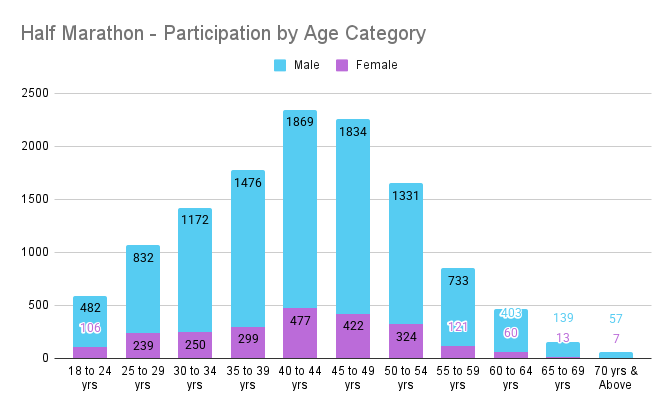
Long distance running is often called a sport for the middle-aged, and the TMM 2026 data proves it.
40-44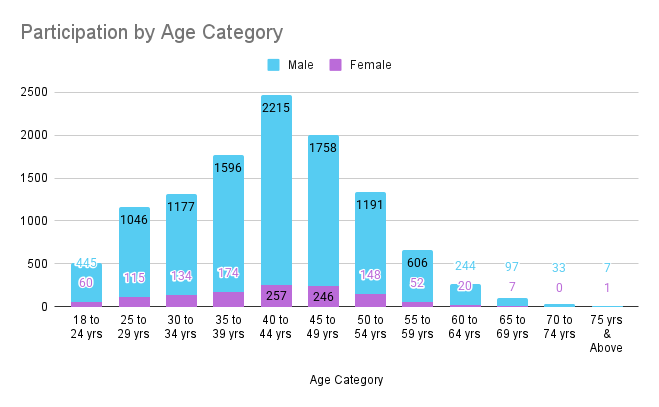
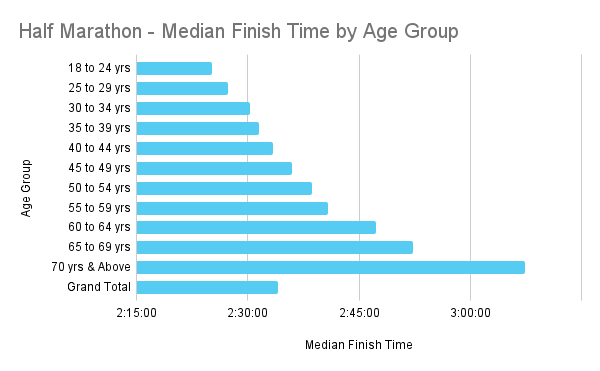
The data reveals a striking contrast in how age impacts performance across distances. In the Half Marathon, the trend is linear and predictable: youth dominates. The 18-24 age group clocks the fastest median time, with finish times gradually increasing with every subsequent age bracket.
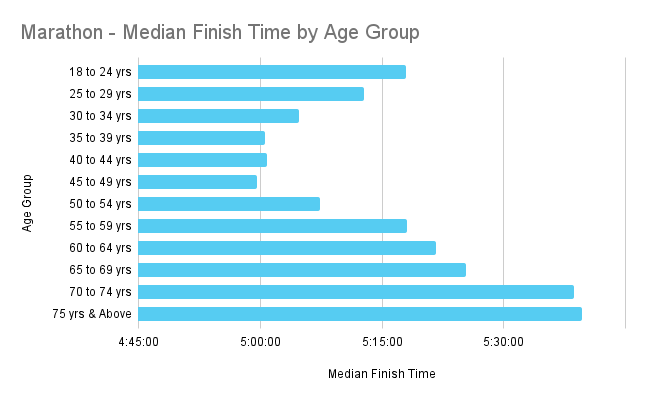
However, the Full Marathon tells a completely different story. The 18-24 are actually significantly slower on average than their middle-aged counterparts. The “Sweet Spot” for the marathon appears to be the 45-49 age category, which recorded the fastest median finish time, dipping below the 5-hour mark.
For the statisticians among us, the finisher data for TMM 2026 follows a textbook Normal Distribution.
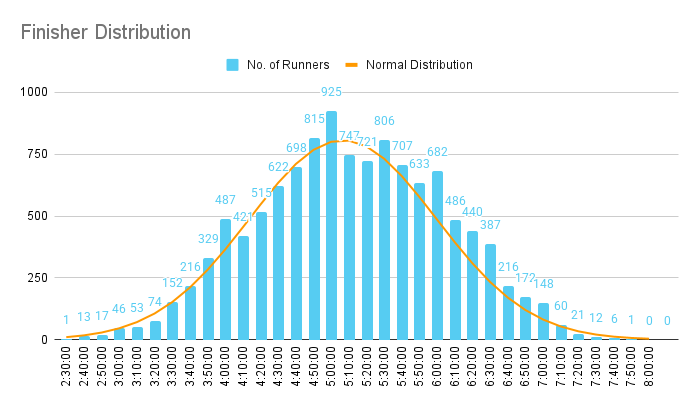
The Full Marathon “5-Hour Bus”
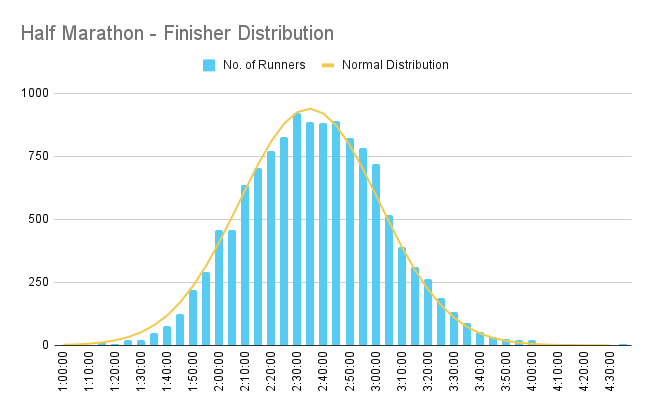
The Half Marathon “Bulge”
The weather on the race day was 22-26 degrees. 2025 also had a similar weather pattern. So any comparison with the previous edition can only be affected by two factors - Either Runners are getting faster or the addition of Coastal Road in the route.
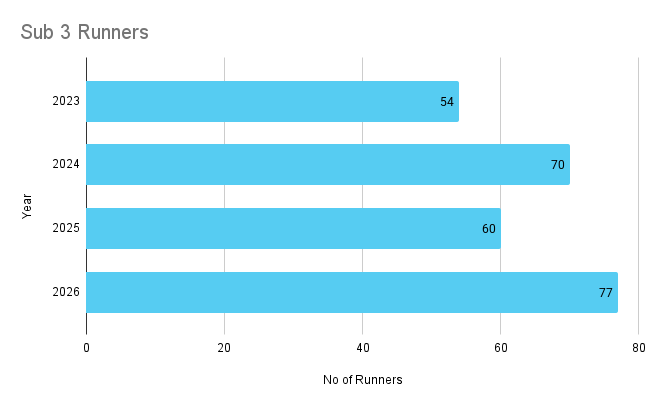
The “Sub-3” hour mark is the holy grail for amateur marathoners, and in 2026, the Indian running community shattered the ceiling.
After a dip in 2025 (where numbers dropped to 60), the field rebounded spectacularly this year. A record-breaking 77 runners crossed the finish line in under 3 hours. This is an increase from the 70 runners we saw in 2024 (one of the best race days with regards to weather), signaling a clear upward trajectory in high-performance amateur running.
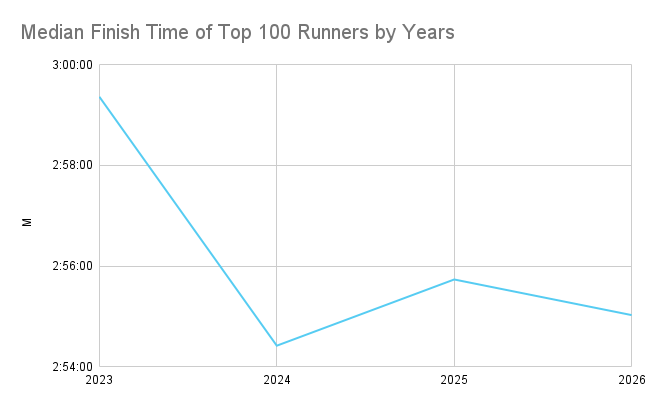
While the number of sub-3 finishers tells us about breadth, the median finish time of the Top 100 tells us about the depth at the front of the pack.
The data reveals a massive shift in performance standards since 2023. In 2023, the median time for the top 100 runners was hovering near 2:59:00. In 2026, that benchmark dropped significantly to approximately 2:55:00.
What does this mean? It means the “front of the pack” has collectively shaved off nearly 4 minutes in three years. The dip in 2024 probably indicates one of best race days with regards to weather. The Indian sub-elite amateur field has established a new, faster baseline.
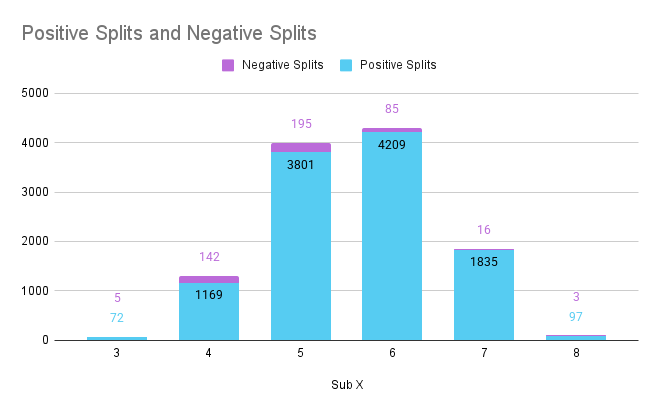
The Mumbai marathon is a tale of two parts. The first part often feels fast (till 30km); the second part has the heat and the killer climbs. Newly added Coastal Road added to the runner’s challenges to pace fast in the second half.
This year, if you ran a negative split (running the second half faster than the first) at TMM 2026, you belong to an elite minority.
In the Full Marathon, the “Sub-4” group had the highest success rate with pacing strategies, yet even there, only 142 runners managed a negative split against 1,169 who slowed down. As we move to the slower time brackets (Sub-6 and Sub-7), the negative split virtually disappears.
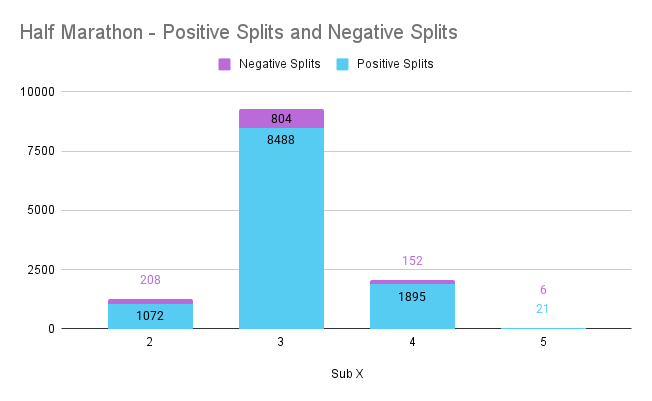
The Half Marathon tells a similar story but with slightly better pacing management in the faster brackets. In the Sub-2 hour group, nearly 16% of runners achieved a negative split (208 runners). However, the vast majority of the field (over 8,400 runners in the Sub-3 group) succumbed to the conditions, running a positive split.
If you stood at the start line of TMM 2026 and shouted “Amit!", chances are a dozen heads would turn. We analyzed the first names of the finishers to find the most common monikers, and the results are interesting.
The Men: Topping the charts is Amit, followed closely by Rahul, Sanjay, Sandeep and Sachin.
The high frequency of the name “Sachin” perfectly correlates with our age demographics. The bulk of the TMM runners (aged 35–45) belong exactly to the generation that grew up worshipping the cricket legend.
The Women: Neha Takes Gold For the Women. She is followed by Priyanka, Pooja, Shweta, and Poonam.
[Cover image credit - Procam Intl.]

Aravind is a technologist, marathoner, and self-confessed running shoe geek. He’s passionate about the intersection of technology and running, with a keen interest in running mechanics. Aravind is also the co-founder of GeeksOnFeet, a platform dedicated to helping runners train smarter through data, technique, and community. Find him on Twitter: @imgeeksonfeet