
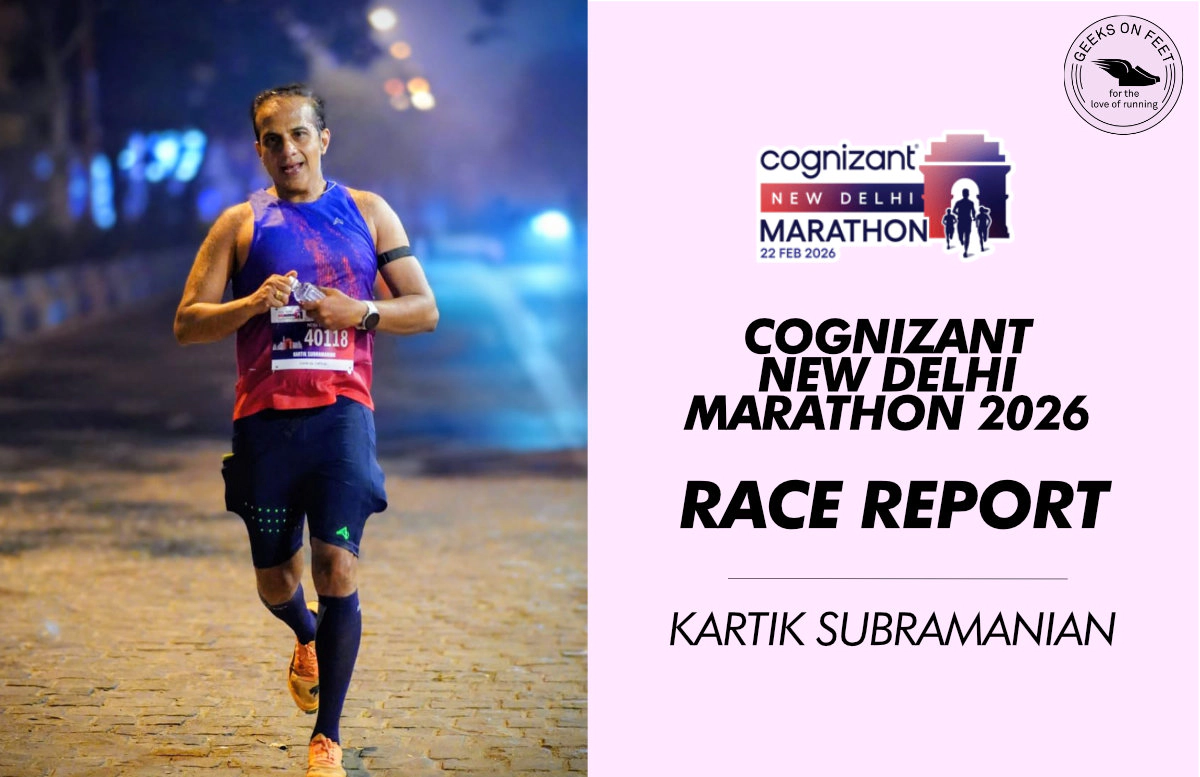
My goal was a 3:15:46 marathon, which meant living in the mid-4:30s per kilometre range while keeping the effort under control early. With a 4:05 AM start and cool Delhi winter air, the conditions were ideal for a steady, disciplined race: start a touch conservatively, settle into rhythm, and then gradually press once the legs felt ready—leaning into the negative-split mindset that had been a theme in training.
I’ve been working with my coach, Nihal, since July 2025. By the time New Delhi Marathon came around, we already had a full 16-week build to the New York City Marathon (November) behind us. After NYC, we rolled straight into a focused 12-week block starting in December—less about reinventing fitness and more about stacking consistent work and sharpening the specific demands of marathon pace.
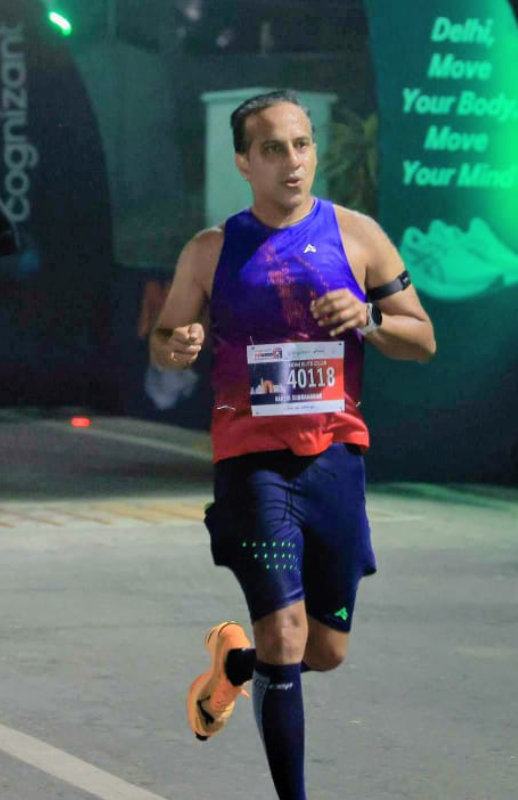
Across this block, my average weekly volume was about 80 km, with peak mileage reaching roughly 105 km. That base was supported by an average of two strength sessions per week, which helped keep the legs durable and able to handle the weekend long-run structure throughout the plan.
Weekend long runs were structured as a progressive run on Saturday (70–100 minutes), followed by a 27–34 km run on Sunday that started around 6:10/km and finished at (or very close to) marathon pace over the last 5–7 km.
Alongside this weekend structure, the quality-work emphasis was on tempo/threshold running—sessions that build the ability to sit at a strong, controlled effort for a long time. A few confidence-building workouts from the block:
Closer to race day, Nihal layered in shorter intervals to improve leg turnover—most notably 12 × 400 m at ~3:45/km pace with 90 seconds recovery.
A consistent message through the block was to trust a negative-split approach—stay patient early, then turn the screw late. I put that to good use in a key tune-up race, the TMM’26 Half Marathon: I averaged about 4:33/km through the first 15 km and then closed hard over the final 6.1 km at roughly 4:10/km. That race gave me confidence that the “hold back, then build” strategy would translate well to New Delhi.
I worked with sports psychologist Siya (Nudge Sports) to address a mental block that had shown up in my previous three marathons—especially around the 25K mark. For Delhi, we built a visualization plan that I recorded as an audio note, and I listened to it repeatedly in the build-up to race day, so the cues felt automatic when things started to get uncomfortable.
Execution over outcome
Surrender the result and commit to the effort
Stay in the now and stick to the plan
Pain is part of the payment
Outcome inspires, process sustains
What does this kilometre ask of me?
Fatigue is real, but so is my resilience
“Execution over outcome.”
“What does this kilometre ask of me?”
Conditions and course
The morning was comfortingly cool—around 14–16°C—perfect for holding pace without overheating. The course was a two-loop route starting and finishing at JLN Stadium and threading through Lutyens’ Delhi. Being largely flat, it was the kind of layout that rewards even pacing and makes it easier to stay honest about effort over both loops.
Pacing and splits
| Checkpoint | Time | Avg pace |
|---|---|---|
| 5 km | 23:51 | 4:46/km |
| 10 km | 47:11 | 4:43/km |
| 15 km | 1:10:18 | 4:41/km |
| Half (21.1 km) | 1:38:07 | 4:40/km |
| 32 km | 2:28:34 | 4:39/km |
| 36 km | 2:46:55 | 4:38/km |
| Finish (42.2 km) | 3:15:20 | 4:38/km |
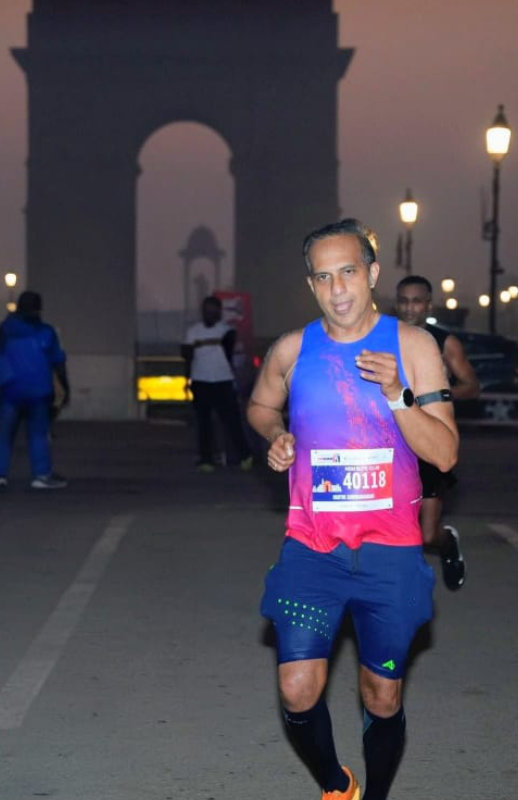
The splits tell the story of the day: a controlled opening that steadily sharpened as the race settled in. From 5K through halfway, I gently brought the pace down without forcing it, and by the time I reached ~25K I was actually feeling good—exactly where you want to be before the marathon starts asking real questions - This is significant in the wake off how my previous 3 marathons have gone South at this point in the race.
Key moments
Fueling and hydration
I stuck to a Maurten-focused plan and kept it consistent from the day-before preload through to the final gels. The goal was simple: keep energy coming in early and regularly so the late-race effort was limited by legs and focus—not by running out of fuel.
The finish
I crossed the line in 3:15:20, slipping under my goal of 3:15:46 by 26 seconds. More than the number, I’m happy with how the race was executed: patient early pacing, a controlled build through the middle, and then digging in when it got hard late. On a flat two-loop course, that kind of steady progression is usually the safest path to a strong time—and it paid off.
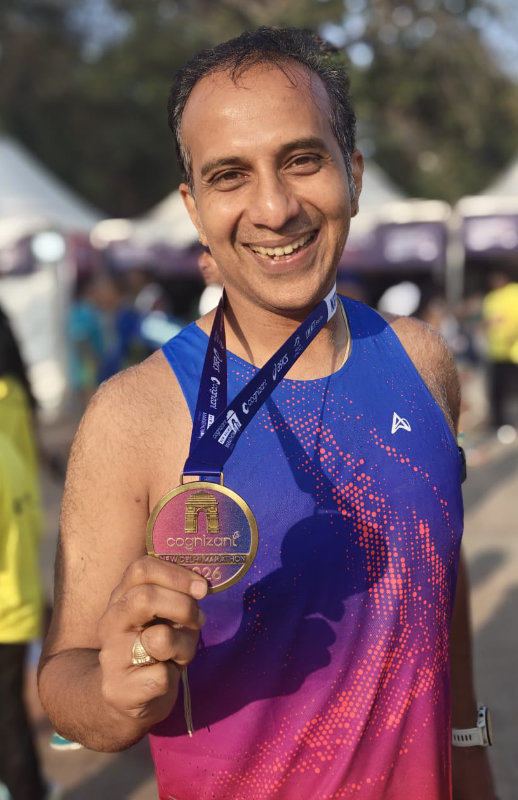
Delhi felt like the payoff of a consistent build: solid mileage, marathon-specific long runs, threshold strength, and a clear focus on process. When it got hard, the cues were simple—execute, stay present, and take it one kilometre at a time. I’ll carry that confidence and those lessons into the next cycle.

Kartik Iyer is a conversationalist, news junkie, AvGeek, running geek, techie, marathoner, strength & conditioning junkie, and a music aficionado in no particular order. He loves striking random conversations with people just about anywhere and on just about anything. He can be reached at @kartikiyer2007 on Insta and on Strava