Race Report: Wipro Bengaluru Marathon 2026 by Uttam
Uttam runs 3:37:48 at the Wipro Bengaluru Marathon 2026 after two missed attempts — six months of strength work, a block-based pace chart from his coach, and a hamstring cramp at 33K that he had to manage to the finish.
By Uttam Singh●30 September 2026●9 min read
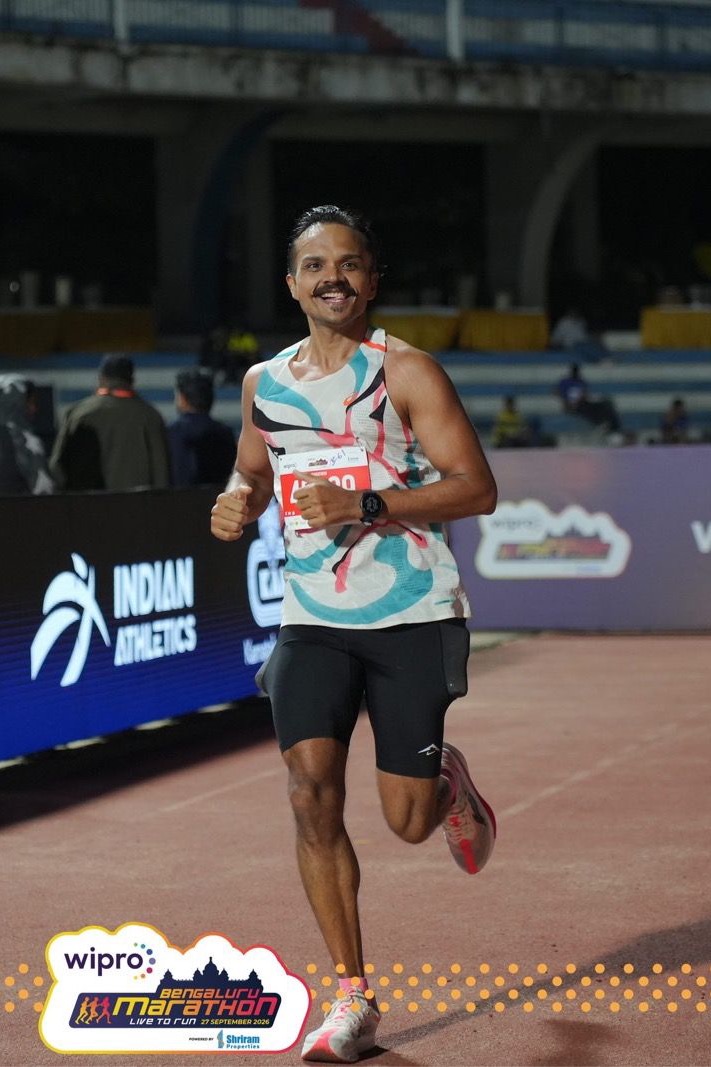
Uttam, raises both arms on the track inside Sree Kanteerava Stadium in the final metres of the Wipro Bengaluru Marathon 2026.
Race Report: Wipro Bengaluru Marathon 2026 by Uttam/img/2026/bm-2026-uttam/wbm-uttam-2026-cover.jpgRace Report: Wipro Bengaluru Marathon 2026 by UttamUttam Singh30 Sep 2026Races
Goal: a 3:30–3:35 FM since 2025. I tried at the Ahmedabad Marathon (Nov 2025) and the New Delhi Marathon (Feb 2026) but couldn’t meet the target.
The Spark
Six months ago, the road to the Wipro Bengaluru Marathon felt daunting. My training started humbly in early April, logging slow 18 km runs at a 7:00/km pace while my heart rate spiked over 145 bpm.
To build an engine capable of conquering Bengaluru’s rolling hills and rising humidity, I committed to a strict weekly formula:
Tuesday: Explosive intervals (building speed)
Wednesday: Heavy lower-body conditioning
Thursday: Grueling tempo runs (raising threshold)
Friday: Upper-body strength & core stability (ensuring form hold)
Saturday: Peak long runs (expanding aerobic ceiling)
Sunday: Active recovery or cross-training
The Secret Weapon: Strength training. I treated Wednesdays and Fridays as non-negotiable for strength training to build injury resilience. Over the entire six-month block, I never skipped a single strength session until the final race week.
The Grind
By June and July, the training block picked up the momentum. The weekly mileage climbed steadily through the 50s and 60s, culminating in a 76.5 km peak week in August. The mornings were defined by alarms, the scent of rain-soaked tarmac, and looping the steady inclines around Cubbon Park and Kanteerava. On July 31st, I pushed through a defining 35 km long run, holding 5:37/km. The fatigue was deep, but the data was encouraging: runs that used to require a 155 bpm effort were now cruising effortlessly at 140 bpm. The aerobic engine had arrived.
The Taper
Dialing mileage down from 356.8 km in August to the low 40s a week during September felt unnatural — the classic “taper tantrums” arrived with phantom calf twitches, restless legs, and an overactive race-pace calculator running in my head. Yet, trusting the process paid its ultimate dividend. As I lined up, looking back at the 1,478 kilometers that I ran over the last 180 days, the anxiety faded. The work was done.
Monthly Mileage
Month
Total Distance (km)
Total Runs
Avg Weekly Distance (km)
Avg Run Pace (min/km)
Avg Heart Rate (bpm)
April 2026
88.43
11
20.63
5:26
150.7
May 2026
168.33
14
38.01
5:22
148.9
June 2026
247.41
18
57.73
5:33
154.9
July 2026
249.43
20
56.32
5:34
151.3
August 2026
356.80
25
80.57
5:42
150.1
September 2026
367.77
38
85.81
5:24
149.2
Top 5 Long Runs
Rank
Date
Distance (km)
Avg Pace (min/km)
Avg HR (bpm)
Max HR (bpm)
Elapsed Time
1
July 31, 2026
35.01
5:37
164
176
3:16:37
2
July 25, 2026
33.02
5:31
161
173
3:01:57
3
June 20, 2026
31.31
5:42
160
175
2:58:29
4
August 13, 2026
30.00
5:20
166
180
2:39:54
5
August 21, 2026
30.00
5:06
166
176
2:33:09
Pre-Race
After disappointing finishes in Ahmedabad (3:43) and NDM 2026 (3:59), my coach Suresh Rathod, and I completely overhauled my race-week execution. By shifting from a chaotic mindset to a highly structured, data-driven strategy, I built the confidence needed to reach my goal.
Block Pacing: My coach ditched the pressure of first-half vs second-half pacing and programmed a structured, block-based pace chart for my Garmin watch that broke the course down into manageable physiological segments.
Eliminated strength training during race week. Instead, I pivoted to gentle mobility work and yoga on Wednesday and Friday to keep muscles loose without inducing fatigue.
Nitrate Loading: Began drinking beetroot juice on Wednesday of race week to optimize oxygen delivery to muscles.
Active Carb-Loading: Started increasing carbohydrate intake on Thursday. Stuck to bland, easily digestible, and familiar foods — like idlis for breakfast and dal khichdi for lunch and dinner — complemented by coconut water for clean electrolyte replenishment.
Automated Alarms: Took human error out of the equation. Set automatic watch alerts which prompted me to hydrate every 15 minutes and consume nutrition every 7.5 km, matching the exact fueling patterns practiced during my peak training runs.
Race Day — Pre
The Night Before: Jitters & Mindset
The Setup (8:00 PM): Meditated, manifested success, and locked in the game plan during one last call with my coach.
The Sleepless Struggle: Adrenaline won. I tossed and turned with virtually zero sleep — but I refused to let it shake my confidence.
Race Morning: Precision Execution
1:00 AM (Wake & Fuel): Rose early and topped off my glycogen with a safe, proven breakfast: two slices of bread with jam and 4–5 local Yelakki bananas.
2:15 AM (Transit): Took a hot shower to wake up my nervous system and hit the road.
3:15 AM (Arrival): Reached the venue. The pitch-black 3:50 AM start felt foreign and nerve-wracking, but flawless logistics (quick baggage drop and plenty of porta-potties) calmed my anxiety.
3:30 AM (Warm-Up): Primed my heart and legs with a gentle 800 m track jog and dynamic drills.
3:40 AM (The Starting Line): Stepped into the starting corral, dialed into my Garmin’s pacing alerts, and held onto my training partner’s golden advice:
Race Day — During
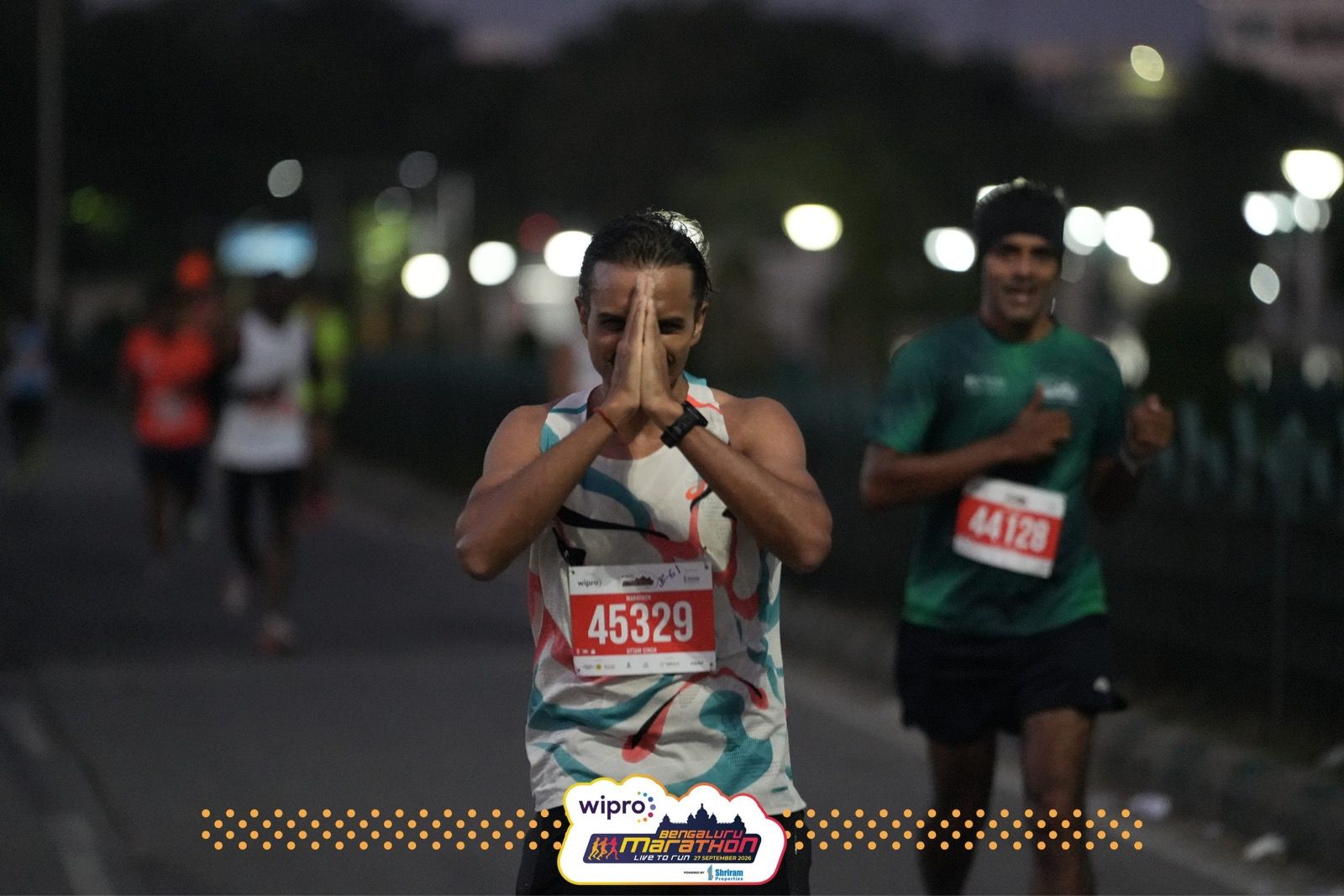
A namaste for the photographers, still in the dark.
The Strategy: Pacing & Execution
Block-by-Block Pacing: Instead of obsessing over splits, I broke the 42.2k into mental segments (e.g., 5:15/km for the first 3 km, then the next 3 at 4:58–5:05/km, etc., until the last 42nd km).
I ran my own race. I let familiar faces surge ahead early and stayed strictly locked into my target zones.
The Fuel & Hydration
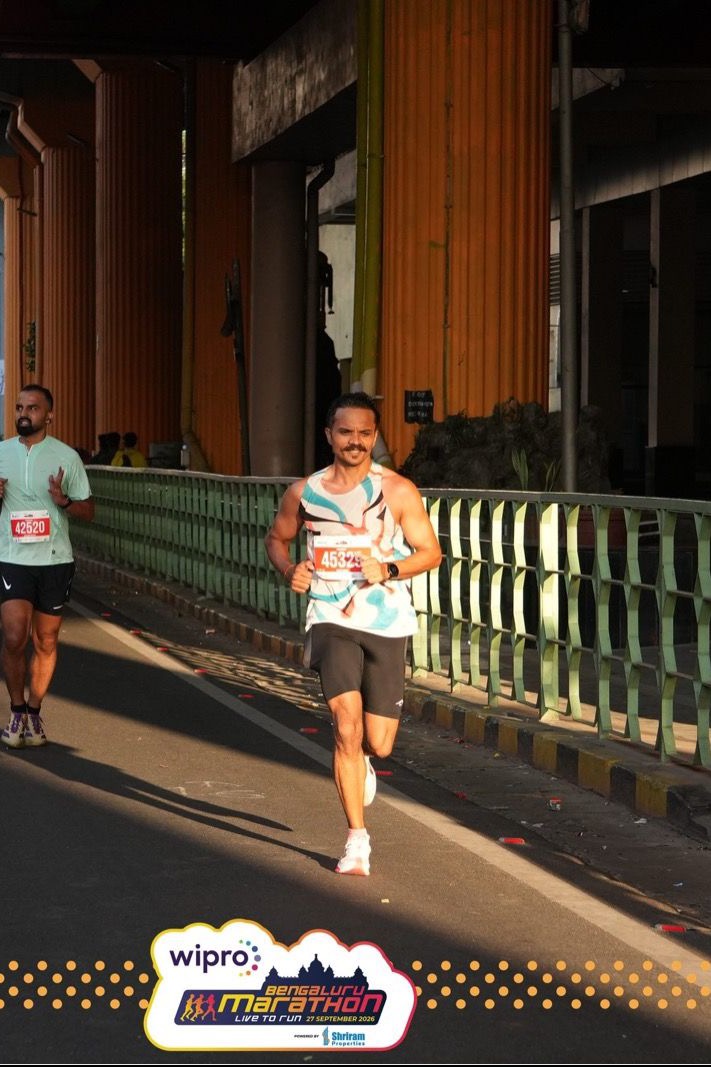
Under the metro line, with the sun now up.
Engine Fuel: Consumed 6 Unived gels (alternating Elite 180 and 100) — one 15 minutes pre-race, then dialed in on a strict 7.5 km schedule.
Hydration: Carried two 250 ml bottles of Fast&Up Reload, using course aid stations for extra water. One of the team mates from RRR26, Ajay, helped with two extra bottles of Fast&Up Reload around 15th and 30th Km.
The Heat Pivot: To battle the late-morning Bengaluru sun, I doused cups of water over my head at aid stations. Not practiced this in training, but coach approved it.
Overcoming the the Cramp
The Price of Speed (Kms 21–30): I let my pace drift slightly too fast, chasing an ambitious 3:32 finish.
The Lockup (Km 33): My hamstring seized with a severe cramp. While others around me panicked and folded, I adapted.
The Reset: I grabbed Volini spray at three consecutive aid stations, adjusted my pace downward, and relied on pure mental grit to fight through a scorching second half to a strong finish.
Race Day — Post
With the finish line relatively quiet when I crossed, I headed straight to the recovery zone. My muscles were on the verge of locking up, and as soon as the physios attempted some deep stretching, the cramps hit hard. I had to pivot: I just laid flat for 5 minutes to let things settle, then took my shoes off to walk barefoot to the baggage counter — nothing beats that post-marathon barefoot walk to ease the feet.
After a quick change of clothes, I headed back inside the stadium to soak in the atmosphere, catch up with fellow finishers, and capture some well-earned photos.
The post-race setup was excellent. Alongside the usual hot breakfast, there were plenty of freebies to grab around the food stalls. Honestly, after grinding through a tough 42.2k, those hot, nourishing refreshments tasted absolutely incredible.
Overall Experience
On the Kanteerava track.
Hard-Earned Learnings: Trust the Process
If this race taught me anything, it’s that distance running is about consistency. There are no shortcuts: you have to show up and do the boring, repetitive work day in and day out to get better. Progress is slow, and sometimes the best thing you can do is surrender yourself to this beautiful sport and trust the process.
The Bangalore Race Experience
On-Course Support: Having fully stocked aid stations nearly every single kilometer was a massive win, especially for maintaining pace in the later stages (I know this was not the case for half-marathon runners and even a few full-marathon runners).
Cheering Squad: Various running groups of Bengaluru made it easier to race with their loudest cheer. Cheering is something very rare in Bengaluru, as the race happens in the business district as compared to residential areas.
A beautiful finisher’s medal to celebrate the effort and highly nourishing post-race hot refreshments.
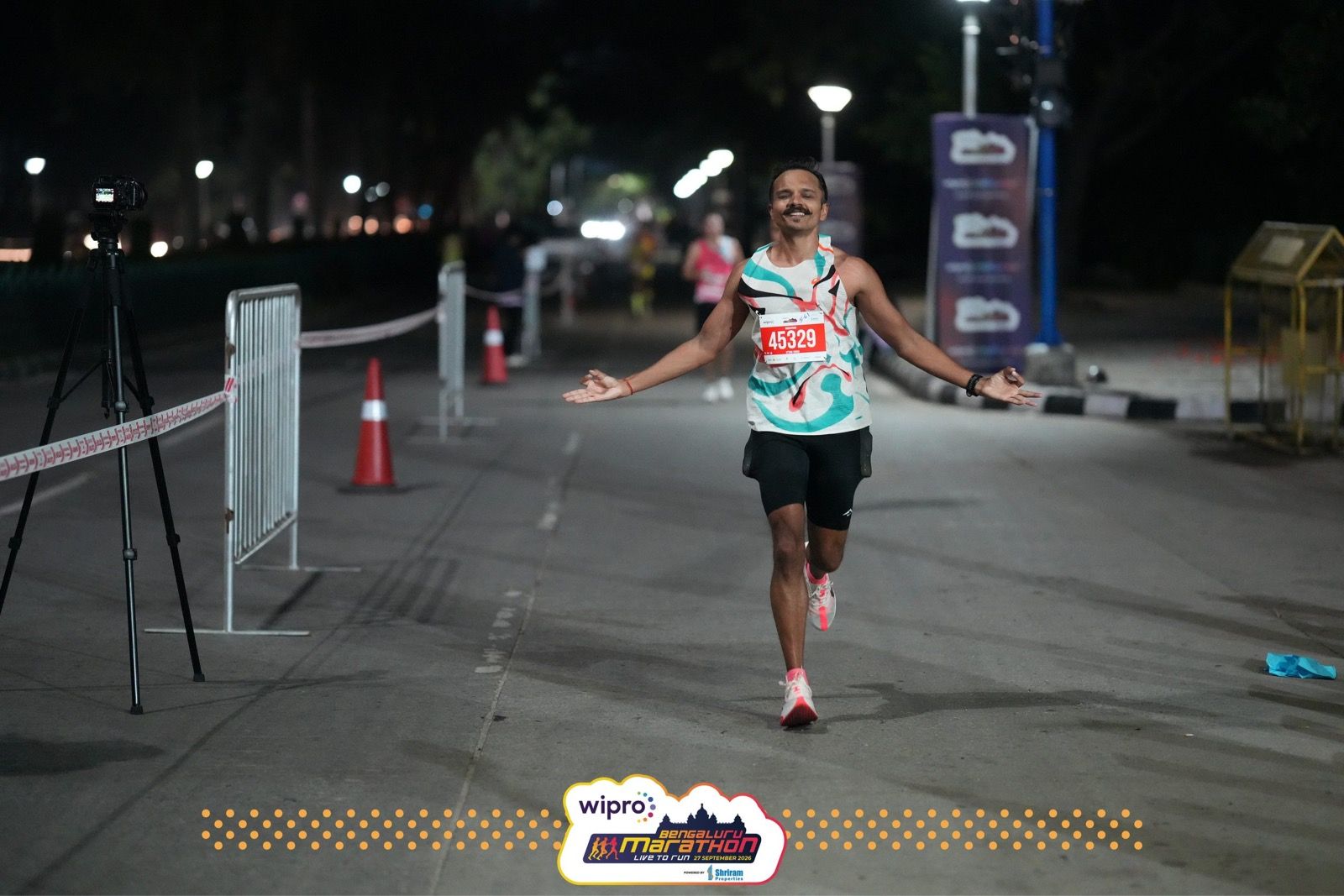
Arms out, pre-dawn.
The Ultimate Runner-Photographer Perk
As a photographer, I’m always the one behind the lens, which means I rarely get high-quality photos of myself in action. Leaving this race with close to 100 professional action shots was the ultimate bonus. It’s basically the only time I get a premium, multi-angle professional photoshoot without having to hire anyone! :-)