

Murali Gaddam runs 2:54:23 at the Chicago Marathon 2026 — 37 seconds inside his 2:55 target, all 42.195 km alongside Vikram, after an uneven five-month training block.

My five-month build-up to Chicago didn’t go quite as planned. I struggled to hit the weekly mileage I had set for myself, generally running 60–80 km. August was my biggest month, at 359 km, before dropping to 269 km in September.
I put more emphasis on strength training midway through the block and added more track sessions in the final few months. Stonehill and the Bengaluru Marathon were my tune-up races. The biggest training run was 37 km: 10 km easy, followed by 27 km at a faster pace.
I knew I could have prepared better and wasn’t expecting a personal best. I went to Chicago with a specific target: get under 2:55 without going out too fast.
I visited the expo on Thursday and spent time looking around the stalls. Friday and Saturday were mostly about eating enough carbohydrates, with rice and potatoes making up much of my meals.
Warmer conditions were expected on race day. My plan was to start conservatively, settle into the target pace, and leave something for the later kilometres.
Vikram and I started together. The agreement was to stay together until 32 km and then see how the race was going for each of us. As it turned out, we ran the entire distance side by side.
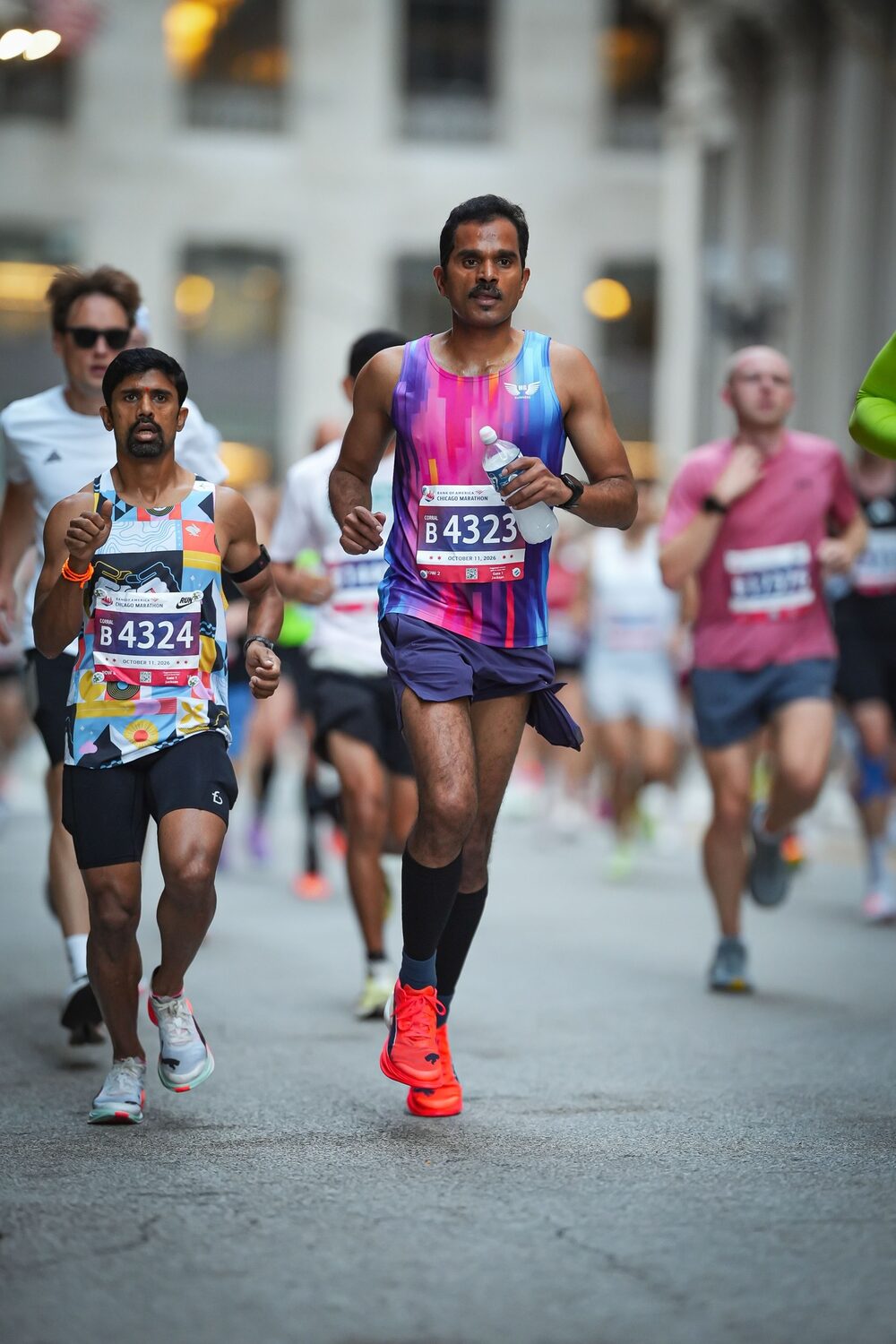
Vikram (B4324) and Murali (B4323), still together.
We settled into pace over the opening kilometres. The first half passed in 1:26:59, slightly ahead of the even pace needed for 2:55. Having Vikram alongside meant we could keep each other going without changing the plan.
After 30 km, the effort started to feel different. The second half seemed hillier than the first, although tired legs probably made the inclines feel bigger than they were. The official clock reached 2:24:34 at 35 km and 2:45:28 at 40 km. Those are 20:58 and 20:54 for the respective 5K stretches, so there wasn’t a major fade.
Source: Official Chicago Marathon 2026 results (mika:timing). Times are cumulative.
| Checkpoint | Elapsed time | Official pace |
|---|---|---|
| 5K | 20:46 | 4:10/km |
| 10K | 41:18 | 4:07/km |
| 15K | 1:01:59 | 4:09/km |
| 20K | 1:22:26 | 4:06/km |
| Half Marathon | 1:26:59 | 4:10/km |
| 25K | 1:42:52 | 4:05/km |
| 30K | 2:03:36 | 4:09/km |
| 35K | 2:24:34 | 4:09/km |
| 40K | 2:45:28 | 4:10/km |
| Finish | 2:54:23 | 3:58/km |
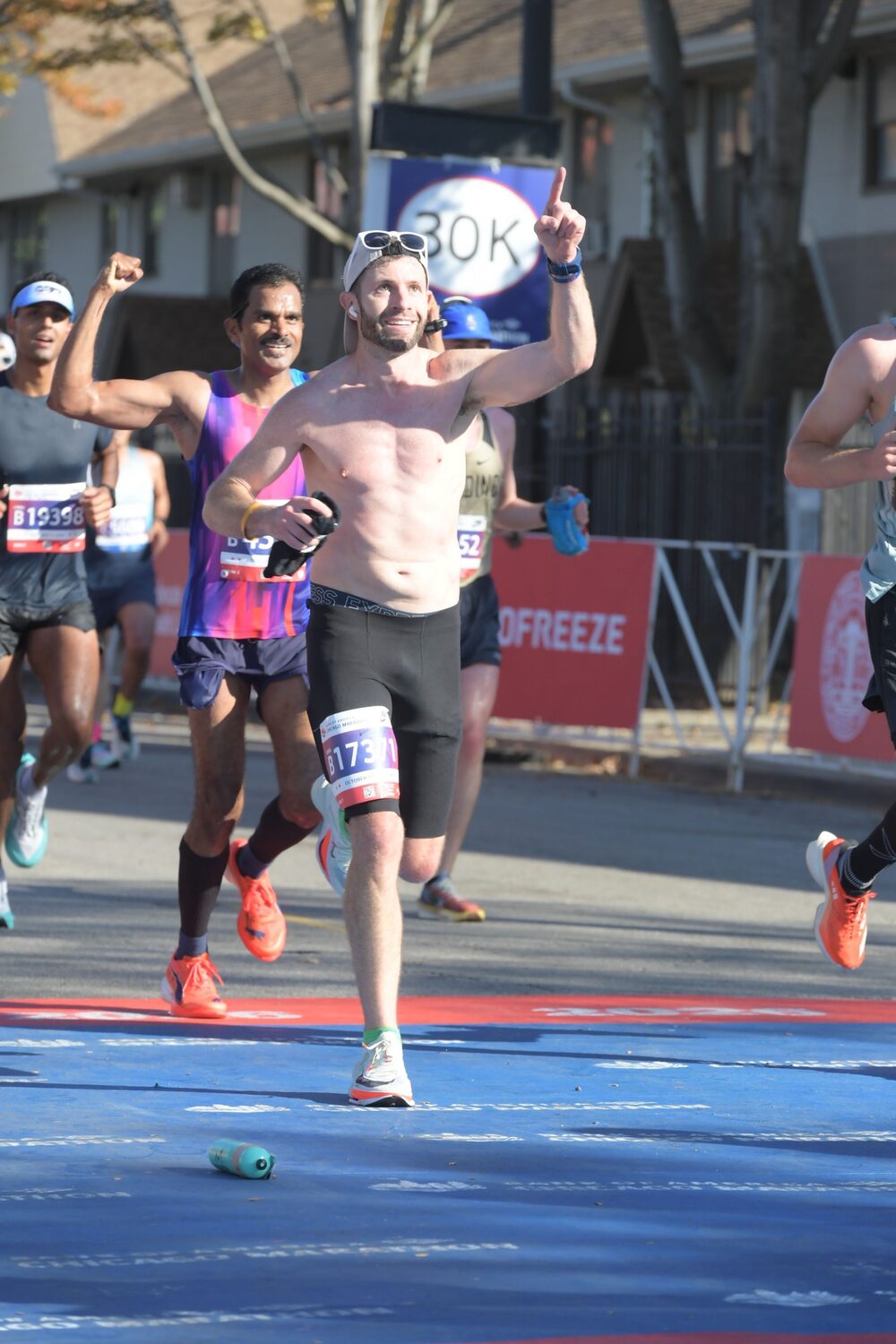
The 30K banner: 2:03:36, and the point where the routine had to hold.
I took seven gels during the race. In the first half, I alternated water and Gatorade at aid stations. In the second half, I took water and Gatorade at every aid station.
As the race got harder after 30 km, I kept to that fuelling and hydration routine.
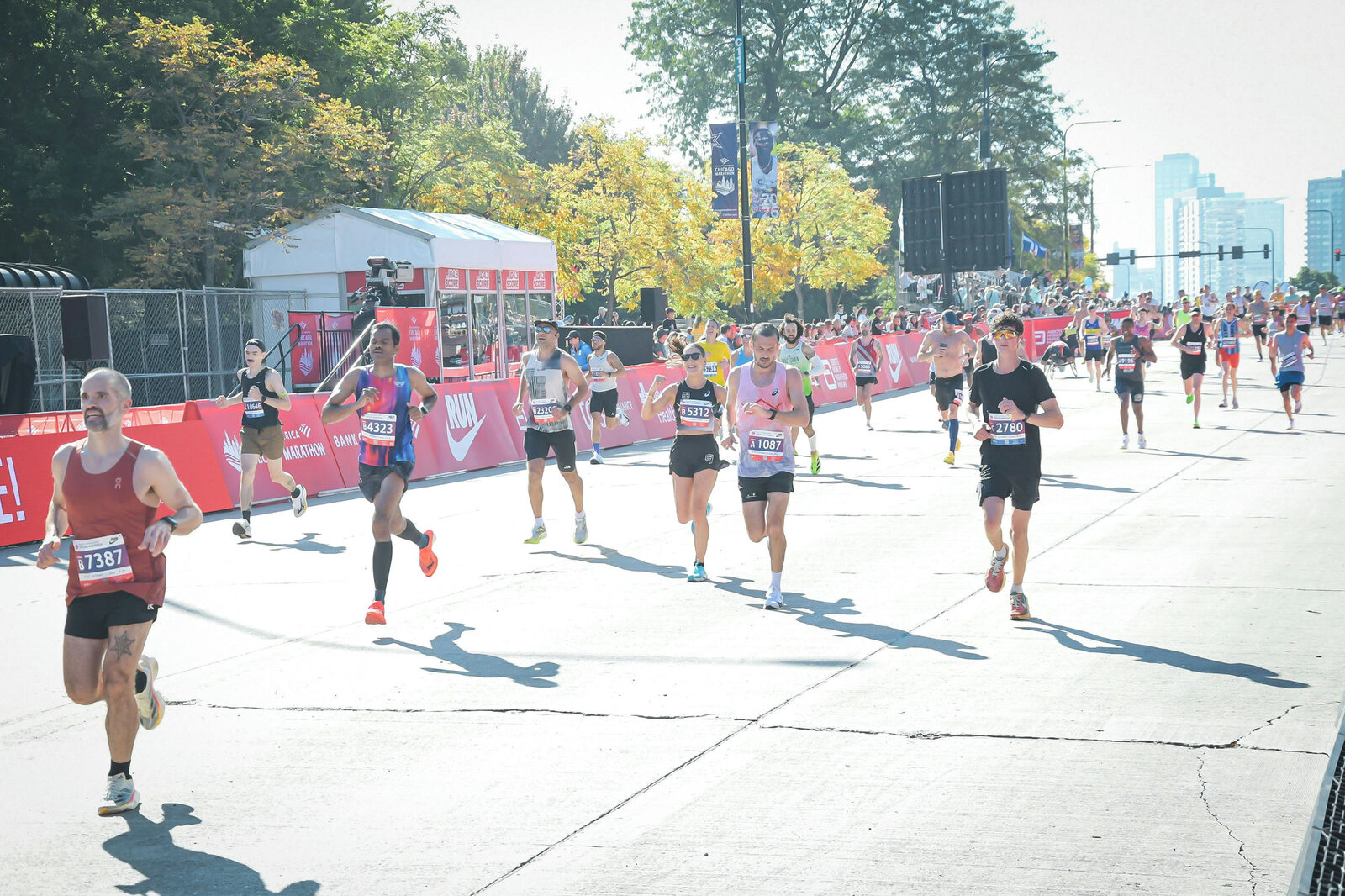
The long run home.
With a little over 700 metres left, I tried to pick up the pace. The incline near the finish felt like the steepest part of the course, especially after 41 km. I pushed through it and crossed the line in 2:54:23.
That was 37 seconds inside my goal. It wasn’t a PB, but it was the race I had set out to run.
My preparation had gaps, and I could feel the work getting harder after 30 km. Still, the pacing held up: 1:26:59 for the first half and 1:27:24 for the second. I didn’t have to recover from a big early mistake.
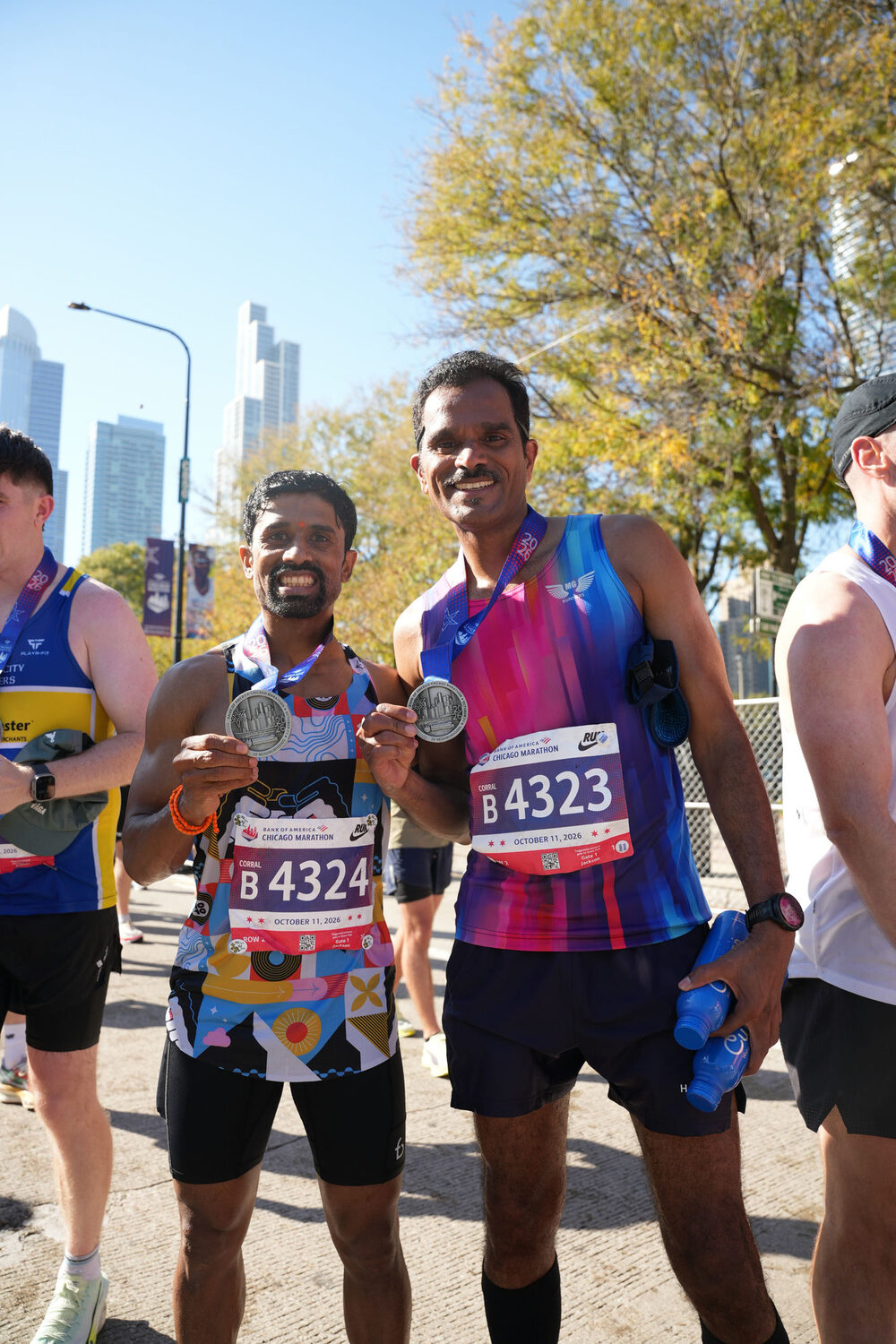
The medals, and the company.
And I got to share every kilometre, including the final push, with Vikram. That’s what I’ll remember most about Chicago.
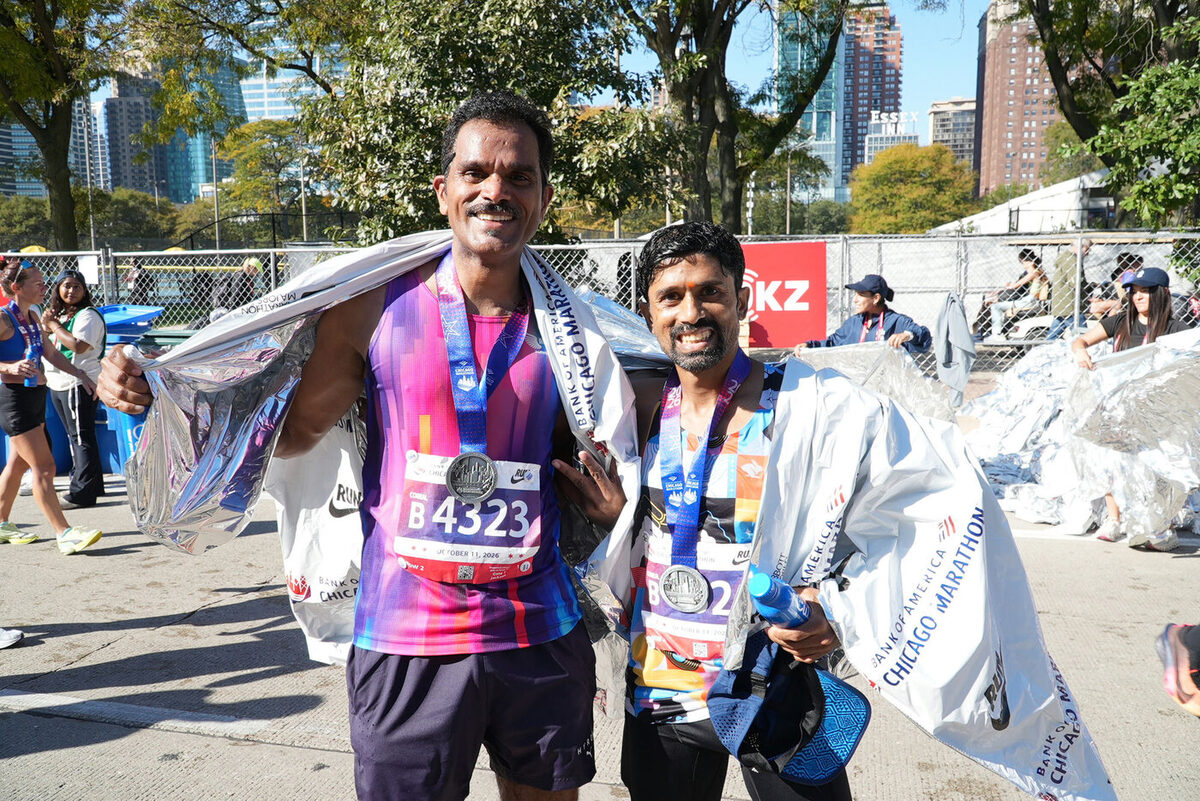
42.195 km together. Murali and Vikram, after the finish.

