

From struggling to swim 75 metres to finishing his first IRONMAN 70.3 in 6:43:31 — 35 weeks of preparation, jellyfish stings in the swim and a 34°C half marathon in Goa.

I had spent years building my running fitness and completing marathons, but taking on a triathlon meant stepping into two disciplines that demanded a completely different set of skills.
On 1 November 2026, after months of early mornings, swimming sessions, long rides, brick workouts, setbacks and learning, I crossed the finish line at IRONMAN 70.3 Goa in 6:43:31.
The challenge was clear from the beginning:
My structured triathlon preparation took shape from March 2026, after the New Delhi Marathon, giving me approximately 35 weeks to prepare for race day.
Swimming was undoubtedly my biggest challenge.
I started relearning how to swim in January 2026 at Basavanagudi Aquatic Centre, after a gap of almost 20 years.
Initially, even swimming 75 metres continuously was difficult. I could manage around 300–400 metres in a 50-minute session, with multiple breaks in between.
The challenges were fundamental: learning to breathe comfortably underwater, getting the freestyle breathing rhythm right, correcting stroke mechanics and body position, understanding how to use my kick efficiently without wasting energy, and building the confidence to swim continuously.
Open-water swimming introduced an entirely different dimension: sighting, navigation, waves, visibility and swimming alongside other participants. It was very different from the controlled environment of a swimming pool.
Before I could start building cycling endurance, I had another challenge to solve: finding the right bike.
A decent-spec road bike was costing upwards of ₹1 lakh, and at that point, I was still unsure how far I would take this triathlon journey. So, I decided to explore the resale market.
After weeks of searching, I finally found one that ticked all the boxes. The cherry on top was that it was a well-maintained carbon-fibre bike, available within my budget.
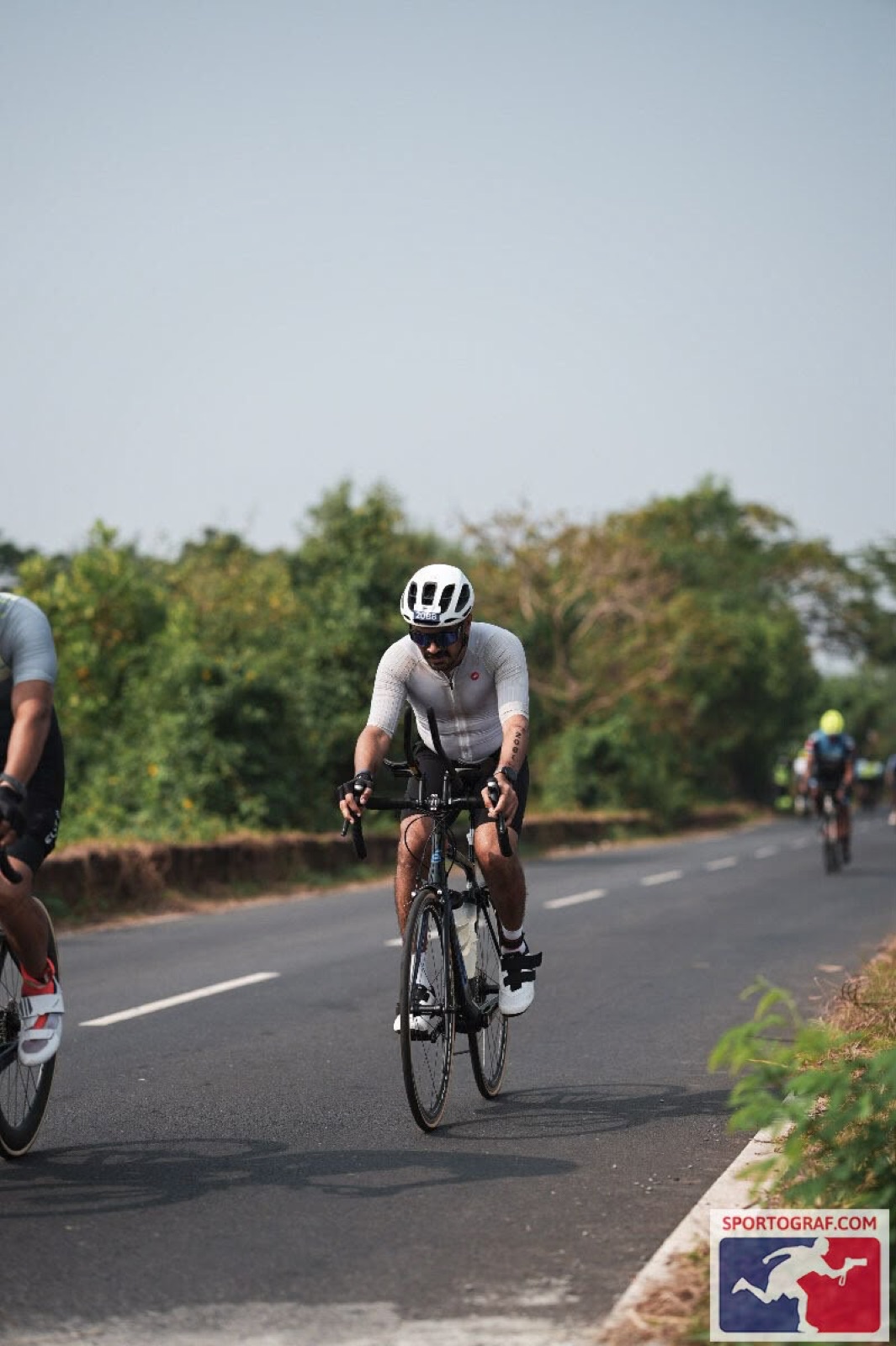
On the bike course in Goa.
I got my first proper bicycle towards the end of January 2026.
As training progressed, I moved towards longer endurance rides, tempo efforts and eventually brick workouts — running immediately after cycling.
The long Sunday rides became an important part of my preparation. I also made a conscious effort to start some cycling and running sessions after 8 AM to experience conditions closer to race day.
Before starting triathlon-specific preparation, I had completed around nine full marathons over the previous three years. My marathon personal best was 3:31 at the New Delhi Marathon in February 2026.
However, triathlon running is different from standalone running. The challenge is not simply to run 21.1 km. It is to run 21.1 km after swimming 1.9 km and cycling 90 km.
I continued to follow my running coach’s structured sessions on Tuesdays, Thursdays and Saturdays. These included quality workouts, easier runs and long runs.
The priority was to establish consistency and address the weakest discipline.
Brick workouts became more consistent, along with a couple of sprint-distance triathlon training sessions to get used to combining all three disciplines.
Longer bike rides, including sessions approaching 80–100 km, became part of the routine. Brick workouts combined cycling and running, while longer open-water swims and triathlon simulations helped develop the ability to maintain effort across multiple disciplines.
Training included longer endurance rides, open-water swimming, brick sessions and race-specific simulations. I started practising how much carbohydrate and fluid I could consume during longer rides and how to manage fuelling during the run.
Training in warmer conditions in Mangalore also helped me understand how heat could affect pace, heart rate and overall performance.
The chart below shows the recorded distance in each discipline. Swimming combines pool and open-water distance, converted into kilometres.
Across the 35-week period, the recorded totals were:
4 October 2026
During the bike course, I had to brake suddenly at a U-turn point. I lost control and went down. My chain slipped, and I also suffered a puncture.
For a few minutes, I was unsure how to proceed, especially without a pump. After a brief pause, I regained my composure, borrowed a pump from another cyclist, fixed the puncture and got back on the course.
The incident taught me an important lesson: race preparation is not only about fitness. It is also about being confident with your equipment, knowing how to handle mechanical issues and staying composed when something unexpected happens.
The final two to three weeks were about arriving at the start line fresh rather than trying to gain additional fitness at the last minute.
The taper involved reducing overall training volume and long-session duration, retaining short, controlled efforts to keep the body familiar with race intensity, avoiding unusually hard workouts and unnecessary fatigue, prioritising sleep, recovery and mobility, keeping nutrition and hydration consistent, checking race equipment, bike setup, nutrition supplies and logistics, and mentally preparing for the swim, bike and run, including pacing and transitions.
The most important part was resisting the urge to squeeze in extra training. The priority was to reach race day healthy, rested and confident.
I decided to drive from Bangalore to Goa a week before race day rather than travel at the last minute, to settle in and complete a few short swim, bike and run sessions in Goa.
My plan was to complete all the hard training by Wednesday. Thursday was reserved for a light swim, while Friday was planned as a complete rest day. However, knowing that my body was not particularly accustomed to taking a full day of rest immediately before an event, I planned a short activation session for Saturday: a 650 m easy swim, a 5 km easy run and 6 km of easy cycling.
Another important consideration was the Goa heat. I ensured that all my training sessions were completed before 9:30 AM. Heat adaptation should be developed progressively during the training phase rather than attempted at the last minute.
Race expos were not entirely new to me. However, the athlete briefing experience at IRONMAN Goa was something entirely new. A couple of weeks before the event, the organisers shared a detailed 38-page Athlete Information Guide, followed by an online video briefing session with the Race Director. At the expo, multiple briefing sessions were organised, along with dedicated Q&A opportunities for athletes.
Holding that race bib made everything feel real. My first IRONMAN 70.3 was happening. Race day was here!
Race morning felt very different from an ordinary training day. There was excitement, anticipation and, somewhere in the background, a little nervousness.
Bike and the race bags for T1 (Swim to bike) & T2 (Bike to run) where checked in the previous day.
I went through my race-day checklist, checked my equipment and nutrition, and made sure the bike and transition requirements were in place. I kept reminding myself to stay calm and follow the plan. The hard work had already been done over the previous months. Today was about execution.
I was not there to chase someone else’s race. I was there to complete my first 70.3, execute my plan and enjoy the experience.
My objective was to execute the race sensibly, manage my effort across all three disciplines and, most importantly, cross the finish line.
I did not want to start aggressively. The plan was to conserve energy during the swim, maintain a controlled effort on the bike and keep enough in reserve for the half marathon.
With all the prayers going through my mind, the swim started with an unexpected challenge.
Within the first 600 metres, I suffered multiple jellyfish stings on my left hand and leg.
It was uncomfortable and mentally unsettling. At one point, I even lost track of time and wondered whether I had overshot the swim course or the swim cutoff.
Rather than panic, I focused on continuing steadily and getting through the swim. My priority was to complete the distance without wasting unnecessary energy.
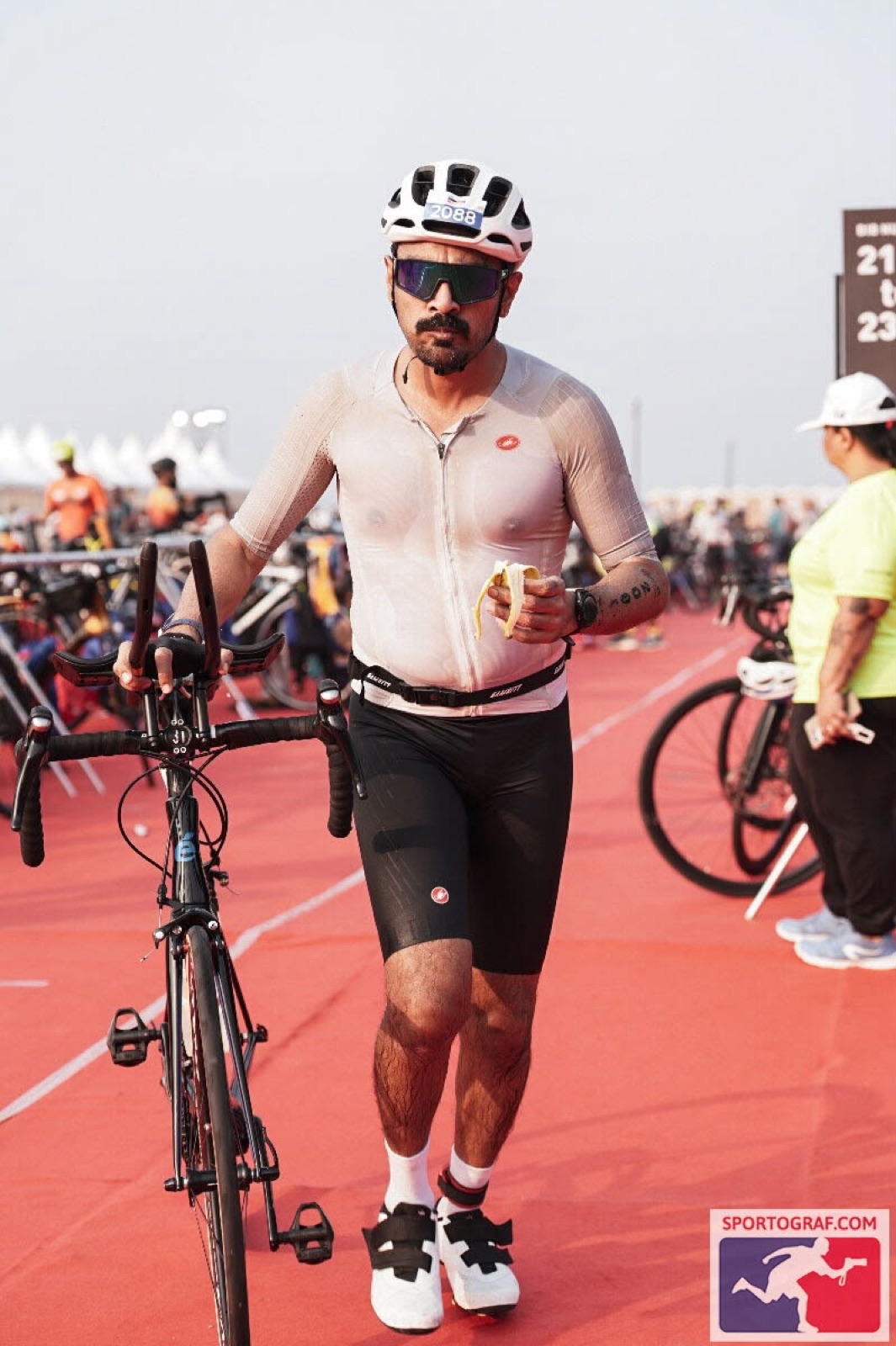
T1: bike, and the banana after the swim.
My pre-swim nutrition was two bananas and one gel, followed by another banana after the swim.
Eventually, I made it out of the water in 55 minutes and 14 seconds.
The bike leg was probably the most controlled part of my race.
I focused on maintaining a sustainable effort rather than chasing speed in the initial kilometres. The first part of the ride went well, and I was comfortable with my pacing.
However, by the second loop, around the 50 km mark, the Goa heat started catching up with me.
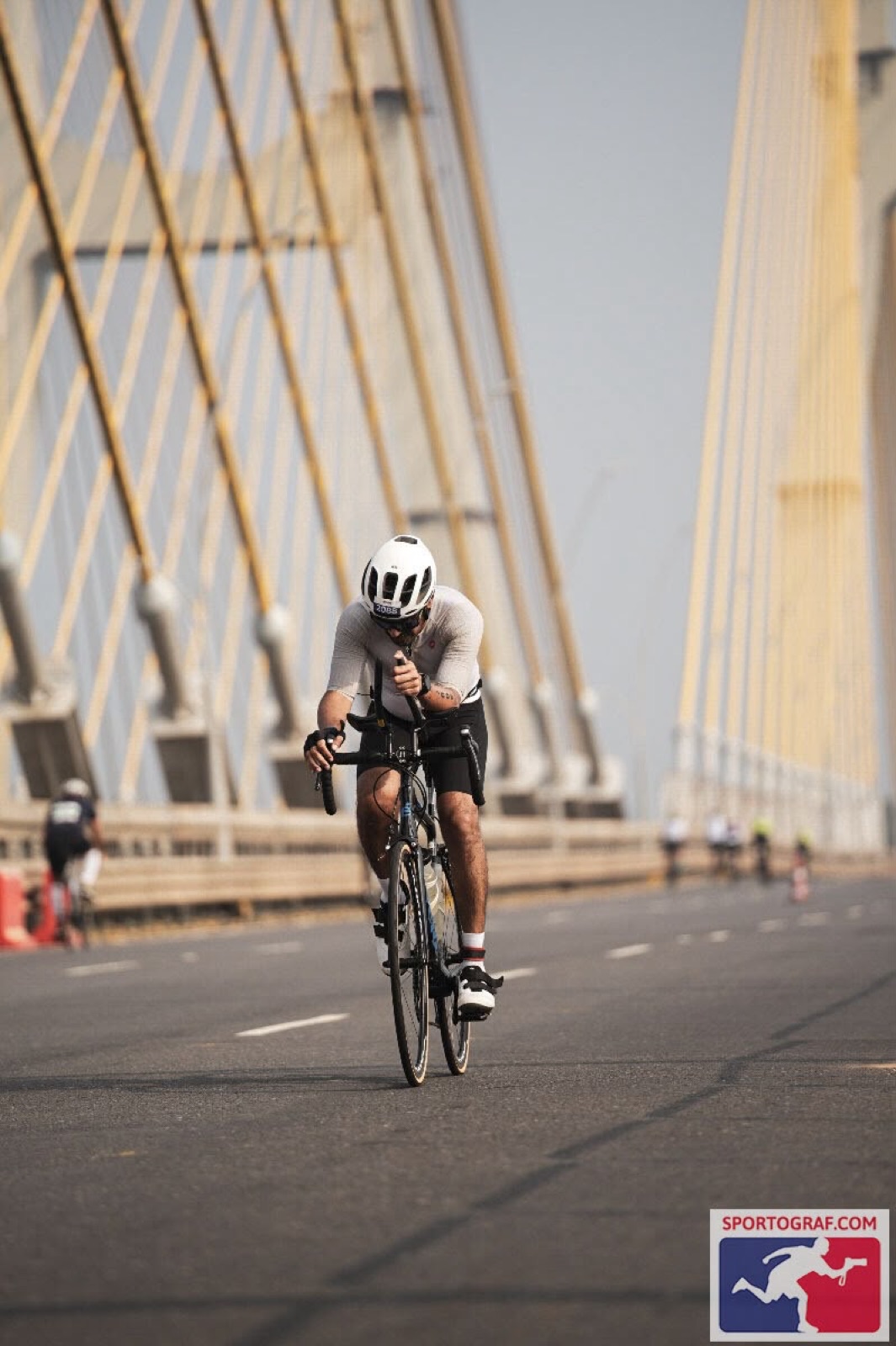
Across the bridge on the bike leg.
I realised that managing body temperature was becoming just as important as managing my effort. I started taking ice-cold water from the aid stations and pouring it over myself to cool down.
My bike nutrition included:
I kept taking fluids and nutrition throughout the ride, at approximately 15–30-minute intervals, aiming to maintain energy levels for the run.
I completed the 90 km bike leg in 3:19:12, averaging approximately 26.9 km/h.
This was undoubtedly the toughest part of the day.
With temperatures crossing 34°C, the run became a test of endurance, patience and mental strength.
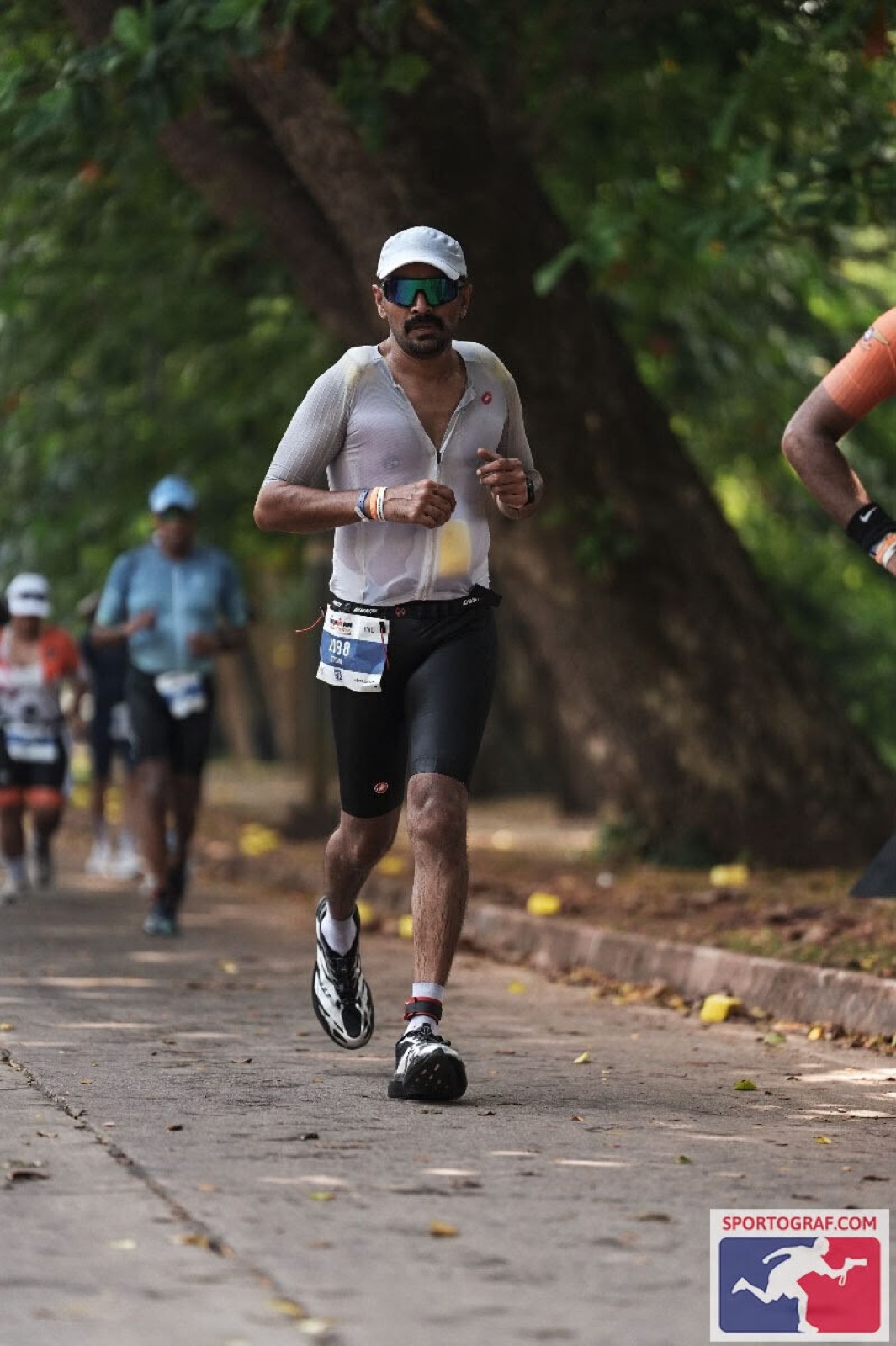
On the run, under what shade there was.
My initial pace was reasonably comfortable, but after approximately 7 km, the heat started taking its toll. I realised that holding my planned pace was no longer the priority.
My strategy changed from chasing the full 21.1 km to simply getting from one aid station to the next.
I poured ice water over myself at almost every aid station. But with the heat, by the time I reached the next station, I was already dry again!
Instead of thinking about the entire half marathon, I broke the race into manageable sections. One 7 km loop at a time. One aid station at a time. One kilometre at a time.
My run nutrition was limited to one gel, along with approximately 500 ml of water and 100 ml of electrolyte drink.
Looking back, this is one area I would plan differently for my next 70.3, particularly for a hot-weather race.
I eventually crossed the run finish in 2:16:49.
| Discipline | Distance | Time |
|---|---|---|
| Swim | 1.9 km | 55:14 |
| T1 | — | 7:33 |
| Bike | 90 km | 3:19:12 |
| T2 | — | 4:44 |
| Run | 21.1 km | 2:16:49 |
| Official finish | 70.3 miles | 6:43:31 |
My first IRONMAN 70.3 was complete. 6:43:31 — a finish time I will always remember.
For me, the biggest achievement was not the ranking. It was completing a distance that required me to learn an entirely new discipline, build cycling endurance and bring my existing running background into a completely different sporting challenge.
The feeling was a combination of relief, exhaustion, satisfaction and pride.
The swim had tested my composure, the bike had tested my ability to manage the heat, and the run had tested my mental strength.
Looking back, there are definitely things I would change, especially around run nutrition and heat management. Every race teaches you something, and this one gave me plenty to take into my next challenge.
There is always a community behind the athlete.
My family was always there, supporting me through the early mornings, training commitments and the time away from home. Their patience and encouragement made it possible to stay consistent through the preparation.
My Run coaches played an important role in helping me build the skills and discipline required for this challenge. their guidance helped turn a difficult goal into a manageable process.
My friends and training partners made the long sessions easier.
The biggest lesson from my first IRONMAN 70.3 is that endurance is built one session at a time.
On race day, not everything went according to plan. Jellyfish stings disrupted the swim, the heat affected the bike and run, and my run nutrition was not where it needed to be. But I kept adjusting and moving forward.
From struggling to swim 75 metres to completing 70.3 miles — this was much more than a race. It was a journey of learning, patience, resilience and the people who made it possible.
And this is only the beginning.

