

Two months after moving from Bangalore to Kuala Lumpur, Aditi on what humidity does to a runner, how she cut back and rebuilt, and what it takes to find your feet in a new running city.

The weather was one of the biggest and most daunting changes when we moved from Bangalore to Kuala Lumpur. In Kuala Lumpur, air conditioning is a necessity. Back in Bangalore, even a fan was a far cry.
Life has changed in smaller ways too. In Bangalore, visiting a mall was an outlier, maybe a trip to the cinema once every six months. In KL I visit a mall once or even twice a day, whether it is for groceries or a DIY item for setting up our new home. It has been a little more than two months since we moved here, and this is my take on adapting to humidity as a runner.
For runners, humidity refers to the amount of water vapour present in the air. Relative humidity tells us how much moisture the air holds compared with the maximum it can hold at that temperature. Heat, on the other hand, refers to the temperature of the surrounding environment.
The combination of high temperature and high humidity is particularly challenging because it reduces our body’s ability to cool itself through sweating.
When humidity is high, sweat evaporates less efficiently from our skin. Since evaporation is one of the primary ways our body gets rid of heat during exercise, regulating body temperature becomes harder.
For runners, this can show up as a higher heart rate, increased perceived effort, fatigue, greater fluid and electrolyte losses, and a slower pace. This is why a pace that feels comfortable in a cooler climate can become considerably harder in a humid one.
The air temperature on your weather app does not capture any of this. Sports medicine uses the Wet Bulb Globe Temperature (WBGT), which combines temperature, humidity, sun and wind into a single heat-stress number. Humidity carries the most weight in it, so a 28°C morning in KL can be far more stressful than a 28°C morning in Bangalore.
We have covered WBGT in detail before:
Adapting to a humid climate requires patience. In the beginning, the goal should be consistency rather than chasing familiar paces or mileage.
Hydration has become a part of everyday life here. Carrying a water bottle whenever we step out, whether for a grocery run or a cab ride, is now second nature. With humidity frequently crossing 80% in Kuala Lumpur, I find myself sweating much more readily, even during everyday activities.
If you want to go further and train for heat deliberately, Sanchit’s piece on heat acclimatization is a good place to start.
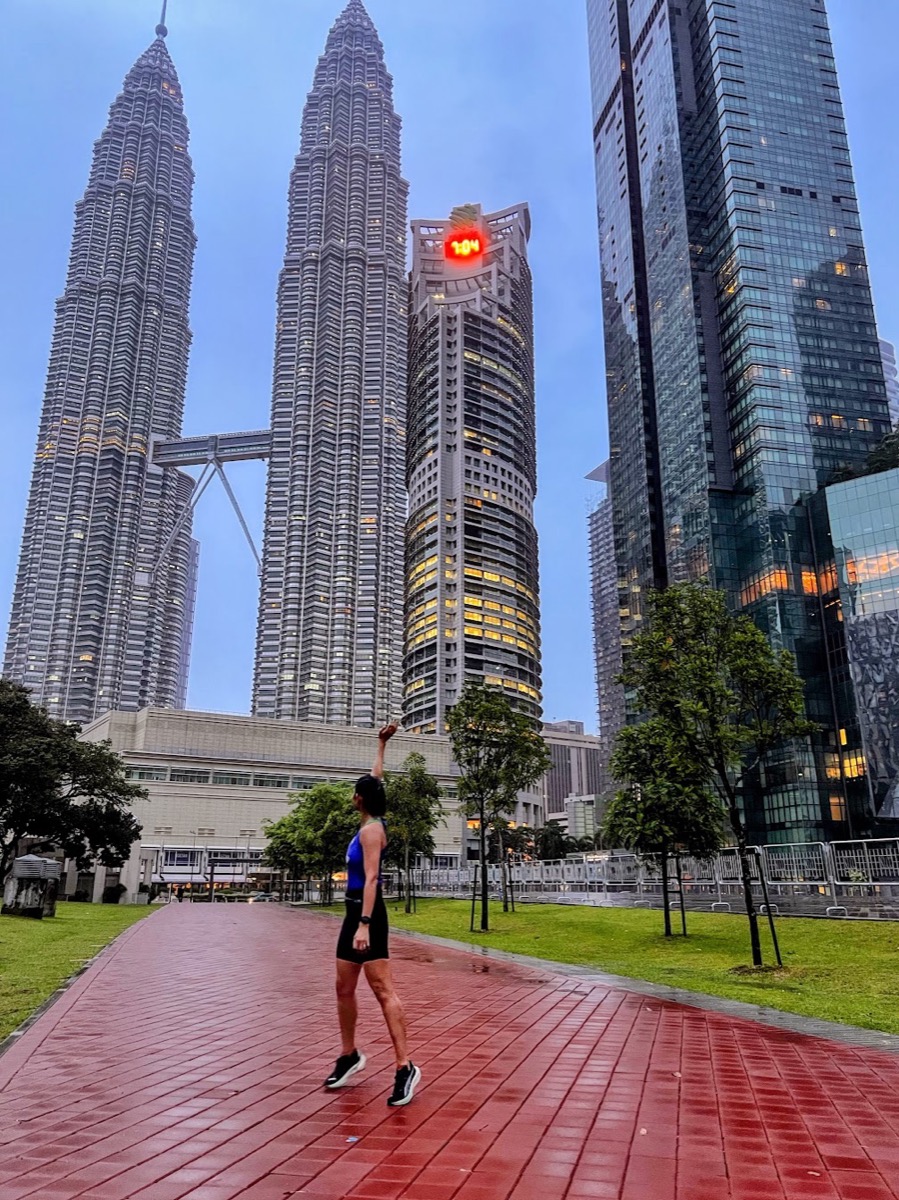
After a morning shower in KLCC Park, below the Petronas Towers.
Kuala Lumpur gets frequent tropical showers throughout the year. October and November are typically the wetter months in the Klang Valley, as the inter-monsoon period gives way to the Northeast Monsoon.
Rain can arrive suddenly, often as a heavy downpour or a thunderstorm, so it is important to plan your routes and timing. Easy short runs and medium-long runs in a drizzle are manageable once you know the city better.
Kuala Lumpur is undulating, and finding a completely flat route is quite a challenge. The gradients are no joke. Whether you are preparing for trail races or ultras, or simply want to build climbing strength, the city offers plenty of opportunities.
KL also has a wonderful running culture. It is blessed with parks, stadiums and pedestrian-friendly footpaths that give runners plenty of options.
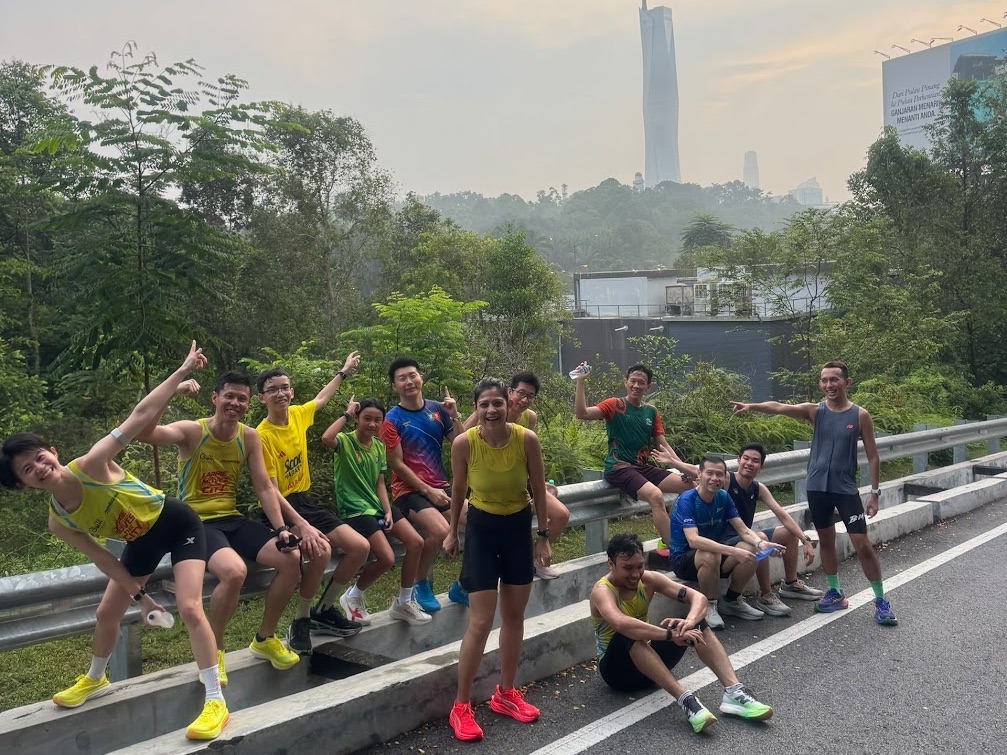
A morning group run, with Merdeka 118 in the distance.
Moving countries and adapting to a new environment is challenging in more ways than one. Even something as simple as planning a running route takes more thought. In Bangalore, I seldom had to think about where I would run. I knew exactly which loop to take, how far it was and how long it would take me. I could wake up, get ready and head out without much planning.
In Kuala Lumpur, I had to start all over again. Discovering new routes, understanding the terrain, finding water stops, and figuring out which parks and roads were suitable for running all became part of settling in.

