

Two runners with the same VO₂max, same threshold, same economy. One falls apart in the final 10K. Metabolic flexibility can explain the gap.

Here is a question.
Two runners can have the same VO₂max, similar lactate threshold and roughly the same running economy, yet one falls apart dramatically in the final 10K of a marathon. Why?
We tend to look for answers in the usual places. Training volume, pacing, hydration, fuelling, perhaps simply a bad day. But there is also another piece of the puzzle that most runners rarely think about: how they are fuelling the effort from within.
Think of the human body as a sophisticated hybrid car. It has two principal fuel sources, fat and carbohydrate. The clever bit is knowing which one to use, and when.
Endurance runners are generally familiar with the first three parameters that determine performance:
Metabolic flexibility asks: Which fuel is your engine using to run those kilometres?
Metabolic flexibility is the ability to produce energy efficiently from the appropriate fuel, at the appropriate intensity, while switching between fuels as the demands of exercise change. In physiological terms, it is the ability to adjust between fat and carbohydrate oxidation dynamically in the optimal manner, according to energy demand and availability.
Think of it as a hybrid car engine that can switch between petrol and battery depending on what the road demands.
During easy running/low-moderate intensity, a well-trained athlete can derive a substantial proportion of energy from fat. As intensity (or effort, as in the later stages of a marathon) rises, carbohydrate contributes progressively more because it can generate energy at a much faster rate. At very high intensities, carbohydrate becomes the dominant fuel.
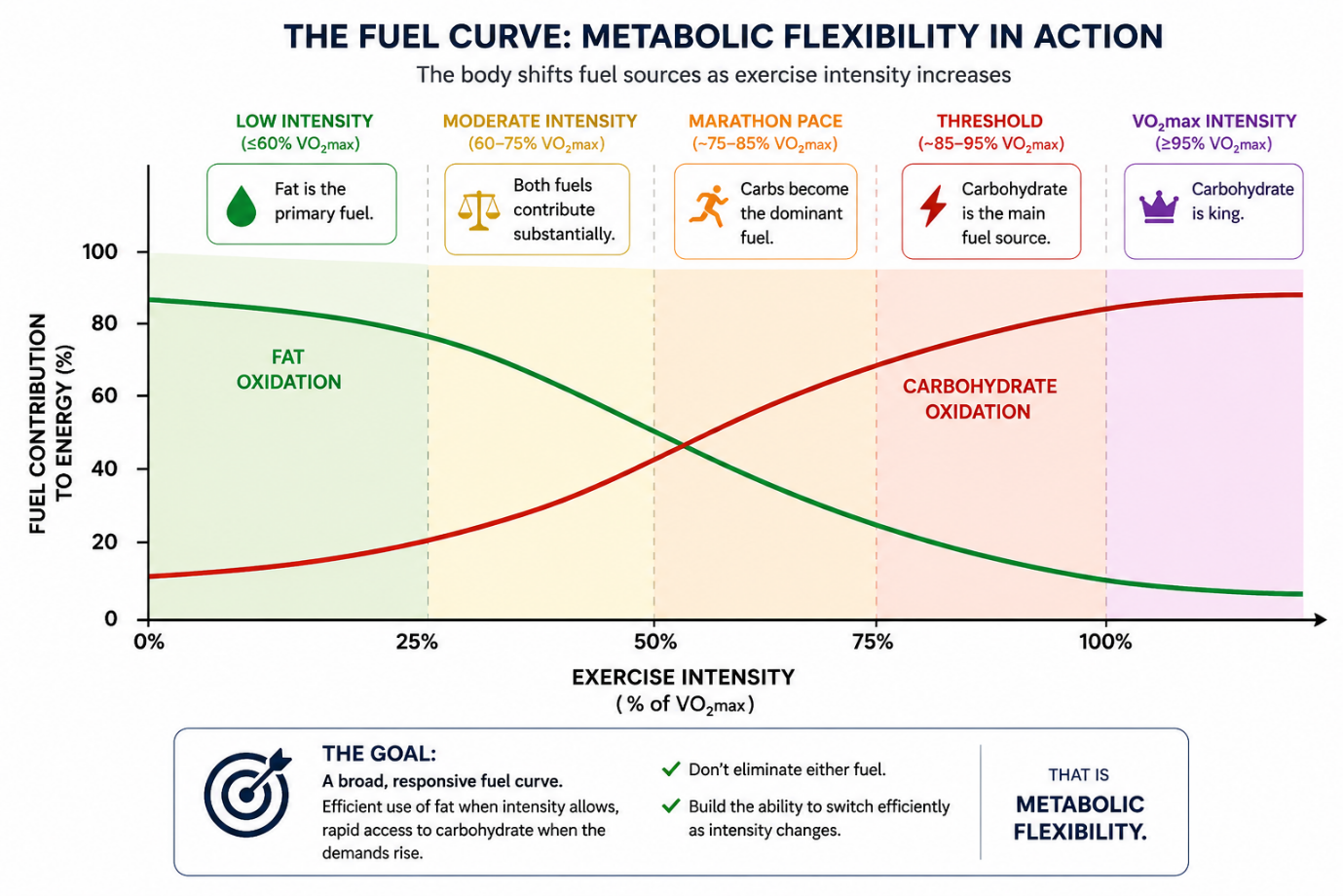
A crossover, not a switch
While the “Switch” is an excellent metaphor, what is more imporant is nothing actually flips. Both fuels burn at almost every intensity, and the crossing simply marks where carbohydrate passes half the energy supply. Brooks and Mercier described this crossover in 1994 as the meeting of two continuous curves. Across 1,121 athletes, peak fat oxidation occurred anywhere between 23% and 89% of VO₂max (Randell, 2017) – a wide range. It shifts even within a single runner , based on the pre-run meal, training status, heat and hours on the feet. So in a marathon it is a gradual drift along the curve, not a line crossed after halfway.
Our bodies carry a huge amount of stored fat. Carbohydrate stores, primarily in the form of glycogen in our muscles and liver, are comparatively small. Fat therefore represents an enormous energy reservoir. The problem is that accessing that reservoir is relatively slow. Carbohydrate can deliver energy at a much higher rate, which is why the body increasingly turns to it as exercise intensity rises.
Two tanks, two problems
A lean marathoner carries roughly 60,000–80,000 kcal as stored fat — enough, in theory, to run several marathons back-to-back. Total glycogen (muscle + liver combined) is only around 1,500–2,000 kcal — barely one well-fuelled marathon. Fat is the enormous, slow-release reservoir. Carbohydrate is the small, fast-flowing one. The endurance runner’s job is to spend both wisely.
This creates an interesting endurance trade-off.
Better fat oxidation at lower intensities means less dependence on limited glycogen stores. In a long race, that potentially leaves more carbohydrate (i.e. glycogen) available for the later stages. Later stages of the race is when the ability to produce energy rapidly becomes increasingly important in avoiding that dreaded wall 35 Km into a marathon.
A marathon is not one metabolic state. The demands of the first 10K are different from those of the final 10K. Cruising at marathon pace is different from running the finishing kilometre as if your life depends on it.
So, it’s not simply about training to become a better fat burner. Better carbohydrate utilisation is what allows us to sustain those higher intensities.
The best endurance athlete, therefore, isn’t necessarily someone who burns the most fat in a race. It is the athlete who can rely heavily on fat when the intensity of effort permits, then shifts efficiently towards carbohydrate when the race demands it.
The first thing to understand is that metabolic flexibility is not developed through a single workout, diet or supplement. The most reliable way to improve it is also the least glamorous: consistent endurance training.
The objective is not merely to increase fat burning. It is to develop both sides of the system, allowing the body to use fat efficiently during easier running while preserving its capacity to use carbohydrate when intensity rises.
Easy and steady running increases the number and capacity of mitochondria, improves blood supply to the muscles and develops the enzymes involved in fat oxidation. Over time, a trained runner can produce more energy from fat at a given submaximal pace, reducing the rate at which limited carbohydrate stores are consumed.
Intervals, threshold runs, hills and marathon-pace sessions develop the ability to produce energy rapidly. Although these sessions rely heavily on carbohydrate, they also improve mitochondrial capacity and the muscles' ability to process lactate.
A runner who can oxidise large amounts of fat but cannot produce energy efficiently from carbohydrate is not metabolically flexible. They are only trained on one side of the equation. This is why chronic carbohydrate restriction can be counterproductive for runners.
Cutting carbs isn't the answer
Long-term low-carb or keto diets can nudge fat oxidation upward, but they blunt the very adaptations that let a runner attack the finishing kilometres — glycogen replenishment, high-rate energy production, and the ability to hold pace at threshold. Fat-adaptation without carbohydrate capacity is half an engine.
Instead of following a permanently high-carbohydrate, low-carbohydrate diet or Keto diet, runners can vary carbohydrate availability according to the purpose of the session.
The phrase behind the plan
“Fuel for the work required” is Professor Louise Burke’s framework — better known as carbohydrate periodisation — developed with her team at the Australian Institute of Sport. Rather than eating high-carb or low-carb all of the time, availability is deliberately varied across the week so key sessions get the fuel they need and easier sessions do not. It is periodisation of nutrition, in the same spirit that runners already periodise their training.
Hard sessions, marathon-specific workouts and important long runs should usually begin with sufficient carbohydrate availability. These are the sessions in which pace, duration and training quality matter.
Short recovery runs and genuinely easy sessions do not always require deliberate carbohydrate loading or fuel during the run. If a runner has eaten normally during the previous day, they may already have sufficient glycogen for the work.
| Session | Primary purpose | Practical fuelling approach | Important consideration |
|---|---|---|---|
| Easy or recovery run under 60 minutes | Aerobic development and recovery | Normal daily eating is usually sufficient. Carbohydrate during the run is generally unnecessary. | Running fasted is optional, not required. |
| Easy or steady run of 60–90 minutes | Aerobic endurance and mitochondrial development | Eat according to hunger, timing and comfort. Carbohydrate during the run is optional. | Do not turn an easy run into a depleted endurance test. |
| Intervals, hills or threshold session | Aerobic power, lactate processing and rapid energy production | Begin adequately fuelled. Consider carbohydrate during longer sessions. | Low carbohydrate availability may reduce pace and total work completed. |
| Long run over 90 minutes | Endurance, durability and fuel management | Depending on purpose, consume approximately 30–60 g of carbohydrate per hour. | Not every long run needs full race fuelling, but neither should every long run be deliberately depleted. |
| Marathon-specific long run | Race pace, durability and nutrition rehearsal | Progressively practise the planned race intake, often 60–90 g per hour. | Use the same gels, drinks, fluid and timing intended for race day. |
| Occasional low-carbohydrate session | Provide a different metabolic stimulus | Restrict this to an occasional short, easy session. | It is not proven to improve performance overall and should never compromise key training. |
| Back-to-back sessions or rapid recovery | Restore glycogen for the next workout | Begin refuelling soon after the first session and meet total carbohydrate and protein needs. | Delaying recovery may reduce the quality of the next workout. |
We spend enormous amounts of time thinking about the size of our aerobic engine, our threshold pace and our running economy. These are important, measurable and familiar.
Metabolic flexibility asks us to look at the same engine from a different perspective: how efficiently can it switch between its two principal fuels as the demands of running change?
The goal is not to become a better fat burner at all costs. Nor is it to avoid carbohydrate. It is to build an engine that can rely efficiently on fat when the intensity allows, while retaining the ability to turn to carbohydrate when the pace demands it.
There is no metabolic hack. The ability to do this well is built gradually, through years of consistent aerobic training, appropriate intensity and intelligent fuelling.
For the amateur runner, that may be the next percent worth finding.
Related in this column: Into Thin Air — what altitude teaches every runner.

