

Why do the world's best runners train at altitude? What can we learn?!

On the evening of 18 July, 60,000 screaming spectators inside London’s Olympic Stadium brought the house down as they witnessed something many thought they would never see. Josh Kerr, the British middle-distance runner, stormed to a breathtaking 3:42.66 for the mile (1600m), finally erasing Hicham El Guerrouj’s iconic world record that had stood untouched for 27 years. Four months earlier, Kerr had boldly declared that breaking the WR was his singular goal for the season. Calling his shot and then delivering it in style in front of a super-charged home crowd — can’t get many better moments than this in sport.
In the days leading up to his unbelievable race, Kerr revealed a detail that caught the attention of running geeks. His last benchmark training workout was a 2:42:45 1200m time trial, run not at sea level, but in Albuquerque at an elevation of 1625 m(5,335 feet). The time was astounding by itself, the altitude made it even more remarkable. The running community immediately caught on — this was the strongest indication yet that Kerr’s ambitious “Project 222” (3 min 42 secs = 222 seconds) was not just a pipe-dream.
View this post on Instagram
Elite distance runners have long understood this relationship with altitude. When marathoners disappear to train at Flagstaff, Colorado or Kenya’s Rift Valley for weeks at a time, they are not looking for spectacular mountain views. They are searching for an environment that enables adaption in ways that can pay dividends months later on race day.
For us amateur runners, altitude has a slightly different connotation. The Ladakh marathon has become a bucket-list event for many runners across the country. Every year, the organisers of this popular destination run have a non-negotiable rule for participants: arrive in Leh at least a week before your race. This is with good reason. The consequences of ignoring this guideline can range from a disappointing race performance to extremely serious health hazards.
The difference in perspective is interesting, isn’t it? The world’s fastest runners deliberately seek out altitude to become faster. Amateur runners are warned to fear it. The same environment that helped Josh Kerr prepare for a world record can leave an otherwise well-trained marathoner gasping for breath on the roads of Leh.
The late coach Joe Vigil, one of the pioneers of altitude training in American distance running, often reminded athletes that altitude should never be viewed as a shortcut. It is simply another training stimulus — one that rewards patience, intelligent planning and respect for physiology.
Altitude is neither friend nor foe. It is a remarkably effective teacher.
Contrary to what many runners believe, the percentage of oxygen in the air remains almost unchanged at altitude. What falls is atmospheric pressure. Each breath you take delivers fewer oxygen molecules into the bloodstream than it would at sea level. Your muscles, demanding the same energy to maintain the same pace, suddenly find themselves working with a smaller oxygen budget.
The immediate effect of altitude is impossible to ignore. Within hours of reaching altitude, breathing becomes deeper and more frequent as the body tries to compensate for the reduced oxygen available with each breath. Heart rate rises, particularly during exercise, because the cardiovascular system has to work harder to deliver oxygen to working muscles. The result is familiar to anyone who has stepped off a flight into Leh and gone for what they assumed would be an easy jog. Pace drops. Perceived effort rises. Even seasoned marathoners discover that their usual training rhythm has disappeared.
Fortunately, the human body is remarkably adaptable.
The first adaptation happens surprisingly quickly. Plasma volume falls over the first few days, concentrating the blood and making oxygen transport slightly more efficient. Soon after, the kidneys respond to lower oxygen availability by producing erythropoietin (EPO), the hormone that stimulates the production of red blood cells. Over the following weeks, haemoglobin mass gradually increases, improving the blood’s capacity to carry oxygen. Other adaptations follow: muscles become more efficient at extracting oxygen, capillary density improves and mitochondrial function becomes better suited to the demands of endurance exercise.
Elites spend weeks living at moderate altitude to stimulate these physiological adaptations while descending to lower elevations for their hardest interval sessions, where they can still run at the speeds required to develop race fitness.
Live High, Train Low
Elite coaches figured out decades ago that living at altitude and training at altitude are two different problems. Sleeping high triggers the adaptations — more EPO, more red cells, better oxygen extraction. But training hard at the same altitude means every interval is slower than it should be, and race-pace work starts to feel foreign. So they split the two apart, sleeping at 2,000 to 2,500 metres for the adaptation while doing the hard sessions down at lower elevations where they could still hit real paces.
Kenyan runners do this from Iten, dropping into the valleys for the hard days. American groups sleep in Flagstaff and take the intervals down to Phoenix. It is a big reason serious elite training almost never happens entirely at 2,500 m.
No discussion of altitude would be complete without mentioning East Africa.
For decades, runners from Kenya and Ethiopia have dominated global distance running. Their success has understandably fuelled the popular belief that altitude alone produces champions. The reality is more nuanced.
Many of these world’s greatest runners have grown up between 2,000 and 2,800 metres above sea level, particularly around places such as Iten, Eldoret and Bekoji. Living at these elevations from childhood almost certainly contributes to favourable physiological adaptations. Yet researchers are equally quick to point out that altitude is only one part of a much larger picture that includes genetics, active lifestyles from an early age, a strong running culture, exceptional coaching and extraordinary depth of competition. Altitude provides fertile ground; years of disciplined training determine what eventually grows there.
We do not need to move to Kenya or Colorado to benefit from altitude. In fact, many Indian runners are already training at a modest altitude without giving it much thought. Bengaluru sits at roughly 920 m above sea level. That is well below the elevations used in professional altitude camps, yet it is high enough to produce a small physiological advantage over prolonged periods of training. Ask experienced marathon runners from Bengaluru why they often produce personal bests in places like Delhi, and many will tell you that racing closer to sea level simply feels easier.
My own experience has echoed that observation. Over several marathon cycles, I have consistently found that months of training in Bengaluru translate into race performances at sea level that feel around 3–5 seconds per km easier than the equivalent effort back home. It is hardly dramatic enough to transform a runner overnight, but across 42.2 kilometres those seconds quietly accumulate into meaningful gains.
| City | Altitude (m) | Notes for runners |
|---|---|---|
| Chennai | 6 | Sea level |
| Kolkata | 9 | Sea level (TSK 25K) |
| Mumbai | 14 | Sea level (TMM) |
| Kochi | 7 | Sea level |
| Ahmedabad | 55 | Sea level |
| Delhi | 215 | Near sea level (NDM, DHM) |
| Chandigarh | 320 | Flat and cool in winter |
| Coimbatore | 410 | Foothill |
| Hyderabad | 505 | Undulating, with elevations |
| Pune | 560 | Mild elevations |
| Dehradun | 670 | Doon Valley, cool climate |
| Mysuru | 770 | Modest elevation |
| Bengaluru | 920 | Modest-altitude advantage (WORLD10K, BM) |
Approximate mean elevations; local variance across a city can be ±50 m.
Altitude also demands respect.
If Ladakh is on your race calendar this September, the organisers' recommendation to arrive at least a week before race day should be treated as non-negotiable. The body simply needs time to begin adapting. Attempting to fly into Leh and race immediately is an unnecessary gamble and fraught with serious risk, regardless of fitness.
| Destination | Altitude (m) | Notes for runners |
|---|---|---|
| Coorg (Madikeri) | 1,190 | Coffee-country |
| Munnar | 1,585 | Hill-station for long runs |
| Srinagar | 1,585 | Kashmir Marathon |
| Gangtok | 1,650 | Sikkim base for trail runners |
| Darjeeling | 2,045 | Himalayan 100 stage race |
| Manali | 2,050 | Himachal training base |
| Nainital | 2,080 | Kumaon lake town |
| Shimla | 2,205 | Shimla Marathon |
| Ooty | 2,240 | Altitude-training staple |
| Kodaikanal | 2,195 | Palani hills escape |
| Tawang | 3,050 | Tawang Marathon by Indian Army |
| Leh | 3,524 | Ladakh Marathon start line |
| Kaza (Spiti) | 3,650 | Spiti Ultra base |
| Rohtang Pass | 3,980 | Manali-Leh road threshold |
| Khardung La | 5,359 | Khardung La Challenge |
A useful rule of thumb: anything above ~2,500 m (8,200 ft) is where acute mountain sickness (AMS) risk begins to matter for most sea-level residents. Above 3,500 m, acclimatisation days are not optional.
When I ran at the Ladakh Marathon a few years ago, I spent several days acclimatising before the event. During that period, I completed a short trek to Ganda La Pass, climbing to nearly 5,000 metres (15,500 feet) before returning to Leh a couple of days before the race. The trek was memorable in its own right, but it also helped me appreciate how profoundly altitude changes physical effort. Back in Leh, running no longer felt quite as foreign as it had on the first day.
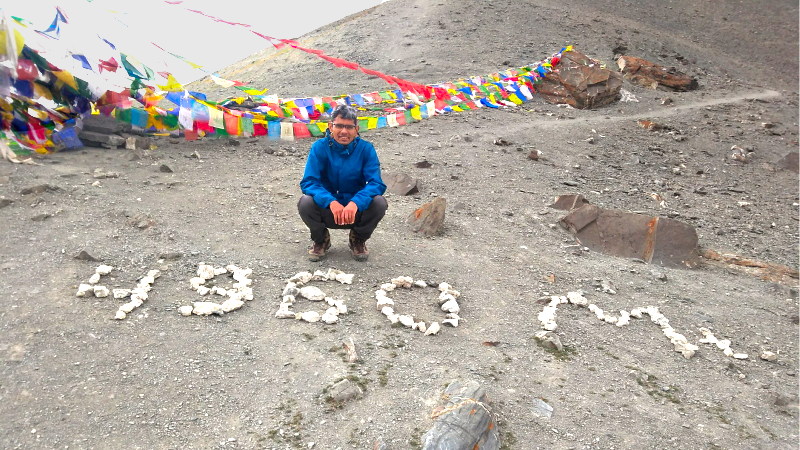
That experience reinforced a lesson the elites have understood for decades. Altitude rewards patience. Trying to fight it usually ends badly. Working with it produces a very different outcome.
Every runner is searching for an edge.
Carbon-plated shoes, sports nutrition, sleep tracking and strength training have all become part of the modern marathon conversation. Altitude deserves a place on that list — not because it is a shortcut, but because it teaches us to understand how our bodies respond to stress and adaptation. Renowned Italian coach Renato Canova has often cautioned against viewing altitude as a magic ingredient. The benefits come only when athletes continue to train well while allowing sufficient time for adaptation. Altitude enhances a sound training programme; it cannot compensate for a poor one.
For most of us, altitude will never involve spending a month in Flagstaff or Iten. It may simply mean recognising the quiet advantage of training in Bengaluru, planning an extra week before racing in Leh, or understanding why your watch shows slower paces during a holiday in the mountains.
Josh Kerr’s world record reminded us that the finest details often separate extraordinary performances from merely excellent ones. His altitude training was one of those details. It was not the only reason he rewrote history, but it was certainly part of the preparation that made the performance possible.
That may be the biggest lesson altitude offers every runner.
A note on the title — “Into Thin Air” is a hat tip to Jon Krakauer’s unforgettable account of the 1996 Mount Everest disaster. This column explores altitude through the lens of running rather than mountaineering, but the borrowed title carries the same reminder: the mountains inspire awe, demand respect, and reward those who understand them.

