
From Cubbon Park sunrise runs to ice-plunge afterparties, a new generation is rewriting what Indian running looks like — and the data is starting to back the vibes.

You can’t miss them these days.
In and around Cubbon Park at sunrise. Along the Agara Lake loop. Spilling out of darshinis and cafés in Indiranagar wearing totally accessorised, cool running gear. The soundtrack is revealing too — equal parts laughter, sneaker chatter, coffee grinders and the occasional “Bro, pace slow!"
For someone who has spent well over a decade in the Indian amateur running ecosystem, this is unmistakably something new. Running groups have existed for years, of course. Most cities have long had their clusters of marathoners, weekend warriors and training communities. But what we are seeing now feels qualitatively different — a cultural shift.
The running boom in Indian cities has found its second coming. And Gen Z is driving it.
The evidence is no longer anecdotal. The 2026 edition of the TCS World 10K Bengaluru offered perhaps the clearest statistical validation yet. For years, the race demographics had been dominated by runners in their 40s — the classic Indian amateur running profile. This year, the 25–30 age group emerged as the single largest cohort in the country’s premier 10K event. A clear marker that a generational handover is already underway.
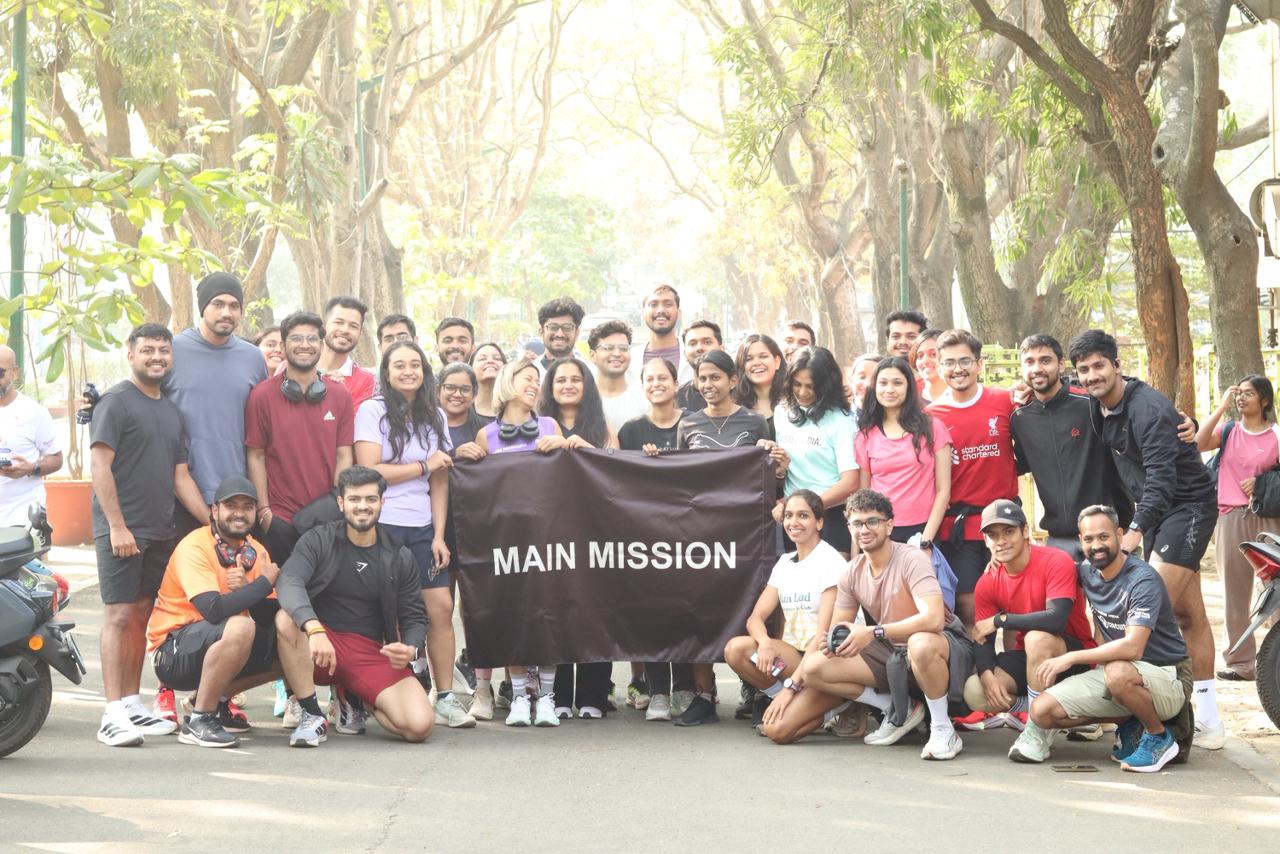
Indiranagar Running Club
For many runners of my vintage, the contrast with the early years of the Indian running movement is striking. When I began running in the late 2000s, the fashionable phrase doing the rounds was, “Running is the new golf." It was a line that revealed more than perhaps intended. Running then was largely the domain of upwardly mobile professionals navigating mid-life recalibrations. Many of us arrived at the sport carrying expanding waistlines, stressful jobs and the vague ambition of becoming healthier before annual blood reports forced the issue more aggressively.
Running offered structure, identity and eventually joy. Somewhere along the journey came the runner’s high, race medals, Garmin/Strava obsessions and endless discussions around VO2 max and negative splits. The demographic profile reflected this reality. Corporate executives. Entrepreneurs. Forty-somethings discovering endurance sport after years of sedentary work lives.
Today, the cultural references have changed entirely. “Strava is the new dating app,” goes one popular social media line. And like most good jokes, it contains more than a grain of truth.
The rise of Gen Z running clubs across Indian cities is not merely about fitness. These clubs sit at the intersection of wellness, social connection, identity formation and urban loneliness. To dismiss them as superficial because they also involve coffee, music, and Instagram obsession is to fundamentally misunderstand what is happening.
For Gen Z, the run club is becoming what pubs, malls and perhaps even corporate offices once were for earlier generations: a place to belong.
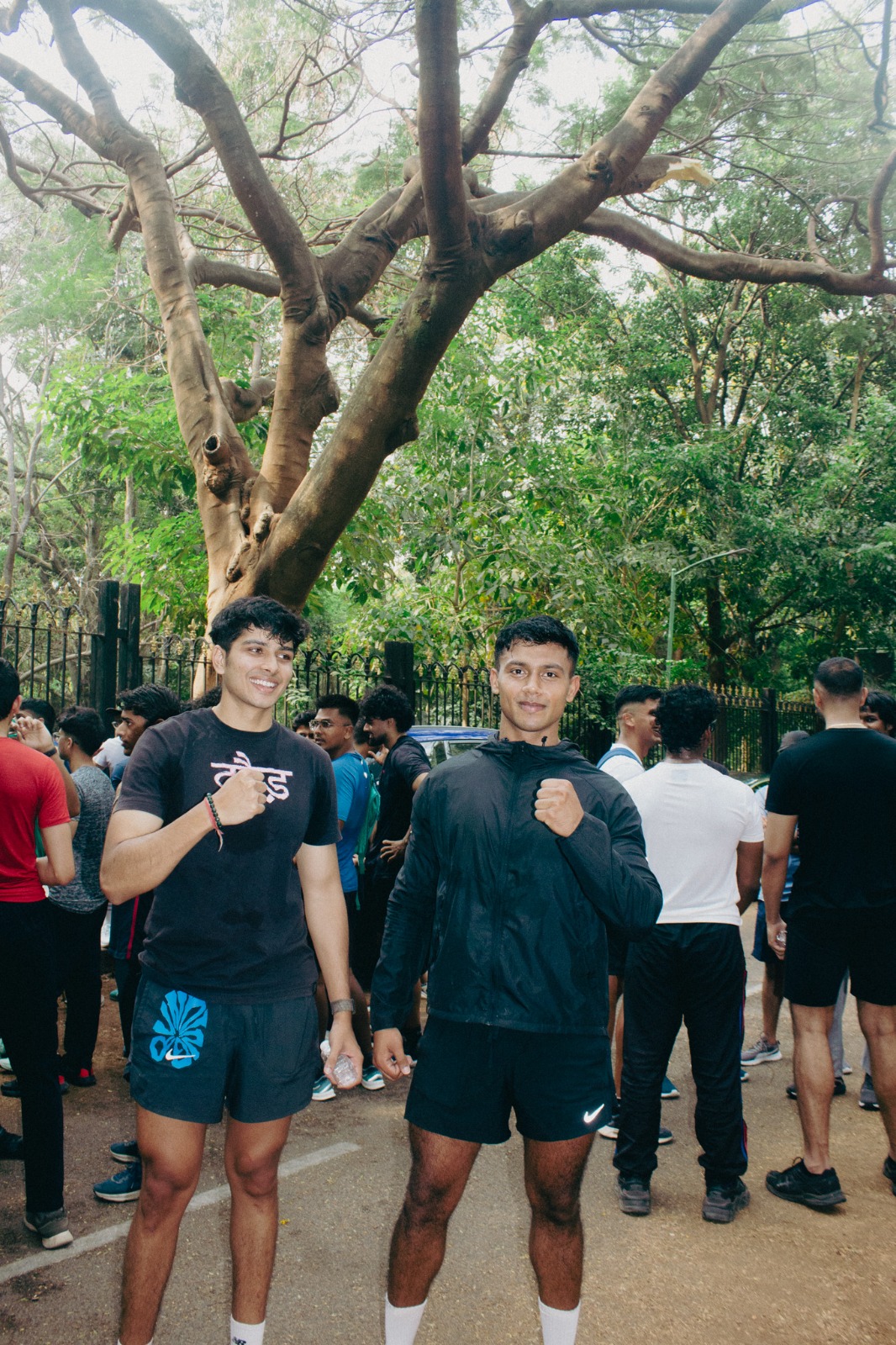
Deepak Dang (right) at a Daud Sunday run.
Few stories capture this phenomenon better than that of Deepak Dang, co-founder of Daud, one of Bengaluru’s fastest-growing Gen Z running collectives.
Deepak grew up in Karnal, Haryana and arrived in Bengaluru in his early twenties carrying ₹20,000 borrowed from his parents and the ambition of building a life in the fitness industry. The early days were difficult. Odd jobs at gyms paid the bills but did not offer direction. Somewhere during that phase, he stumbled upon a reel showing a group of people running together in a park before heading out for coffee.
That seemingly ordinary sequence sparked an idea.
“I realised this was bigger than just running or fitness,” Deepak told me during our conversation. “People were looking for connection.” Fortuitously, he found a like-minded collaborator in Aryan, whom he met at a gym where both worked out. Together, they launched Daud with a simple proposition: “Make running Cool” — aspirational, social and accessible to young people who otherwise may never have considered the sport.
Their first growth hack was charmingly direct. They shot a video on Church Street asking random strangers to join them for a Sunday run. A few people showed up. Then a few more. “For the first 8 months,” Deepak said with a laugh, “it was basically a short run at Cubbon and coffee at Konark every Sunday morning.” This attitude of just keeping at it with intent and conviction perfectly captures how many meaningful communities begin.
Over time, momentum built.
The format evolved beyond conventional group runs. A short 3K social run might be followed by a coffee rave, an ice-plunge session or a community breakfast. Membership fees for curated experiences created sustainable revenue streams. Coffee brands, gyms and wellness companies started noticing the audience concentration. The social media flywheel accelerated visibility further. Today, Daud claims a community of over 40,000 members and is looking beyond Bengaluru into expansion across other cities.
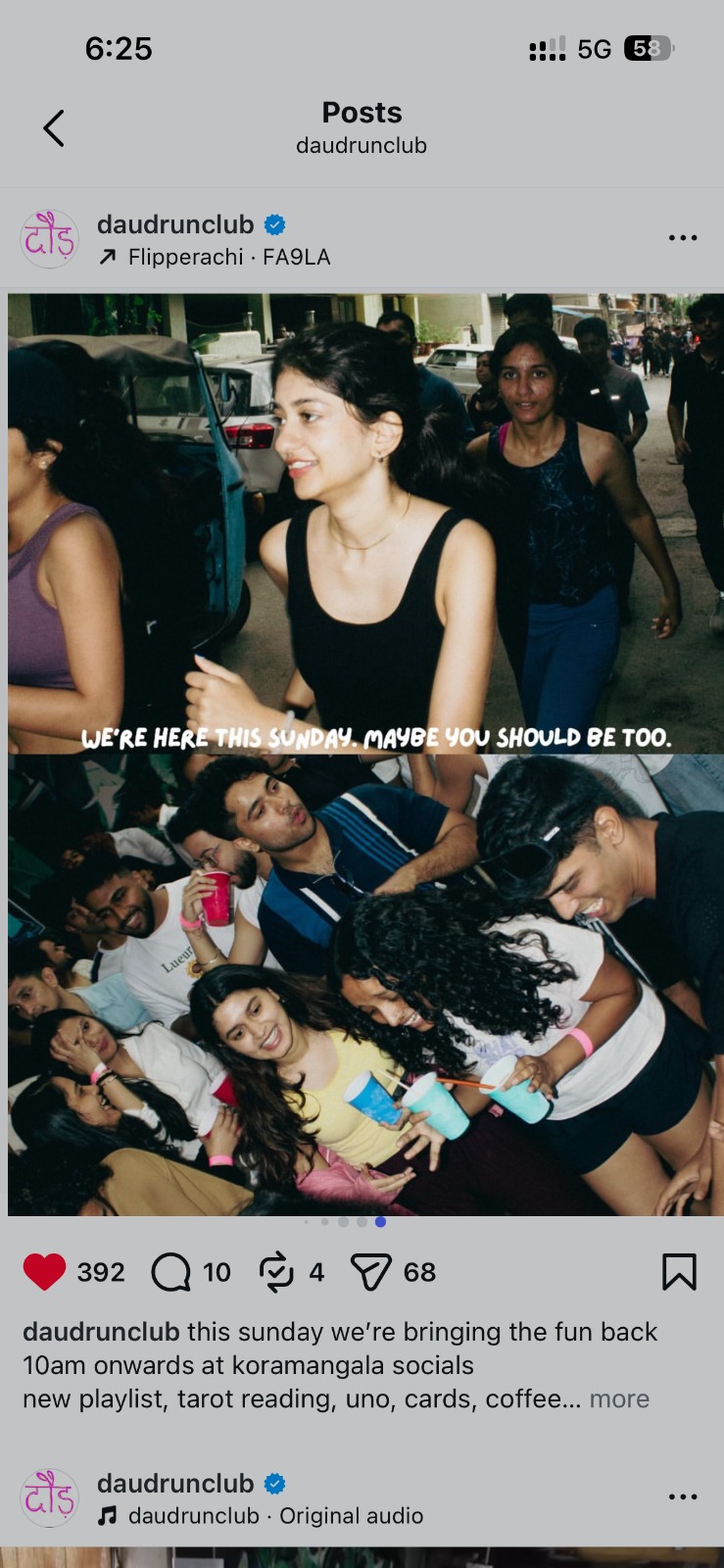 The Daud Run Club Instagram — where a lot of the recruiting happens.
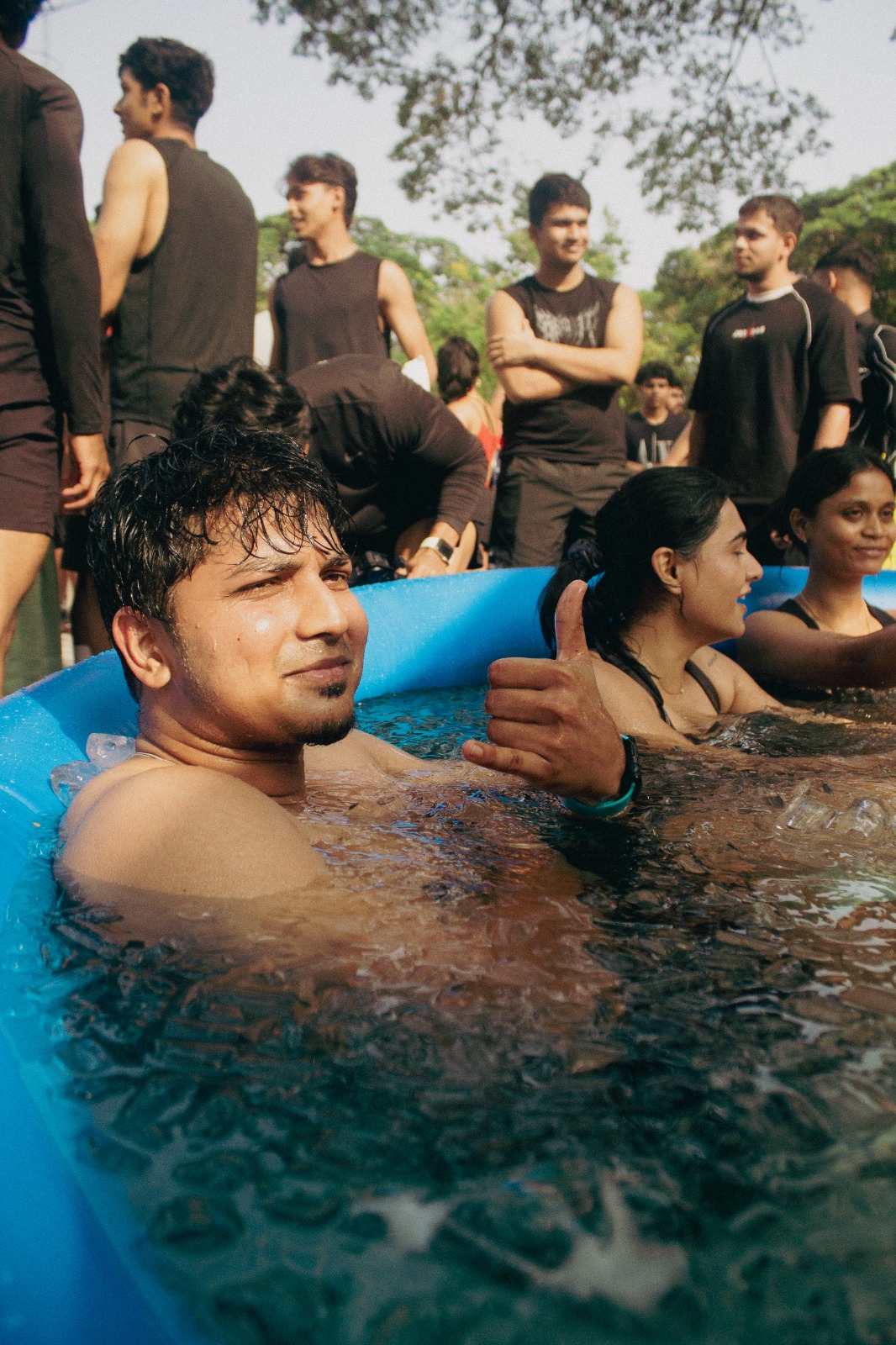 The ice plunge that follows the run — Daud's signature afterparty.
It would be easy for older runners to look at this and instinctively smirk and snigger.
Too performative. Too curated. Not “real running."
I have heard versions of these repeatedly in conversations with seasoned runners over the last year or two (I have been guilty of these too). Deepak himself acknowledged that the club often faces snide commentary from what he jokingly calls “elite runners” — those who see these social formats as diluting the seriousness of the sport.
But these founders are refreshingly unfazed by such criticism.
Maninder, founder of the Indiranagar Running Club, framed it memorably when I asked him about the inevitable “Is this a running club or a dating club?" rhetoric that trails many of these groups.
Fair point.
And perhaps that is precisely where many traditional runners are missing the larger picture. These clubs are not replacing serious running culture. They are expanding the entry funnel into it.
Deepak mentioned that Daud’s Thursday runs increasingly attract members who initially joined for the social aspect but now want to train for longer distances — 10Ks, half marathons and beyond.
That sentence, in many ways, is the heart of this entire phenomenon.
Because what we are witnessing is not simply a recreational trend. It is a lifestyle correction emerging organically within a generation that has simultaneously inherited unprecedented digital connectivity and the resulting social fragmentation. For years now, we have heard alarming conversations around Gen Z and rising anxiety, loneliness, screen addiction and declining real-world social interaction.
Much of modern urban life has been subsumed by phones, laptops, streaming platforms and algorithmically mediated identities. Against that backdrop, there is something deeply hopeful about a bunch of enthusiastic young people voluntarily waking up at 5:30 am on weekends to gather outdoors and run together. Even if some of them are also filming reels while doing it.
Every generation expresses enthusiasm in its own cultural language. Mine probably bored everyone with race timing spreadsheets and heart-rate graphs. This generation documents recovery runs with cinematic drone shots and playlists.
Neither invalidates the other.
If anything, Gen Z has intuitively understood something the broader wellness industry often misses: consistency in fitness rarely emerges from discipline alone. It emerges from community, belonging and emotional reward. These running clubs provide all three.
There is another important dimension here that deserves acknowledgement: safety and inclusivity. Both Deepak and Maninder repeatedly emphasised that creating safe spaces across genders is a central operating principle for their communities. Clear behavioural guidelines, quick intervention in case of inappropriate conduct and a deliberate culture of openness appear to be taken seriously. That matters enormously.
Historically, many fitness spaces in India — gyms included — have not always felt welcoming or comfortable for women. If these newer running communities are managing to create environments where young women feel safer participating in outdoor fitness activities, that alone represents meaningful social progress.
And then there is the broader public health angle. If Gen Z is replacing at least some proportion of late-night binge drinking, passive weekend consumption and isolated screen time with early morning movement, social interaction and outdoor activity, that is unequivocally positive. Coffee is certainly a healthier intoxicant than several alternatives available to urban youth culture.
As someone who has spent years immersed in running, what also struck me about this phenomenon is how it reflects a sort of democratization of the sport. Urban recreational running in India has typically carried subtle class and cultural signalling. Race entries, expensive shoes, GPS watches and English-speaking fitness ecosystems often created invisible barriers around participation.
What people like Deepak are building with Daud feels different.
There is something profoundly inspiring about a young man from Karnal arriving in Bengaluru with borrowed money, discovering community through running and then helping architect an entirely new youth culture around movement and wellness. Along the way, he said, he got over some deep-rooted early life trauma himself. Deepak was severely bullied at school and had a stutter when he came to chase his dreams in this big city and without the ability to speak conversational English. But the young man who spent an hour with me over a video call, spoke eloquently, with passion and without any defensiveness about expressing himself primarily in his native tongue (though I started the interview with a long intro in English — huge learnings for me there).
Running has given Deepak a livelihood, identity and belonging. He is now paying that forward at scale.
This, for me, is a far more compelling story than whether someone paused mid-run to take an Instagram selfie.
Of course, this does not automatically mean that every trend within the run-club ecosystem deserves uncritical celebration. Like any fast-growing cultural movement, there will inevitably be excesses, superficiality and commercial opportunism. Some clubs will fade. Some will prioritise aesthetics over substance. Some participants will disappear once novelty wears off. That is normal.
The important thing is that the overall direction of this unmistakable trend is encouraging.
For the serious running community, this moment presents a real opportunity. We can choose to gatekeep the sport through endless purity tests around pace, mileage and “real runners." Or we can recognise that every experienced marathoner was once a beginner who needed encouragement more than judgement.
Many of the runners showing up today for a casual 3K social run may become tomorrow’s half-marathoners, ultra runners or lifelong advocates for healthy living. More importantly, even those who never progress beyond occasional social runs are still participating in something way more commendable than sleeping till noon on a Sunday (disclosure — I’m a dad to 25-year-old twin boys). This deserves applause, not cynicism.
Watching this shift unfold over the last couple of years has been fascinating precisely because it reveals how adaptable running as a sport really is. At its core, running has always been more than performance metrics. It is one of humanity’s oldest forms of collective experience.
Gen Z’s version of this experience comes with coffee raves, playlists, ice-plunge parties and excellent social media editing.
And Indian running is better for it.
Run joyously.

