
How Uday negotiated Boston for a 2:48:51 marathon PB — shoe trouble, a four-phase pacing plan, and a strong finish on Boylston.

My training cycle for Boston ran for about six months under the guidance of coach Guruprasad and with the team at Royal Sports.
The block included three 30+ km long tempos, a lot of short intervals, and a peak weekly mileage of 80 km held for two weeks. Key highlights were a controlled 2:59 at TMM in January and a 1:22 half marathon at Delhi in February. One confidence-booster workout was a 5×5 km set at target race pace. The training mixed really hard pace weeks with a few low-intensity weeks in between. A few of the long tempos were deliberately scheduled on tired legs to simulate the last 10 km of a marathon. The final 10 days before the race were taper, including the 5 days I spent in Boston.
I travelled to Boston five days before the race to adjust to the cold and the time zone. I kept things light — a few easy runs and a small set of intervals to keep the legs fresh.
I was lucky to have a friend-of-a-friend-of-a-friend-of-a-friend who lives in Hopkinton, just 1.5 km from the start. He welcomed us into his home with so much warmth, and served home-cooked Indian food that was perfect for race-day prep. Thank you again, Ramesh Sir, for your generosity and for making me feel so at home.
Since I was staying so close to the start, I left around 8 AM after a light breakfast of oats and a banana.
This was my second Boston, so I knew the holding areas and the process of marching to the respective wave’s position. The aura of the Boston start line is something else. You can feel the vibe and the energy in every person — including the security personnel.
Minutes before the race, the air was thick with anticipation, anxiety, and nervousness. And then a US Air Force C-130 Hercules thundered low over the start line — the giant frame and the roaring engines felt surreal against the April sky. A cinematic prelude to the miles ahead.
The race started at 10:00 AM. I crossed the start mat at 10:03.
I had split the race mentally into four phases: 21, 7, 7, 7.
Within five minutes of the gun, you realise that everyone in and around you runs fast. The pack stays with you for the entire race, so the work becomes finding your own rhythm and the right pace to hold the distance. It is very easy to get carried away with the sea of runners and the support from the crowd.
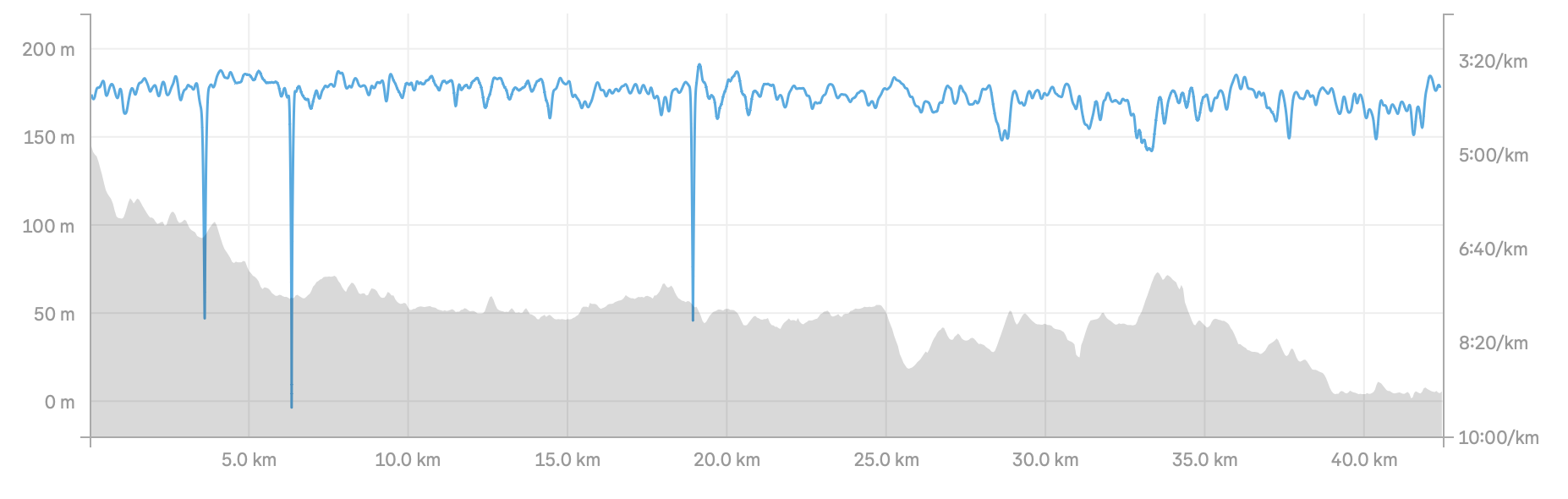
While I was thinking all that, the pace I was actually running was 5–10 seconds faster than the target. My race strategy has always been to go by feel rather than pace. I was feeling good, so I kept pushing. Boston’s first half is mostly downhill, so the perceived effort is always lower in that segment.
By the 3rd km, I was already in pain. The new shoes were hurting my left leg every time I pushed. I tried to absorb it for a while, but by the 4th km it was too much — the laces clearly needed adjusting. I stopped to fix them. Lost 40 seconds.
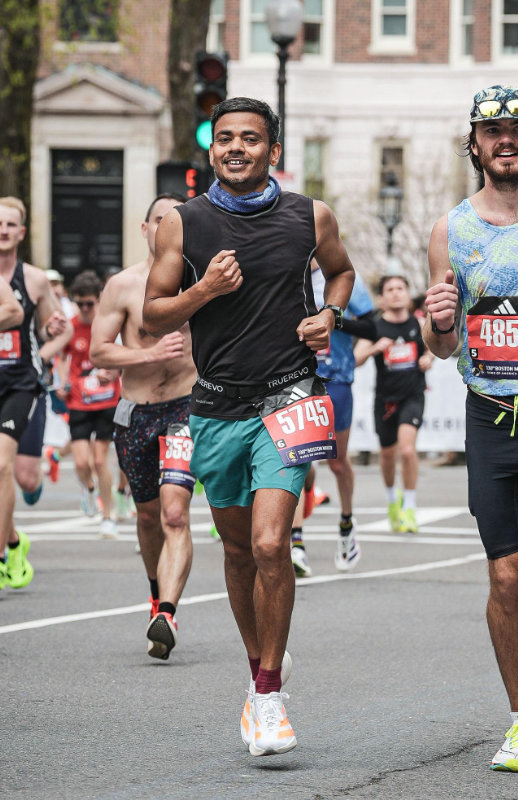
Started running again. The pain returned at the 6th km. This time I decided to stop and properly remove the entire shoe, loosening the laces from bottom to top. Did exactly that in the 7th km. Another 45 seconds gone.
Started running again. The pain had subsided. Now the only focus was getting the rhythm back and clawing some of those seconds back. Luckily, the pain didn’t return. I kept the grind on.
Completed the 15th km in the 58th minute — I was actually on track for a half-marathon PB through the first half.
I hadn’t sweated a drop. But I was drinking water on plan.
At the end of the 18th km — answered nature’s call. Another 40 seconds gone.
19 to 21 was smooth. Even with the three hiccups, I still managed to beat my previous half-marathon PB. At the time, I had no idea whether this was a wise decision.
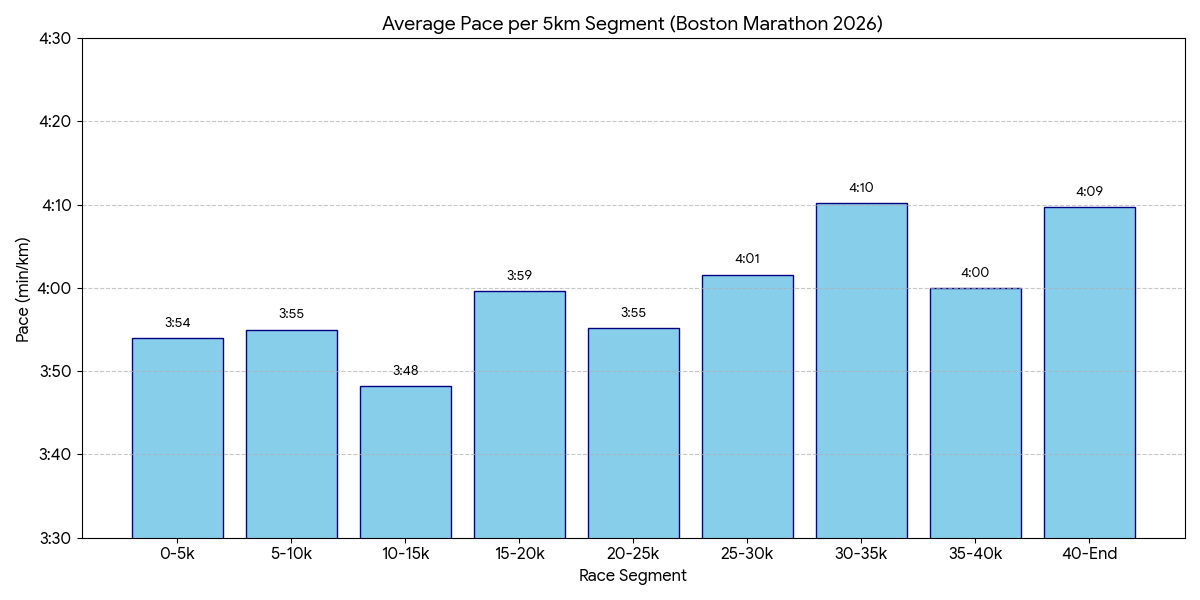
I completed the first half in 1:22. Pace: 3:54.
Energy gel at the 7th and 14th km, and a salt capsule at the 10th km.
This is the segment where you can quietly wreck your race. The first half is done, you’re hardly tired (with all those downhills behind you), and the segment is mostly flat with the steepest downhill of the course sitting right before the hills start. My read: this section needs control. I focused on maintaining rhythm by locking onto cadence and setting myself up for the heartbreak hills. It went smoothly. Average pace 3:58, took a gel at 23 km. The first hill was done before I even registered it.
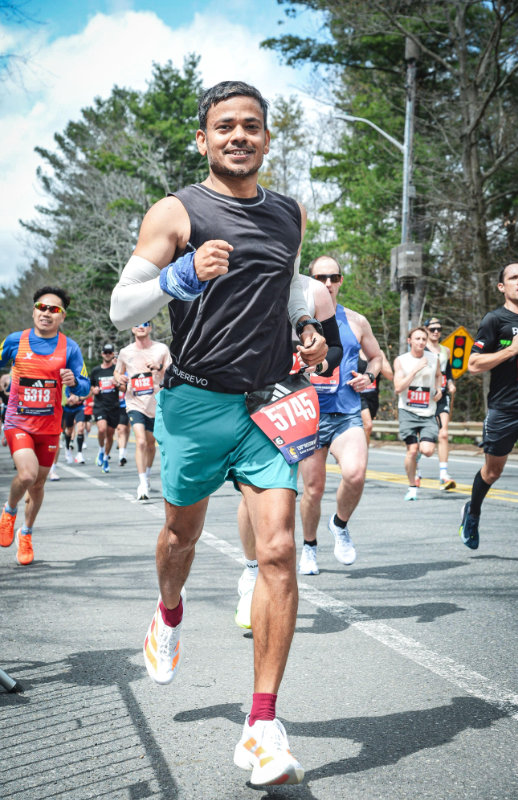
This is the hardest part of the course. Three of the four hills sit in this section. I was ready to slow down if it got bad. The plan: hold slightly faster than 4:00/km on the non-uphill stretches, and on the three 600–800 m hills, run by perceived effort.
The plan worked everywhere except the last hill, the one that comes in the 34th km. I was probably bored, or mentally fatigued — I drifted as slow as 5:00/km pace for a stretch. The 34th km clocked 4:27. I picked up a Maurten gel on course and took it just to break the monotony. First time I’d tried it. It worked, more as a mental reset than anything else.
Average pace in this section: 4:10.
Starting the 35th km, I told myself to bring the focus back and finish strong. I worked out the math: if I could hold 3:50 through this stretch, I’d be very close to 2:45. That thought genuinely helped me push. From 35 to 37 I almost held 3:55. From 38 to 40 it slipped a little, but I stayed at 4:05. In the 41st km I had a mild collision with a runner who suddenly stopped right in front of me.
Boston’s last 1.2 km is actually 1.4 km — at least according to my watch GPS. After the final left onto Boylston, you see the finish line for the first time and it feels close. But there’s still 700+ metres to go. The crowd’s energy and the sight of that historic Boston Marathon finish carries you through.
Average pace in this section: 4:03.
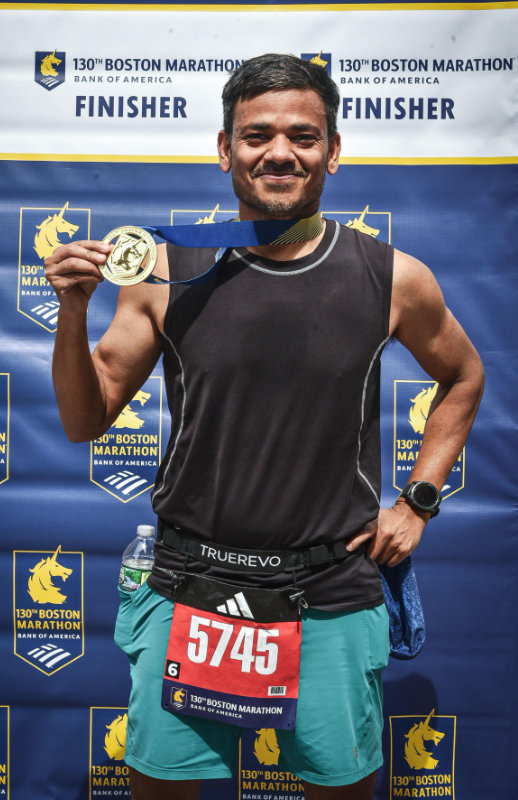
This was a new personal best by ~4 minutes.
You don’t run Boston. You negotiate with it. And at the end, you need to win the negotiation.