

Vijay clocks a 2:47:17 PB at the Sanlam Cape Town Marathon 2026 — sub-2:50 at 50, eight 5K splits within 28 seconds, the cobblestoned climb at 32K, and the unforgiving Loop of Death.

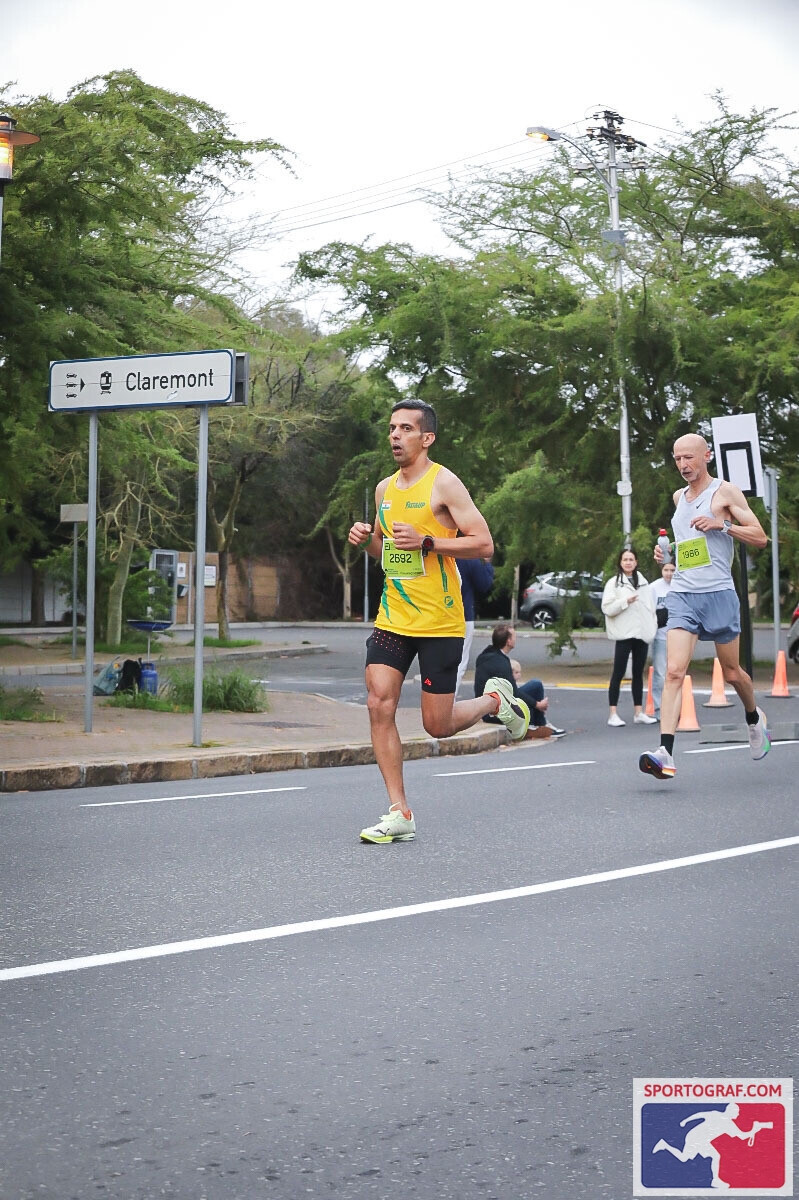
Past Claremont — the suburban stretch where the field thins and the work begins.
Cape Town was a thought-out pick. Three reasons.
First, the 2026 edition was set to be retrospectively confirmed as a World Marathon Major. Second, I had an invite for the World Age Group Marathon Championship. Third, it fell squarely in the summer holidays — a good family trip.
Three good reasons.
Coming off New York in November ‘25 and Mumbai in January ‘26, the base was in decent shape. February was deliberately kept low intensity. The plan was to roll into marathon-specific work from March.
Then illness hit. Twice. March became a write-off.
The silver lining was the decision to pull out of TCS 10K on April 26th and go all-in on the marathon from April 1st. That left five weekends for the big sessions — 30K+ long runs and 100K weeks — before taper.
I was hitting the prescribed paces, but not dominating them. The biggest takeaway from this block was learning to conserve — to get through a training cycle in genuinely tough conditions without blowing up.
Taper started three weeks out. I went in believing the hard work was banked; the job now was just converting it on the day. There was a right calf niggle that had shown up a few times post-20K runs — never serious enough to warrant a red-alert physio visit. To make sure it didn’t blow up during the race, I went for a physio treatment on the last Monday. Strength training continued till the last weekend before the race. Massage has been non-negotiable for me — weekly in the final three to four weeks, the last one on the Tuesday before race day.
On the nutrition side, I stayed with my usual supplement stack but added one new variable — beta-alanine, loaded four weeks out. The idea came from digging into bicarbonate buffering and the growing conversation around lactic acid management. Beta-alanine works on similar lines — delays time to exhaustion by helping regulate lactate buildup. Did it make a difference? Honestly cannot say. But I would probably run the experiment again.
Cape Town was planned as a family trip — booked six months out on Ethiopian Airlines, routing through Addis Ababa with an overnight halt taken care of by the airline.
As always, my preference was an Airbnb over a hotel, and we got lucky this time — a place roughly 800 metres from both the start line and the expo, close to the waterfront. It also gives the flexibility of cooking food, which matters when you have specific race-week preferences. Hard to beat that for race week logistics.
The expo was at DHL Green Point Stadium — the venue gave it an aura, but the expo itself felt more like what you would expect from an emerging event than an established Major. Nothing like London or New York in scale or buzz.
Cape Town as a city is something else entirely. The Atlantic on one side, beaches, and then the mountains sitting right there like they are not supposed to be that close. It gives the place a rare sense of completeness. But that same geography means the weather does whatever it wants. Wind, rain, sun — sometimes all three in the same afternoon. A weekend before the race there was a massive storm with winds around 100 kph.
Weather is going to be one of the defining variables for this race in the years to come, alongside the course terrain.
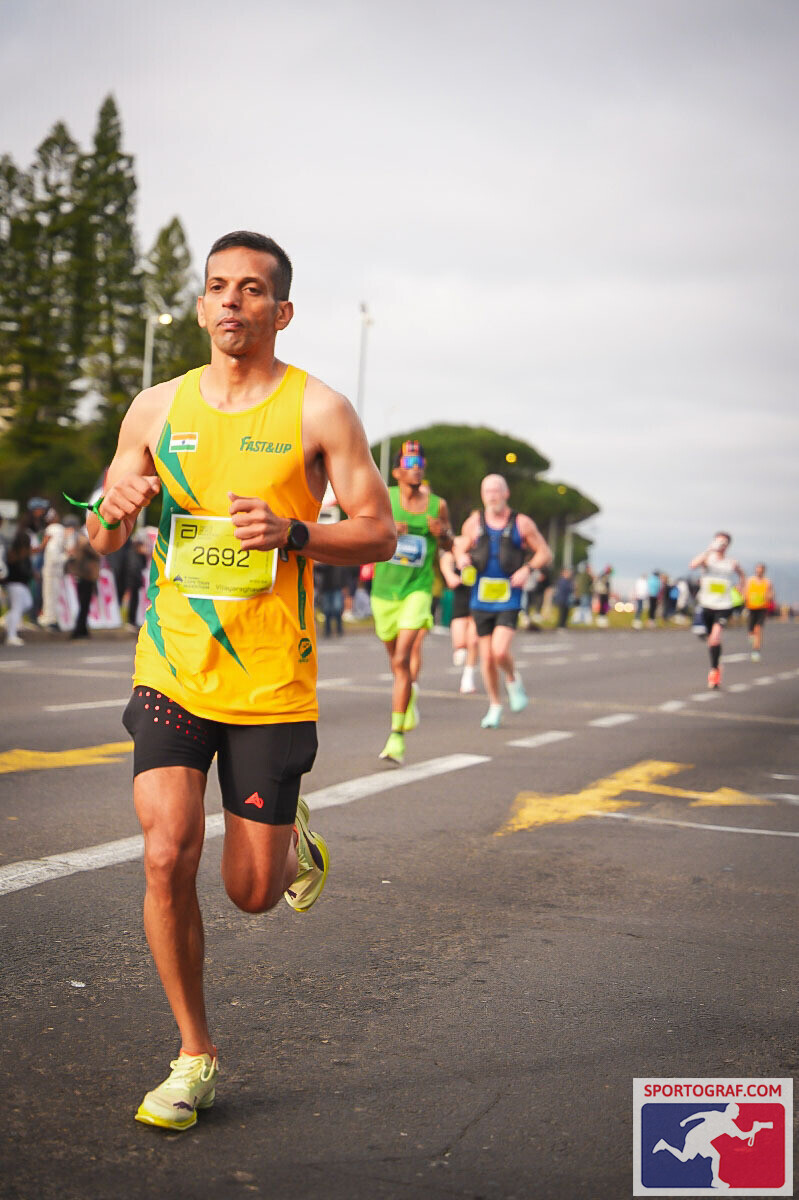
Bib 2692
Weather prediction was about as good as it gets for Cape Town. Temperature around 15°C, dew point matching it almost exactly — the air carrying more moisture than it felt.
My morning started at around 5 AM. Coffee first, then a bowl of rice, dal and potatoes. Before heading out at 6:30 AM, two slices of bread with peanut butter. The night before I had prepped two bottles of Maurten — one 320 mix, one 160 mix. That has become a pre-race routine over the last couple of marathons — no scrambling in the morning.
The plan was to finish the 320 bottle before leaving the Airbnb. Carb math: 80 g from the energy mix, around 50 g from the rice bowl, 30 g from the bread — roughly 160 g before stepping out. The 160 mix was to be finished by the time the gun went off, adding another 40 g.
Total carb load going into the start line: somewhere between 180 and 200 grams.
The age group start was at 8:05 AM from Beach Road, separate from the main field — the elites went off from the stadium. That meant roughly a 2 km walk (sometimes a jog) to the start point. Got there by 7 AM. At 7:30 AM, a quick shot of Fast&Up Activate — two tabs in 75 ml of water.
As the clock ticked toward 8, the energy in the holding area was building. The best in the world at our age, each group in their own section - and I was one of them.
Then the big screen lit up with Kipchoge lining up for his 8 AM start. Huge claps around. The outer layer and head cap came off. Kept the arm warmers on — those could go later. Announcements were nudging everyone to hydrate even if they didn’t feel the need.
Two minutes. The countdown. And we were off.
Over the last three or four marathons I have learnt to keep the strategy simple — a few broad parameters.
4 min/km was the number. I knew exactly how that feels, having practised enough. The other anchor was to go through 30K at or under 1:59 — that would keep me on track for sub-2:50, and if the legs had anything left, a fast final 10K could mean a PR.
The course was a bit of an unknown. Being a relatively new marathon, there was not much out there in terms of runner reviews. A few days before the race I got access to the course analysis from Geeksonfeet, which filled in the blanks on elevation. The course notes were simple enough — a bit of uphill around 6K and 9K, a proper climb at 31K, and rolling terrain throughout. Nothing dramatic on paper, but a good mental map.
Plus the infamous “Loop of Death” that a few reviews had flagged. More on that later.
Train well. Simplify the course. Get on with it.
The pacing clicked early. I latched onto strong age-groupers and moved between them as the race unfolded — whoever was holding the right pace at that moment.
| Segment | Split | Pace (min/km) |
|---|---|---|
| 0–5K | 19:58 | 4:00 |
| 5–10K | 19:54 | 3:59 |
| 10–15K | 19:46 | 3:57 |
| 15–20K | 19:41 | 3:56 |
| 20–25K | 19:30 | 3:54 |
| 25–30K | 19:54 | 3:59 |
| 30–35K | 19:46 | 3:57 |
| 35–40K | 19:42 | 3:56 |
Aid stations were well-placed, though the spread of water, Coke and Powerade with not-so-clear demarcations made it slightly chaotic. I stuck mostly to water plus my own gels and kept it moving.
Nothing eventful through to around 29–30K. The pace was intact, energy levels holding. Hit the hills strong and took advantage of the downhills to recover. Somewhere in the 20–30K stretch I could sense it was going to be a difficult day for a lot of runners — the rolling terrain was taking its toll on people who had not trained specifically for it.
Good to run into Toni Janke around that stretch — he had been at Mumbai 2026 as well. We ran together for a kilometre but he was cramping and knew it was going to be a tough second half. Wished him well and pushed on.
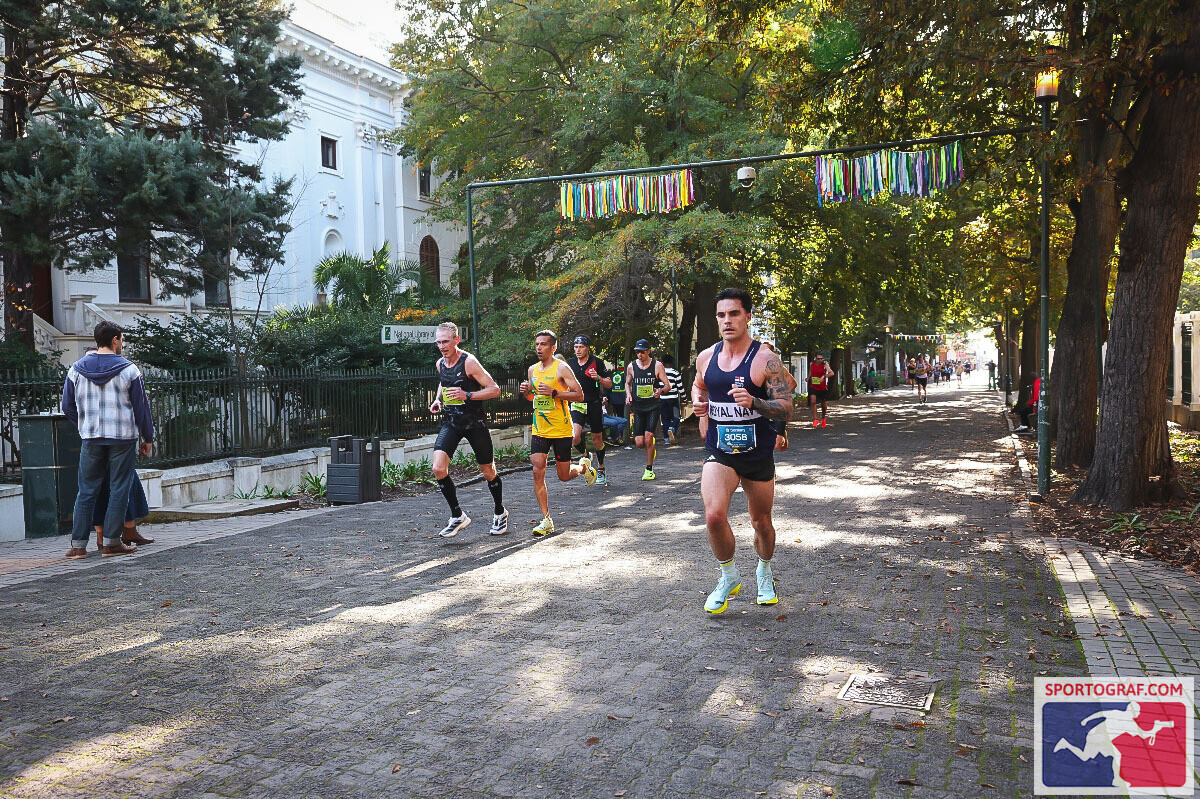
The 32nd kilometre. The steepest of the race. Cobblestones, a church, and a city that came out for it.
The 32nd kilometre was the steepest of the race. A long cobblestoned stretch — almost like a city shortcut carved into the course — with solid crowd support on either side.
If your legs were good, you could carry momentum through it. Mine were. Pace dipped to around 4:02/km but held — and in that moment I was grateful for every uphill repeat I had done at GKVK back in Bangalore.
Turning right, the 33rd kilometre was a nice downhill back onto familiar roads, and my fastest split of the day at 3:49/km. But honestly, it was not the gradient that did it.
There was another 50-year-old right there with me, and we were locked in — step for step, neither giving an inch. Felt like we were racing each other to a podium.
Saw my family for what turned out to be the last time at 36K — and incidentally another one of my faster kilometres. I had spotted them twice before on course, and each time it added something the gels could not.
The Green Point Stadium was visible to the right around here, which on paper feels like you are nearly home.
You are not.
Six kilometres still to go. And that is where the course served up the Loop of Death.
The last five kilometres. A flat, seemingly endless stretch running right alongside the beach — sun overhead, wind doing whatever it wanted, and the finish line nowhere in sight.
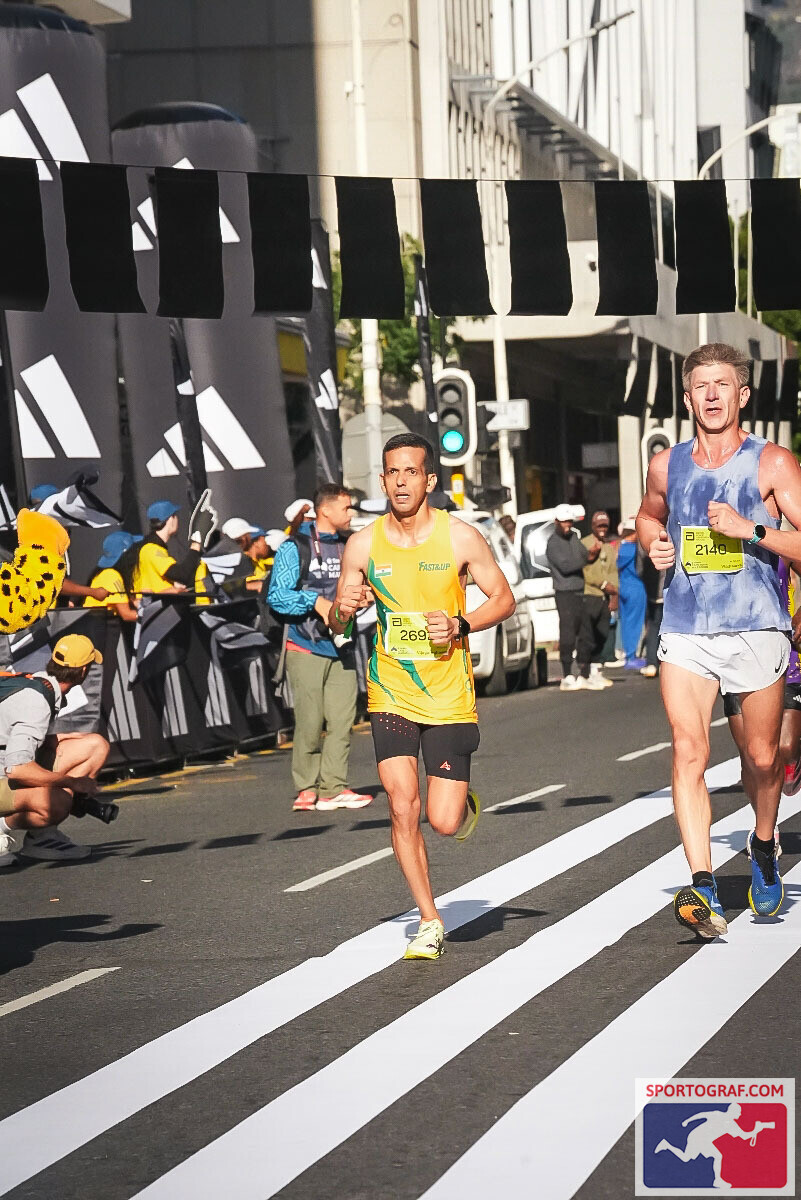
Through the last arch.
The mind started throwing some questions here. I fought to keep the pace at something respectable. Took some Coke and Red Bull through the last four kilometres — whatever it took. In the final two kilometres the pace slipped, but by then I had a rough sense of where I stood.
A PR was on the table if I held it together.
Last 300 metres. One last cheer from my family.
Finished with form.
2:47:17.
| Hour | Plan | Carbs |
|---|---|---|
| Pre-start | Rice bowl + bread + Maurten 320 + 160 mix | 180–200 g |
| Hour 1 (from 20 min) | Maurten 160 + Fast&Up Gel | ~65 g |
| Hour 2 | Maurten 160 + Fast&Up Gel | ~65 g |
| Hour 3 | Maurten 160 Missed a gel — appetite gone | ~45 g |
| Closing 4K | Coke + Red Bull from aid stations | top-ups |
Missing a gel in the final hour is not unusual late in a race, but I knew I was leaving carbs on the table. Drink mixes honestly do a better job at that stage — they go down easier when your stomach is done with solids. However you’ll need someone to hand it over — not always a given, especially for recreational runners doing it on their own.
But in essence I had done my fuelling far better for this race — pre and during — and I know I can do it even better in future with a few modifications.
Post-race routine was the usual: the medal, some things to eat. What we missed here was probably a nice towel or something to cover oneself with.
The Age Group participants had a separate enclosure and hospitality section, which had photo booths and refreshments in abundance. However, bag collection turned out to be a bit of a mess — almost 30 minutes. That should be taken care of in future, since it was an issue of having no process in place.
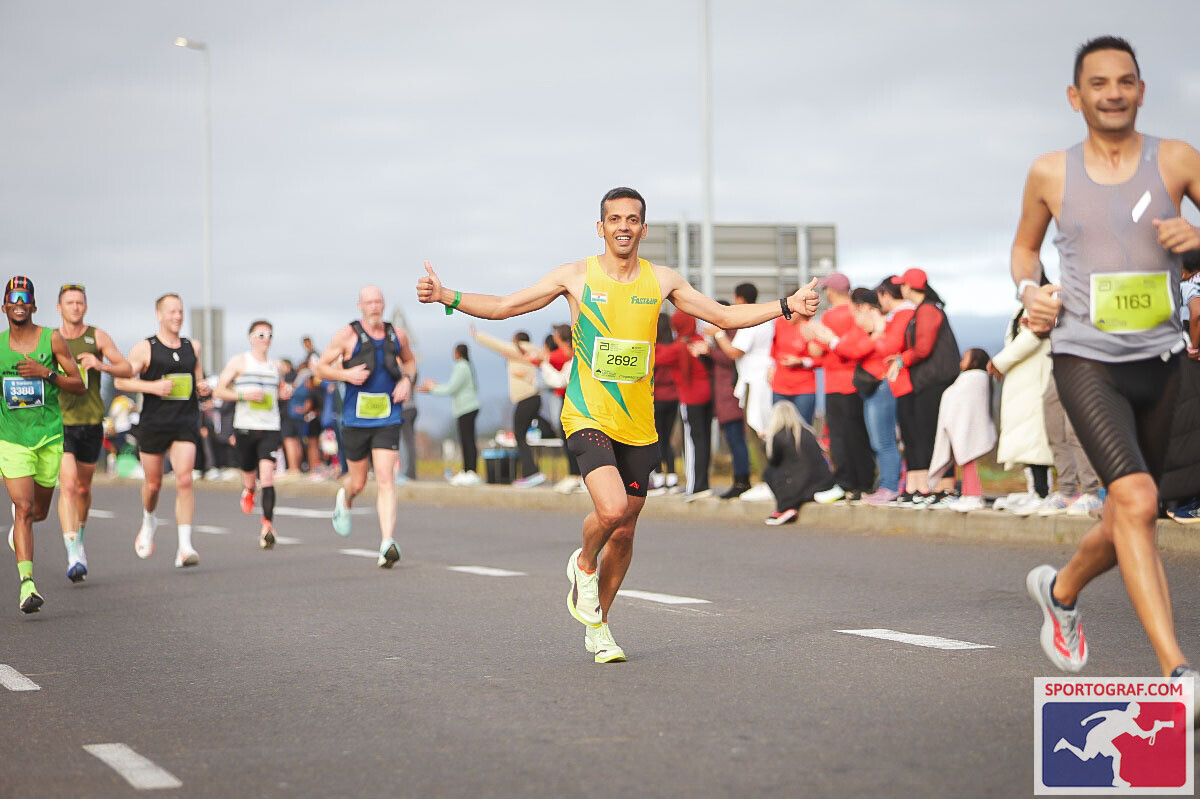
Joy index, peaking.
Cape Town ranks among my most enjoyable marathons. The diversity, the culture, the history of the country and the city all add a dimension that a pure race cannot manufacture. The personal best was, of course, the icing.
Crowd support was strong for most of the course — the highway stretches were the exception, as they tend to be everywhere.
Next big goal is Sydney 2027. It is a deliberate gap. From London in April 2025 to Cape Town in May 2026, I have raced four goal marathons in 14 months — something I have not done before. (2:47, 2:47, 2:50, 2:47.) The body has earned some time off. There may be some intermediate goals from December 2026 onwards and I need to finalise those.
But if this stretch of racing has reinforced anything, it is that limits exist to be stretched. My global peers in the Masters category are proof enough of what is possible — and that is motivation enough to be at it.

