

Anand runs 1:31:55 at the Wipro Bengaluru Half Marathon 2026, his first half since a tendon injury. He finished almost a minute inside his target, and the fast finish showed he had held back too much through the middle.

I went into the Bengaluru Half as a checkpoint: an honest read of where I stand as I build towards a full marathon early next year. It was also my first half marathon since Mumbai in January 2025. Minor patellar tendonitis kept me out for a good part of last year, so just reaching the start line healthy felt like a milestone.
My mileage in the 8–10 weeks before the race averaged around 70 km a week, but that average hides the swings. Business travel took up much of the block: 30–40 km in travel weeks, a few days lost to time-zone changes, then 80–90 km back home. The real risk is the rebound: jumping from a light travel week into a big one is the kind of load spike that often comes before an injury, especially with a tendon history like mine. So I ease back in over a week, and I skip a hard session when my HRV is down or jet lag has cut into my sleep.
Each week had two quality sessions. Midweek I rotated between fartlek, intervals, ladders and tempo, to work the different gears a half marathon asks for. The second was a long run with faster segments built in, which is where I learn to hold pace on tired legs. Everything else was easy Zone 2 running.
Strength and conditioning at Peak Performance, along with regular sessions with my physio, have been central to my comeback. For a runner returning from tendonitis, gradually loading the tendon is the rehab itself.
For the taper, I dropped to 30–40 km in race week, roughly half my usual volume, but kept one short tempo/fartlek on Wednesday. Cutting volume sheds fatigue, and keeping a little intensity keeps the legs sharp.
I collected my bib at the expo on Friday. The corral field on my bib was blank, and at the enquiry counter nearly everyone was being placed in Corral A. I saw just one person given B. The start was clearly going to be crowded, so I accepted in advance that my first kilometre would be slower. With India’s amateur running scene growing so quickly, it may be time for organisers to split Corral A into two or three pace-based corrals.
On Saturday I did a light 40-minute resistance priming session at Peak Performance: enough to wake the muscles up, nowhere near enough to tire them. Research on priming, mostly from power sports, suggests it sharpens how the nervous system recruits muscle. In my experience it leaves me feeling springier and more powerful on race day, and it did again this time.
Food in the final days was built around rice. It’s high in carbohydrate, low in fibre and easy on my stomach. I also avoid wheat and gluten close to a race; it’s a personal preference that keeps my stomach light.
Sleep was the usual pre-race compromise: lights out around 9:30 pm, after some careful negotiation with my son to let me sleep early, and the alarm at 3 am, so about five and a half hours. An afternoon nap on Saturday helped.
Breakfast at 3 am was curd rice with a little honey, a banana and a small coffee. I finished eating two to two and a half hours before the start so my stomach could settle. Rice and honey are a deliberate pairing: glucose and fructose are absorbed through different routes in the gut, the same principle behind dual-source gels. I kept the coffee small because a caffeinated gel was coming just before the start, and I sipped electrolytes on the way there.
I took a cab to UB City and used the restroom there, a good call given the long toilet queues near the track. After a short warm-up, I entered the corral 10–15 minutes before the start. Corral A was packed. I edged forward to about 20 metres behind the line, took my gel and waited. I wasn’t nervous. I tend to tune out the music and noise at the start, and my mind was on the plan.
I settled on 4:24/km, somewhere between my good day and my bad day, to be adjusted by feel. Hold pace through 10 km and stay on the conservative side. Protect time through km 10–14, which the route preview had flagged as the toughest stretch. Then treat the last 5 km as a race.
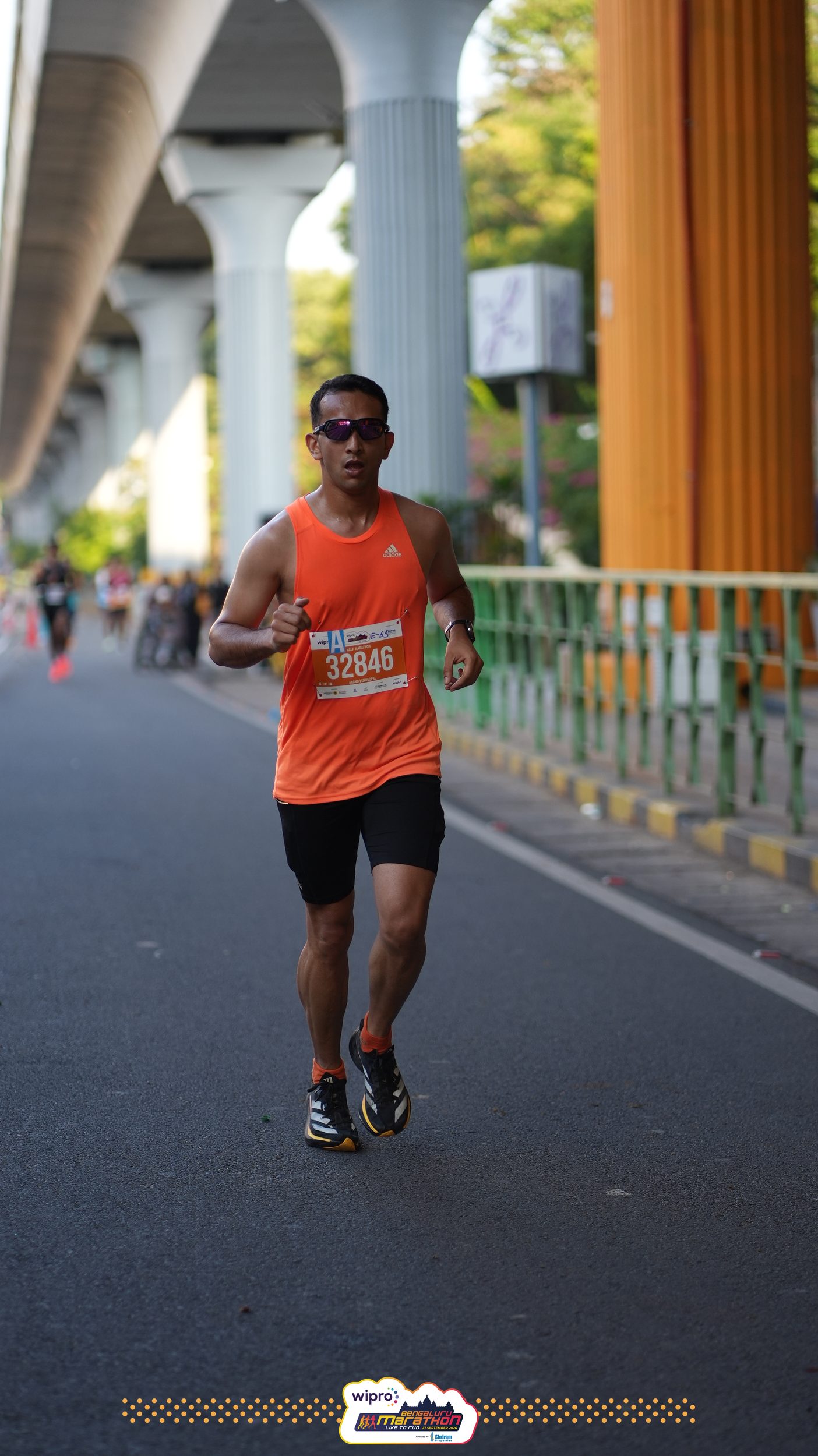
Under the metro line.
The exit from Kanteerava is a turn and a slight climb through a narrow stretch packed with runners, so the first kilometre was chaotic. Once we cleared the stadium I found some space and went through the first two kilometres in 4:20 and 4:19. It felt easy, which is exactly why I didn’t trust it. Early in a race, adrenaline hides the cost of your pace, and heart rate and lactate take several minutes to catch up. I held myself back and took the climb towards Vidhana Soudha in 4:25.
From km 4 to 10 I settled at around 4:20, took a gel near km 6 and drank water just once. At speed, it’s hard to tell a cup of water from a cup of electrolyte when both of them are kept so close to each other at the water stations.
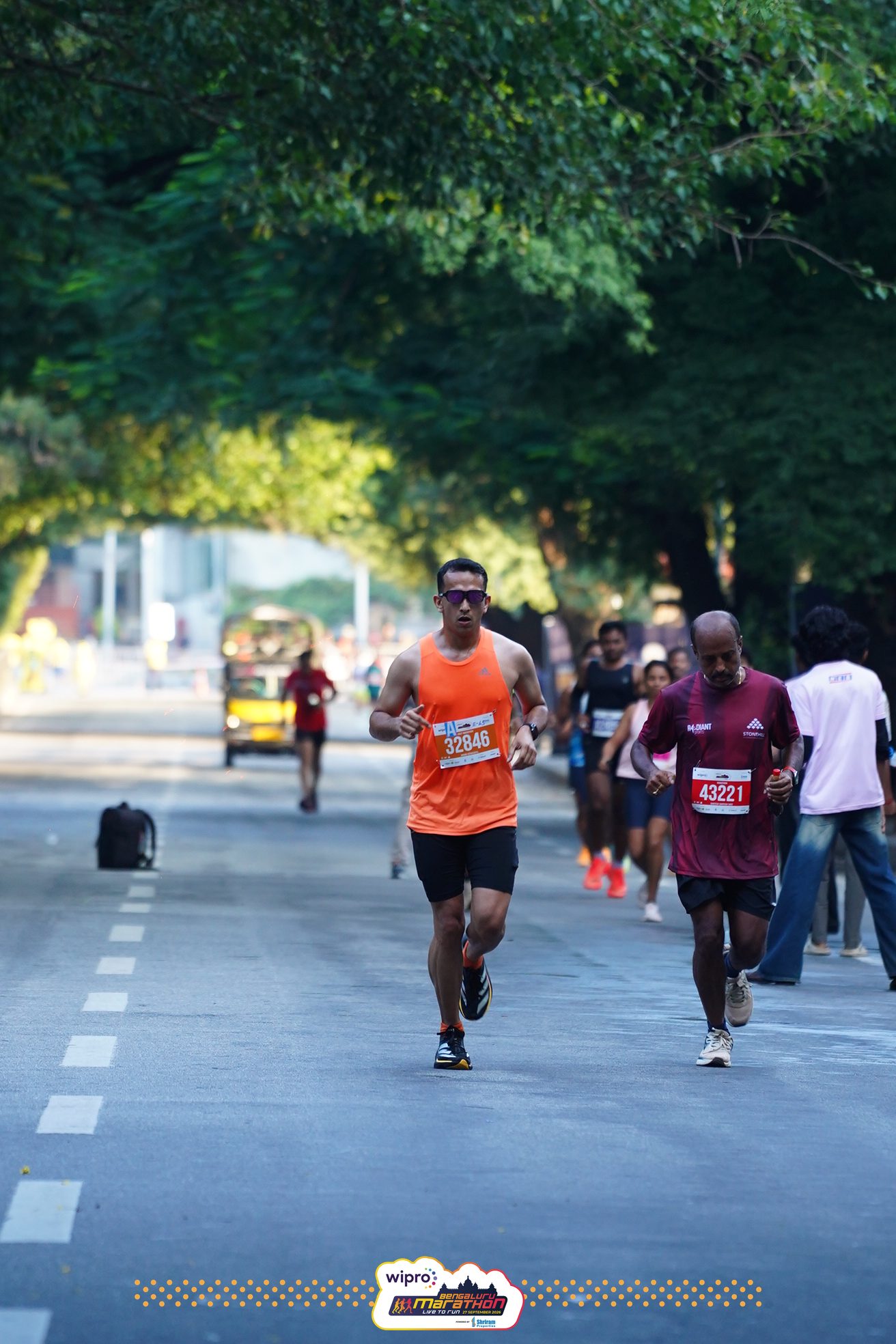
Under the canopy, with the field spread out.
Then came the stretch I’d been bracing for. I took my second gel around this time. Going into km 11 till km 14, I was deliberately mindful of my effort, averaging a pace around 4:30. Looking back, this was the mistake of the day. The stretch was far less demanding than I’d prepared for, and those four kilometres cost me around 40 seconds. My heart rate barely moved through that stretch, holding at the same level as the first 10 km even on the climbs. I wasn’t really slowing my effort. I was refusing to raise it, when my legs were telling me I could.
My pace returned almost immediately at km 15, but my rhythm didn’t. Through the rolling section the running felt laboured, heavier than the numbers on my watch suggested. It wasn’t until the middle of km 19, inside Cubbon Park, that I found my stride again. Easing off isn’t free: once you break your rhythm, getting it back can take kilometres.
From outside Vidhana Soudha, with the downhill in front of me, I finally let go: 4:13 for km 20, then 3:57 for the last. I crossed the line in 1:31:55, almost a minute inside my target of about 1:32:50. I still had good legs over that last kilometre, and more.
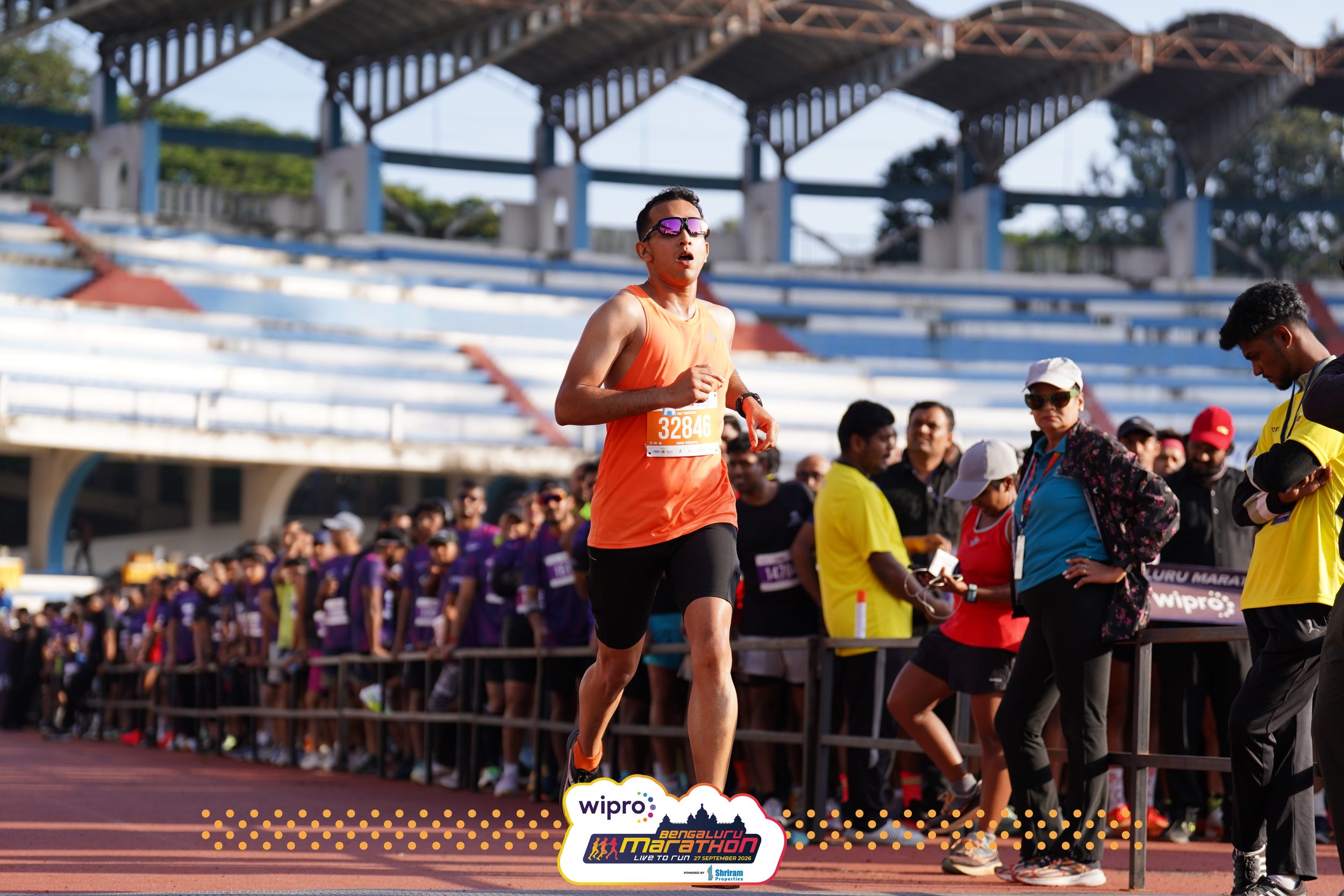
Into Kanteerava for the finish.
The last 500 metres were the most fun I’ve had in a race in a long time, passing runners who were fading and finishing strong. After an all-out half, I usually just want to sit down. This time I took a few breaths and felt fine. The finish area was smooth, and I had my medal, refreshments and bag before the crowds built up.
Later that day I noticed a small swelling in the arch of my foot. Ice settled it within 24 hours. The small muscles of the foot arch are easy to neglect, so targeted foot and calf strength work is going into my routine.
I’m really happy with the result. Every race this year has been a step forward, and this one confirmed the progress is real.
Two things will stay with me. The first is how much the last 72 hours shape the race itself. This time I took them seriously: food I trust, sleep, the priming session, a hydration plan, and having thought through the whole morning from the cab ride to the corral. So much race-day stress comes from decisions that could have been made the day before.
The second is about pace. Sports scientists describe a pace ceiling, called critical speed. Below it, you can run for a long time. Above it, you draw on a small, fixed reserve, and every surge, climb or weave through traffic uses some of it. Half marathon pace sits a little below that ceiling, so the reserve is meant to be saved for the finish. The real question is how close to the ceiling you run before then, and my kick told me I’d had room to run nearer to it through the middle. What would have helped most is a clearer sense of my threshold pace.
Next up is a mix of 10Ks and half marathons over the coming months, all building towards a full marathon early next year.
The half marathon punishes going out too fast, but it also quietly punishes holding back too much, and the second is much easier to miss. Next time, I’ll plan the first 10 km carefully, then be brave with the last 10.

