

Vineet runs 3:14:43 at the Wipro Bengaluru Marathon 2026 as a training run for a 100-miler in December, with a slightly positive split, no taper, and 21 km the day before.

Duration: 12 weeks of logged training (2 July – 26 September 2026), as part of my ongoing build-up for a 100-miler. This marathon was a training run, not a goal race.
Volume: 1,317.5 km in 77 runs over 65 run days: about 120.7 hours and 5,803 m of elevation gain. My weekly target was 100 km, and my peak week was 131 km.
Method: A mileage-focused build with 5–7 run days a week, mostly steady aerobic running, and a long run every Saturday of 25–42 km.
| Distance | Runs | Total km | Avg pace |
|---|---|---|---|
| Under 10 km | 15 | 81 | 5:24 /km |
| 10–20 km | 37 | 542 | 5:30 /km |
| 20–30 km | 15 | 319 | 5:26 /km |
| 30–40 km | 6 | 206 | 5:44 /km |
| 40 km+ | 4 | 169 | 5:22 /km* |
* Includes the NMDC Hyderabad Marathon (30 August, 3:22:25 watch time). The other 42 km runs were on 18 July, 1 August and 12 September.
There were no structured interval sessions. The faster work was continuous tempo-style running:
There was no dedicated taper, since this was a training run. On the day before the race, I ran 21 km at 5:22/km to stay on track for my 100 km weekly target.
Strength sessions focused on building resilience, 2–3 days a week.
This was a local race for me. A dear friend collected my bib, so I skipped the expo.
I woke up at 1:50 am and was ready by 2:25 am. A running friend, Rajiv, gave me a ride to the start.
I ran 500m warm-up jog before the start. I was standing a little way back from the start line, so the first kilometre was slow (5:04/km) while I worked my way through the crowd. My heart rate for that kilometre averaged only 121 bpm.
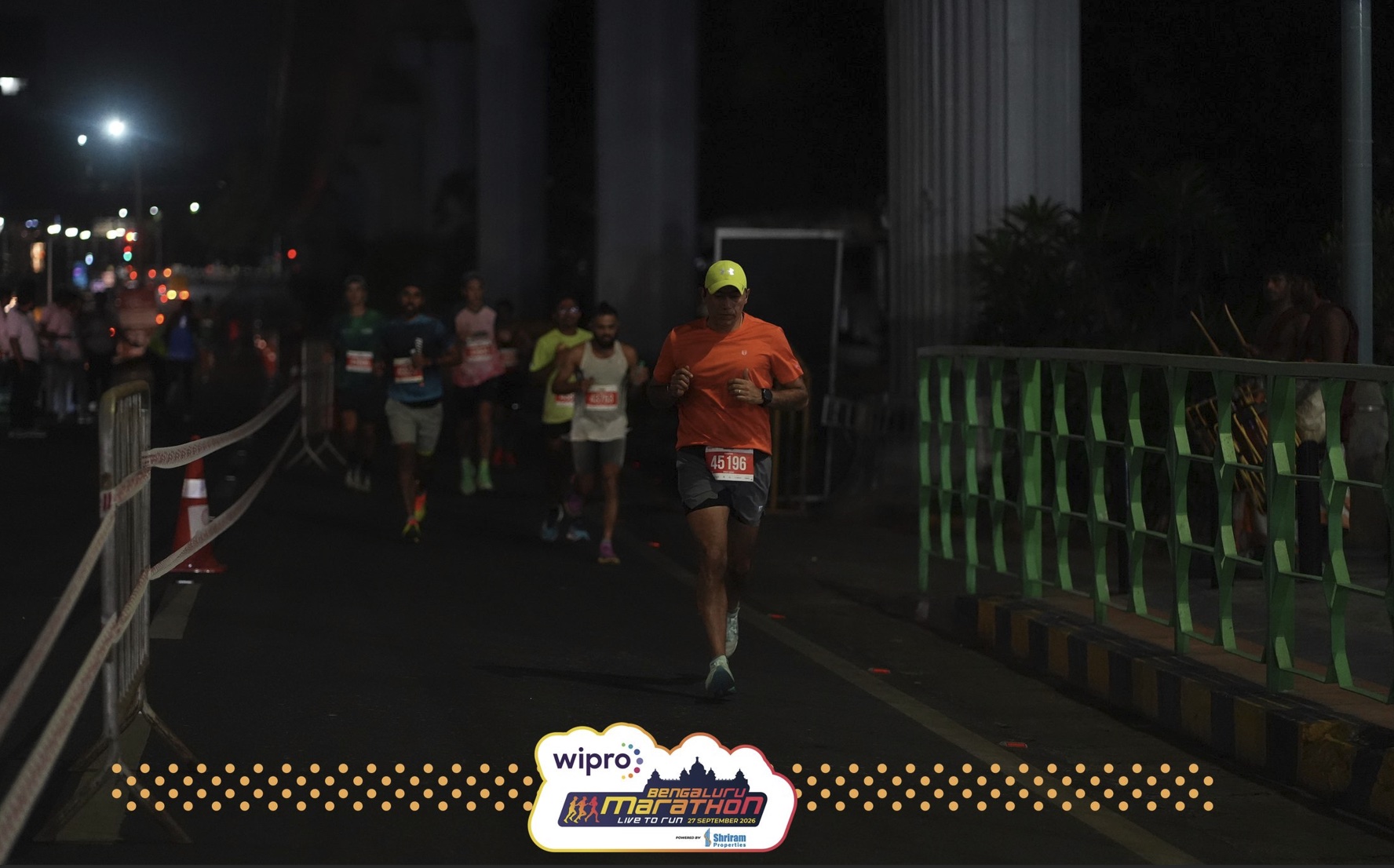
Most of the race was run in the dark.
Pacing: I ran a slightly positive split: 1:36:33 for the first half and 1:38:13 for the second. From km 2 onwards I held 4:29–4:45/km. After the crowded first kilometre, my slowest kilometres (km 3, 24 and 40) were the ones with 10–14 m of climbing. My fastest were km 21 (4:20) and km 42 (4:22).
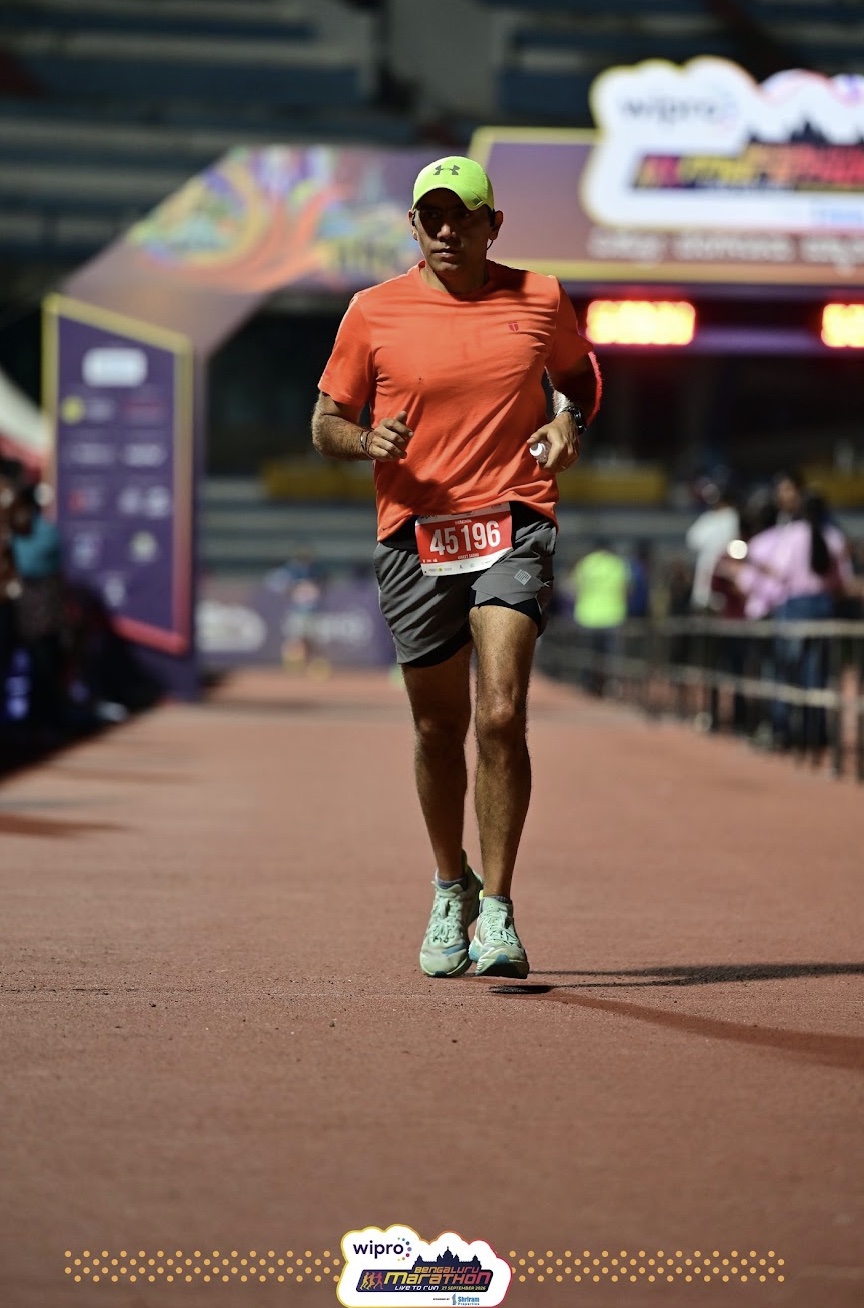
Back on the Kanteerava track, start of second loop.
Fuelling and hydration: Two Fast&Up gels at km 12 and km 22, one small banana from an aid station, and water sipped at aid stations as needed. Garmin estimated about 3.2 litres of sweat loss.
Heart rate and form: My heart rate climbed from the mid-150s to the mid-170s while my pace stayed flat. Cadence averaged 187 spm and rose to 188–190 spm in the last 10 km.
Shoes: Puma Deviate Nitro Elite 3.
| Section | Time | Avg pace | Avg HR |
|---|---|---|---|
| km 1–10 | 46:16 | 4:38 /km | 153 |
| km 11–20 | 45:57 | 4:36 /km | 165 |
| km 21–30 | 46:25 | 4:38 /km | 166 |
| km 31–finish (12.29 km) | 56:08 | 4:35 /km | 174 |
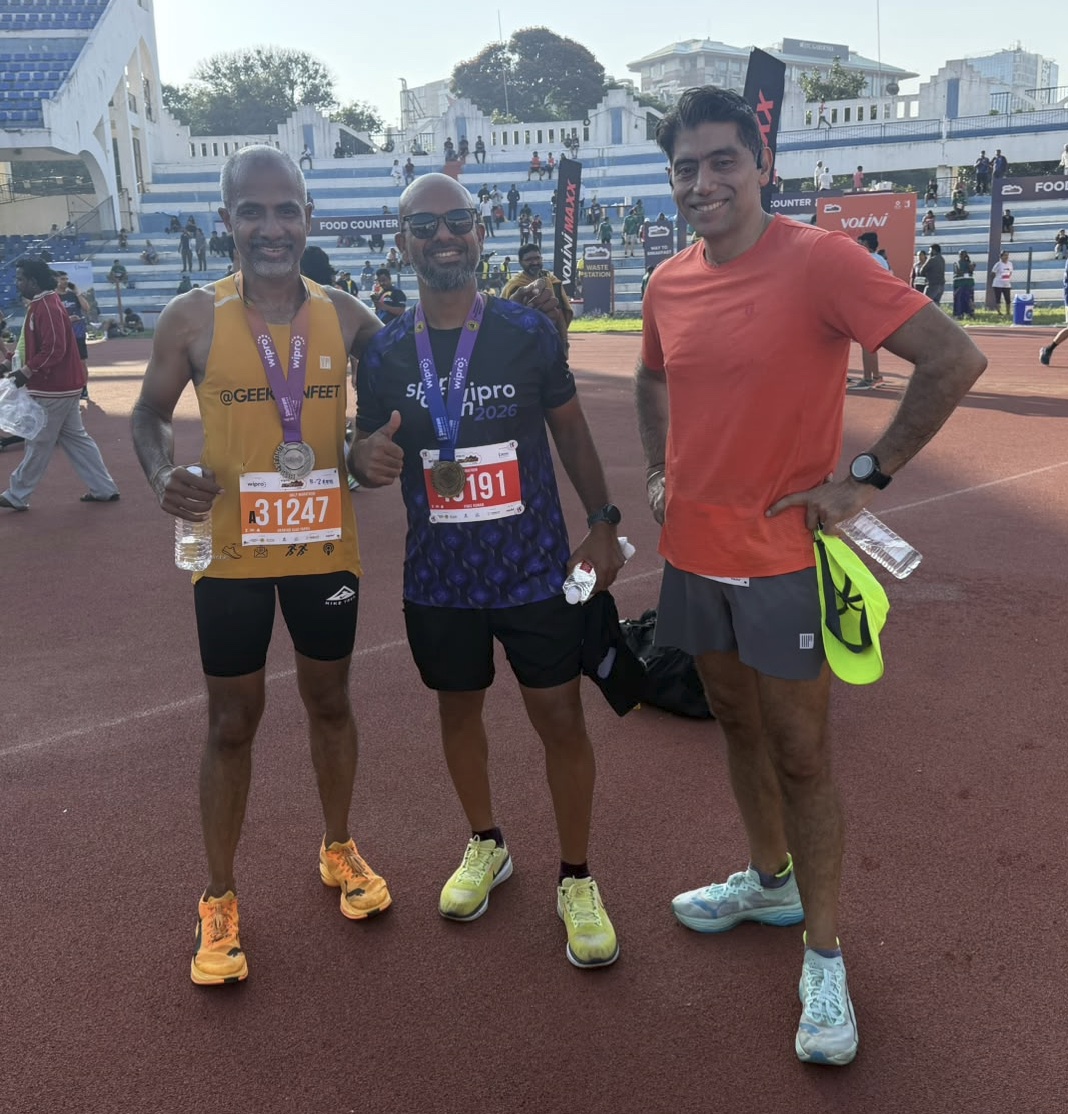
Meeting friends on the track after the finish.
I finished feeling good, as if I still had fuel left for a couple more kilometres. I stayed on after the race, meeting and greeting other runners. I was back running the next day, with 13 km in the morning and 6 km in the evening.
Consistent mileage combined with strength training takes the fear of the distance out of you. At no point did I think about dropping out, and I had no cramps. In fact, I felt throughout the race that I could pick up the pace (remember, it was a training run 🙂). Regular long runs, both easy and close to goal pace, build the confidence to finish strong.
Race morning went smoothly. The stadium track at the start wasn’t overcrowded, and the organisers had arranged a pre-race warm-up. With a 3:50 am start, I ran most of the race in the dark. Apart from a few uneven humps and U-turns, the route was smooth. Most aid stations were well staffed, while a few were self-service, with filled glasses left on the counter. My strategy of starting steady and then overtaking runners through the middle of the race worked well.
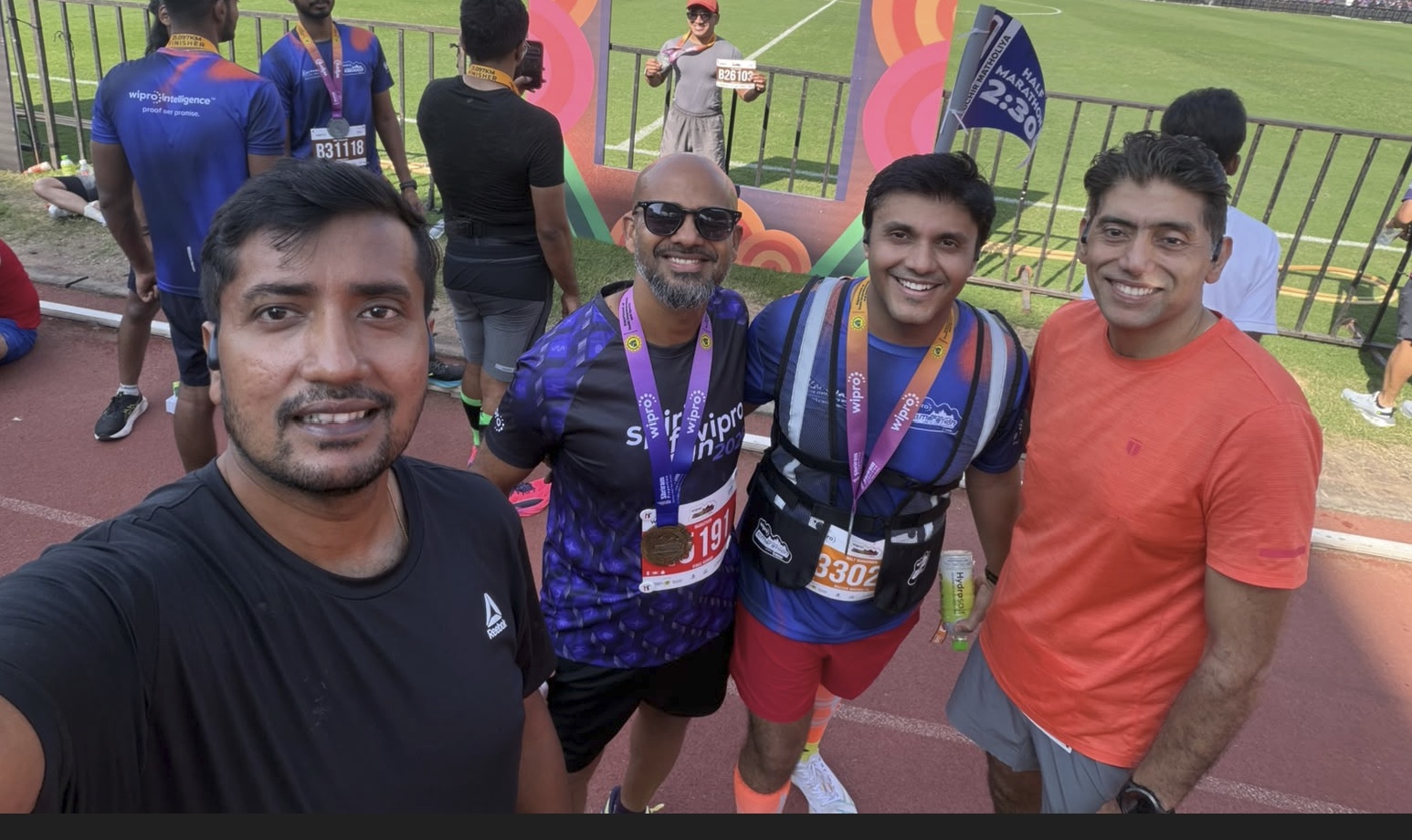
Post-race selfie at Kanteerava.
I’ll continue a similar training cycle through October and November: 100+ km a week, with a few peak weeks of 150+ km. Next up is The Border Ultra 100-miler on 19 December 2026.

