
At the top of the world, don't forget you need to come back down. A 2:55 marathon in Delhi, a 38:08 10K PB, then a bone-stress injury — Oliver Jones on the 72 km Khardung La Challenge 2026, and a descent that proved harder than the climb.

A 2:55 marathon in Delhi and a 38:08 PB at TCS 10K had given me a good start to the season. Then a bone-stress injury interrupted the next block. Khardung La stayed on the calendar, but getting to its 72km start line would take patience.
A 3:46 at the previous Ladakh Marathon gave me some confidence at altitude, but climbing a 5,370m pass before descending another 40 km was completely unknown territory.
On race day we took the bus from Leh to Khardung Village, slept for a few hours and lined up at 3 a.m., a few degrees above freezing.
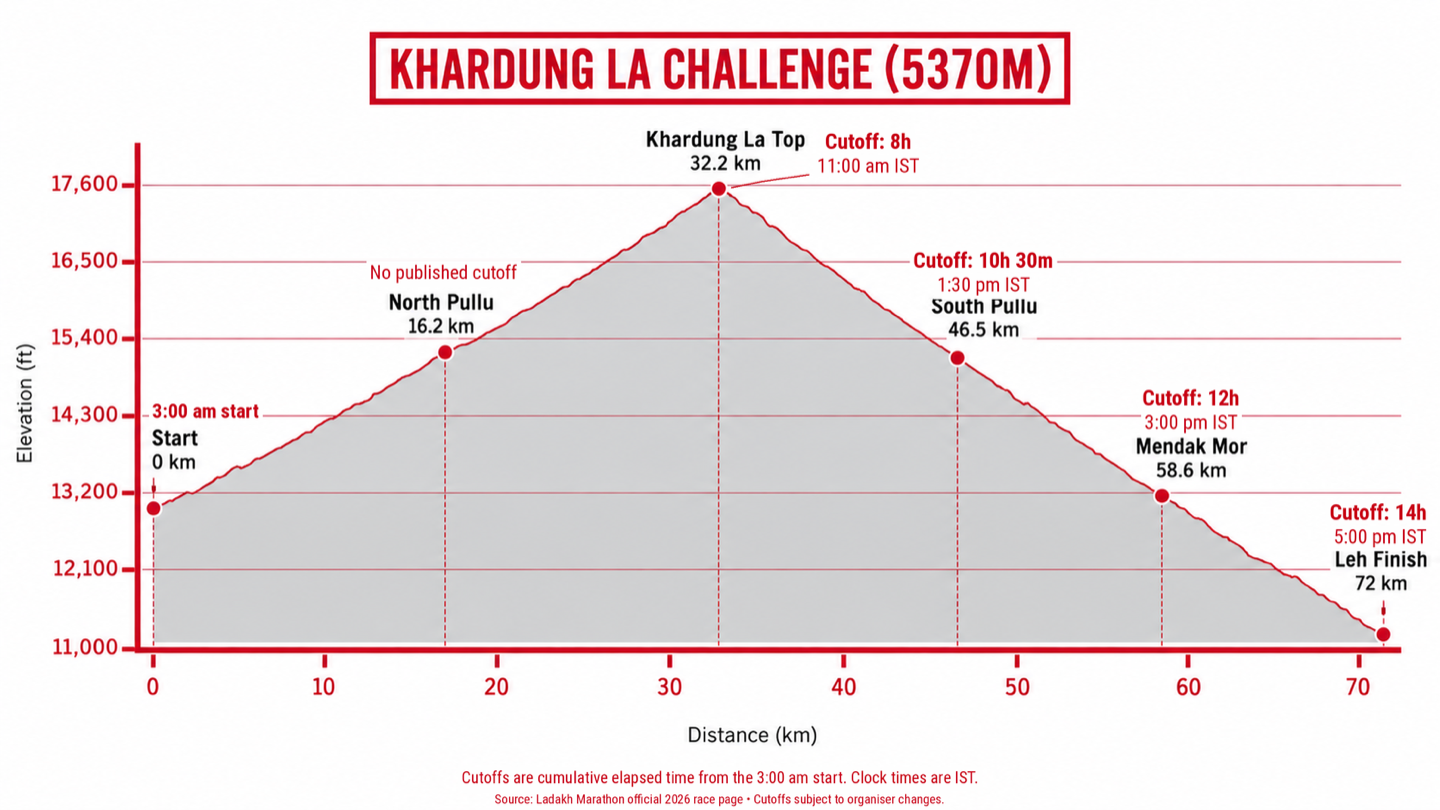
Previous finishers' splits and a course simulation suggested sub-8h was worth attempting. The exclusive eight-hour finisher’s jacket helped too.
I finished in 8:14:17, 14th in the men’s field. The climb went to plan, but I couldn’t hold the pace on the descent.
| Detail | 2026 race |
|---|---|
| Date | 11 September 2026 |
| Distance | 72 km |
| Start | Khardung Village, 3:00 a.m. |
| Start altitude | Approximately 3,975 m |
| High point | Khardung La, approximately 5,370 m, at 32.2 km |
| Finish | Leh, approximately 3,500 m |
| A goal | Sub-8 hours |
| Summit target | 4:20:00 |
| Summit time | 4:16:49 |
| Finish time | 8:14:17 |
| Finish target | 8:00:00 |
| Official average pace | 6:52/km |
| Shoe | Nike Vomero Premium (one pair for the full race) |
| Base kit | Singlet and arm warmers |
| Hydration vest | Running Vest |
| Warm layer | Merino base-layer |
| Shell / gloves | Thin gloves & ultralight wind-cheater |
| Poles | None |
| Bib / rank | 7002 / 14th in the men’s field |
An MRI showed stress changes in my left pubic bone, ending my 10K season. My physio cleared longer rides and advised rebuilding running over about two months.
For Delhi I had been running 85–100 km a week. Swimming, cycling and strength now made up more of my training. My longest standalone run before travel was 22.3 km. I rebuilt from a week without running in June to 67.7 km in the week beginning 17 August.
From 20 July to 23 August I recorded 294.1 km of running, 16.4 hours cycling, 13.3 hours swimming and 18 strength sessions, 68.3 hours in total. The aim was to support the pelvis, hips and legs as running returned.
I also used hypoxic swim sets, breathing every four or five strokes, to rehearse exertion in thin air. I felt they helped me normalise the discomfort, but they were no substitute for real acclimatisation.
I kept some hills and longer runs in the build:
For kicks, I also completed an Olympic-distance triathlon in 2:23 before flying to Leh.
Swimming and cycling had helped keep me fit. Whether my legs could handle nearly 40 km of downhill was the bigger question.
I arrived in Leh on 30 August, 12 days before the race. Guidance advised 15 days. Registration required 10. I met the minimum, but had less time than recommended.
In six days I ran 81 km while learning the course, including the 30.4-km simulation, plus some walking and hiking to break up the intensity. That was more than intended so close to race day, but running in Leh was a pleasure.
HRV stayed below pre-travel levels. Resting heart rate was broadly stable and sleep improved. Garmin’s acute-load estimate fell from 1,688 after the simulation to 597 before the race. On the last night I recorded only 3.7 hours of sleep, with a score of 42.
My watch displayed 75% acclimatisation, but sleep, appetite, symptoms and how easy runs felt mattered more. In hindsight, I would have valued more time at altitude over another training session. Next year I may move to a higher base in the second week to better adapt.
The most valuable pre-race session came on 5 September, six days before the event: from Khardung La down to North Pullu, then back to the pass.
The simulation was 30.4 km in about 3:39: down 15.27 km at 4:57/km, then back up 15.13 km at 9:27/km.
The road was no longer a line on a profile. I knew where the climb changed, where the descent began and where the markers sat.
I pushed the downhill and took only one gel. Arriving fresher and better fuelled on race day made 4:20 to the summit seem possible. Knowing the road and markers also helped me plan my effort.
My race ascent from North Pullu was about 1:15/km quicker. Acclimatisation, fuelling, freshness and race effort may all have helped.
That was my last proper run. I rested on 6 and 7 September, ran a 4.3-km shakeout on 8 September, then rested through briefing and transport.
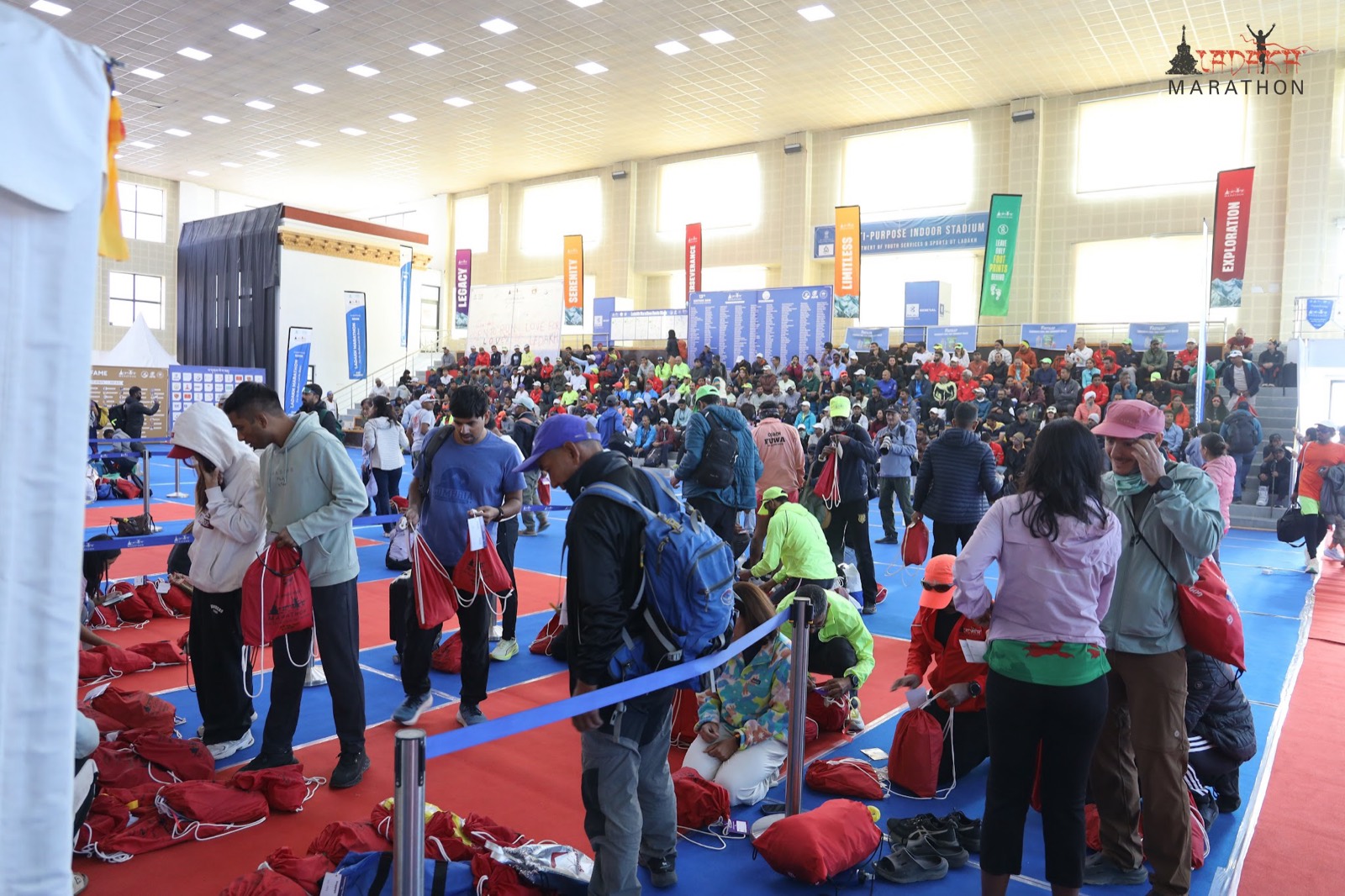
I loaded a kilometre-by-kilometre Garmin plan adjusted for gradient, with paces in the notes rather than as bands. That avoided eight hours of being told off by my watch.
The plan was simple:
The rules required a hydration pack. I used a Salomon vest with one 500 ml bottle, refilling roughly every 5 km.
I chose Nike Vomero Premium for comfort over 72 km and left the poles behind.
I started in a singlet, arm warmers, merino base layer and ultralight windcheater. Thin gloves, a cap, tube scarf and running tights completed the kit.
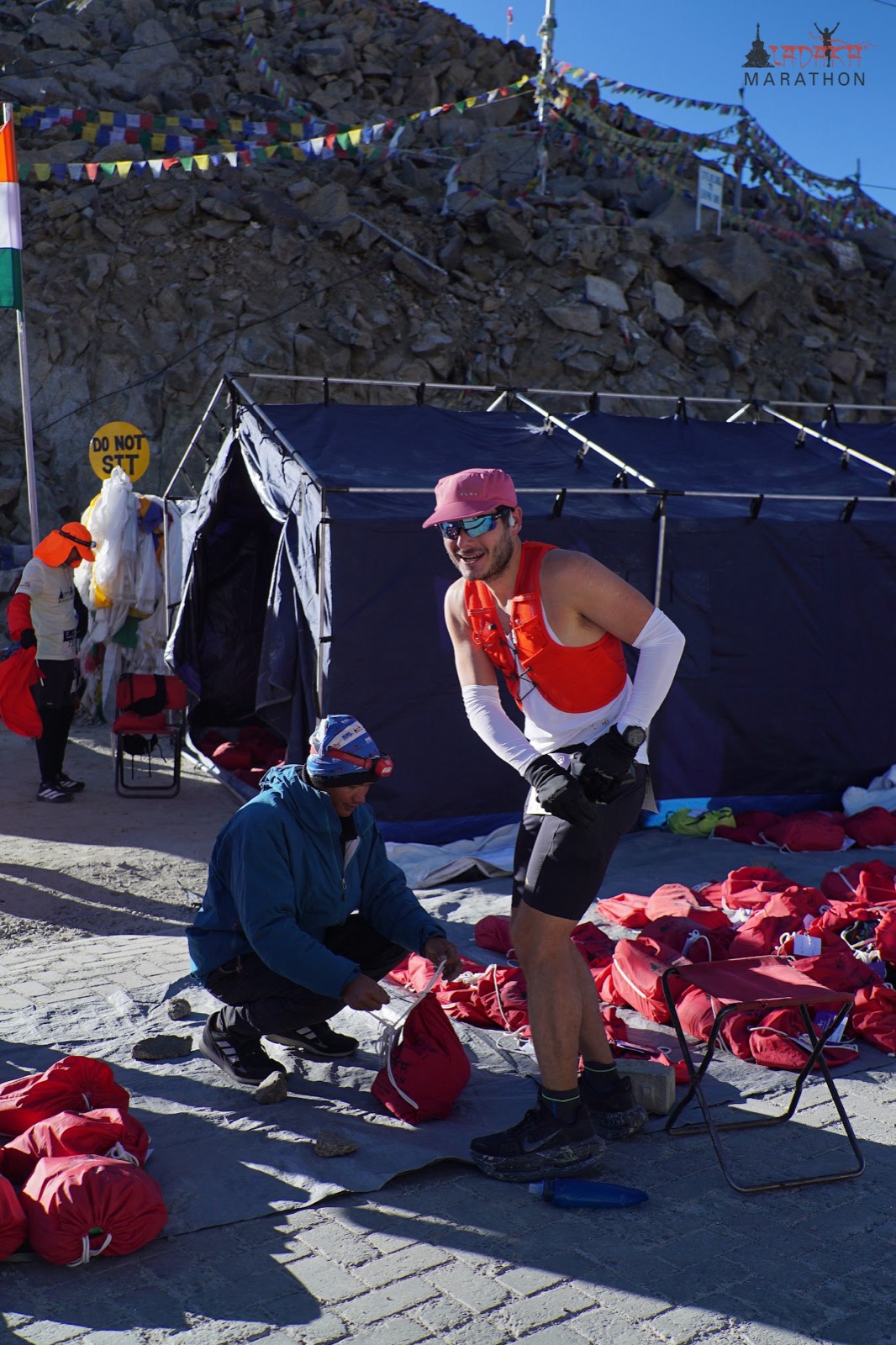
I learned that accidentally removing a timing bib at a station was a common DNF scenario, so bib 7002 went on the front and back of my tights, clear of removable layers. At Ktop I dropped the windcheater, merino and empty bottle, then picked up a pre-filled carb bottle.
I practised that sequence with gloves on.
The final checkpoint schedule was:
| Checkpoint | Eight-hour plan | Actual | Position versus plan |
|---|---|---|---|
| 16.2 km | 1:57:27* | 2:05:31 | 8:04 behind |
| Khardung La, 32.2 km | 4:20:00 | 4:16:49 | 3:11 ahead |
| South Pullu, 46.5 km | 5:51:20 | 5:41:53 | 9:27 ahead |
| Mendak Mor, 58.6 km | 6:53:22 | 6:55:55 | 2:33 behind |
| Leh, 72 km | 8:00:00 | 8:14:17 | 14:17 behind |
*The 16.2 km target is interpolated from the kilometre-by-kilometre plan.
I kept the opening controlled and reached North Pullu in 2:05:31, eight minutes behind plan.
It was tempting to chase the deficit, but the simulation had taught me the value of arriving fresh for the upper climb. I let the pace come to me.
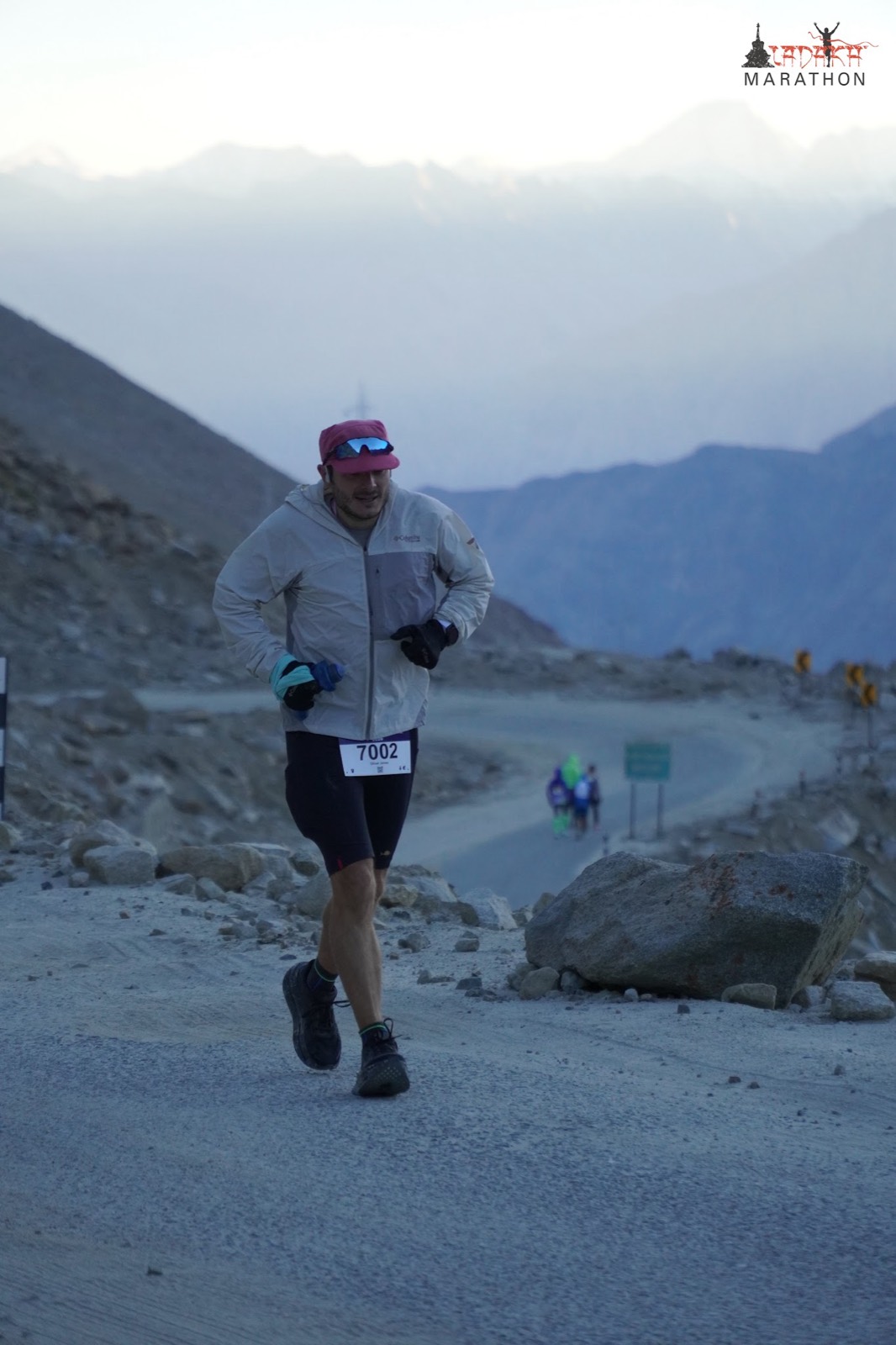
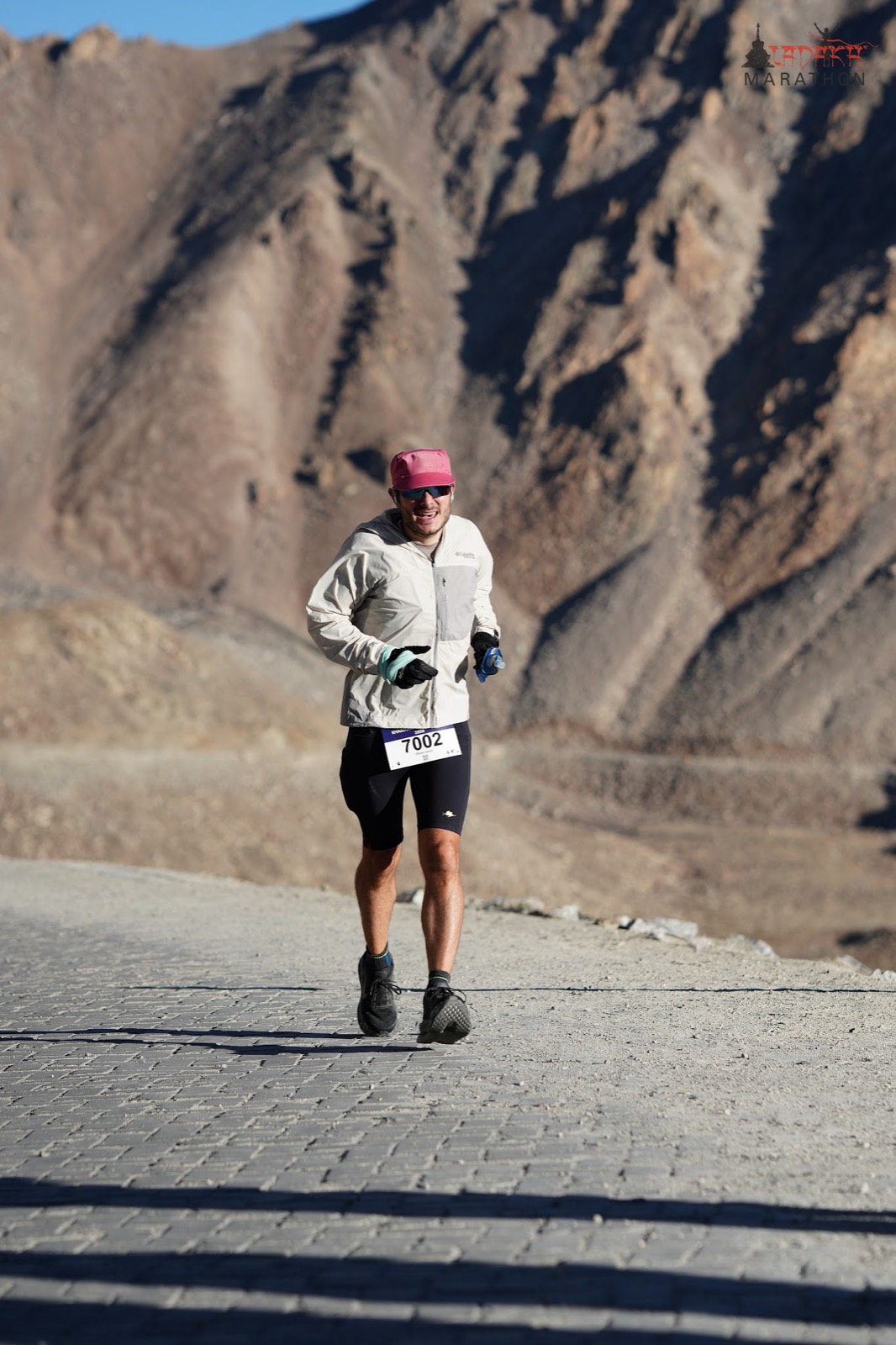
The steeper 16 km took 2:11:18 at 8:12/km, over 11 minutes faster than planned. The air was thinner, but I was making up ground.
I reached Ktop in 4:16:49, three minutes ahead of target. The cautious opening had paid off.
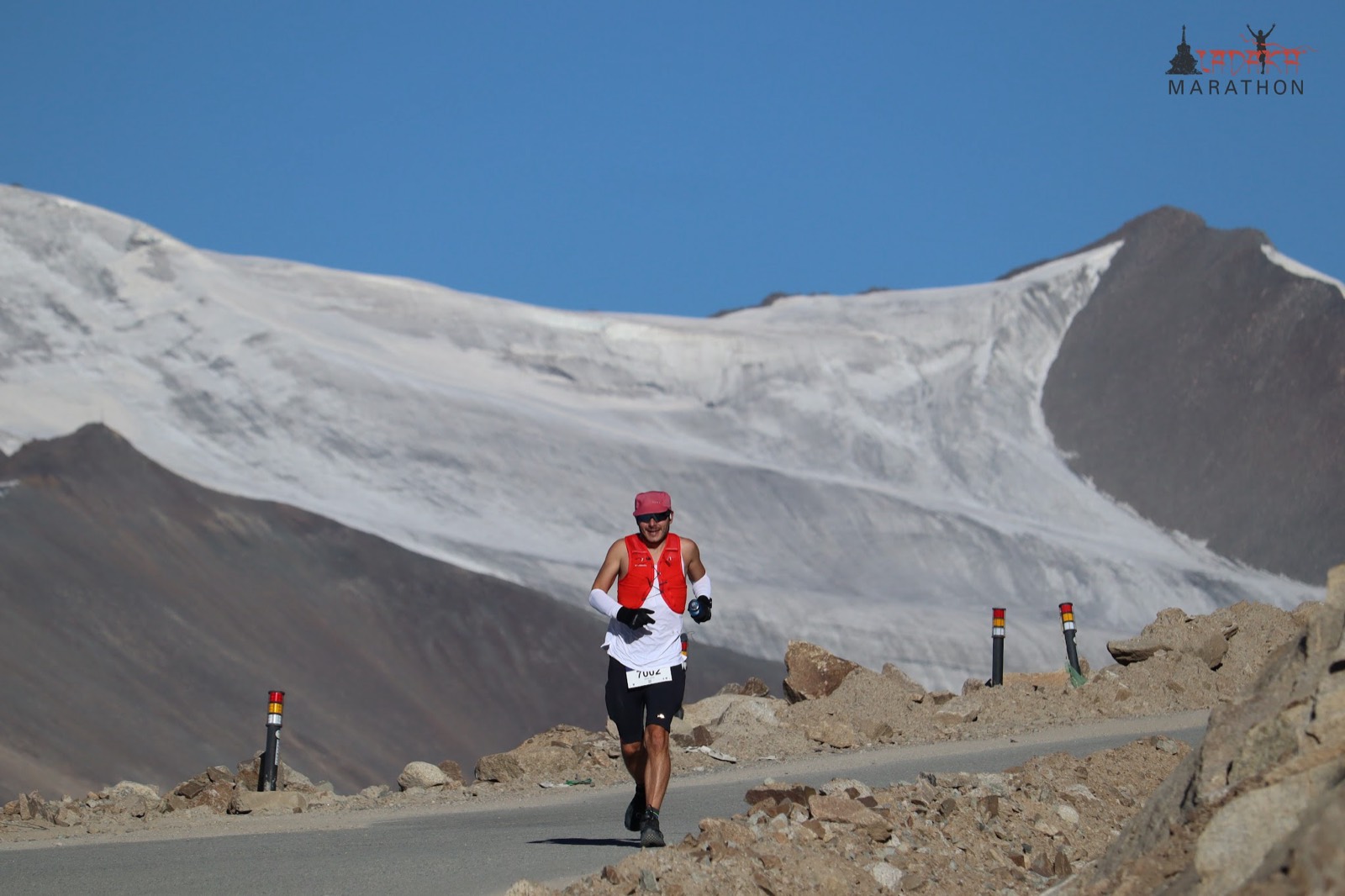
The first 14.3 km downhill averaged 5:57/km, including the summit stop. At South Pullu I was 9:27 ahead of schedule.
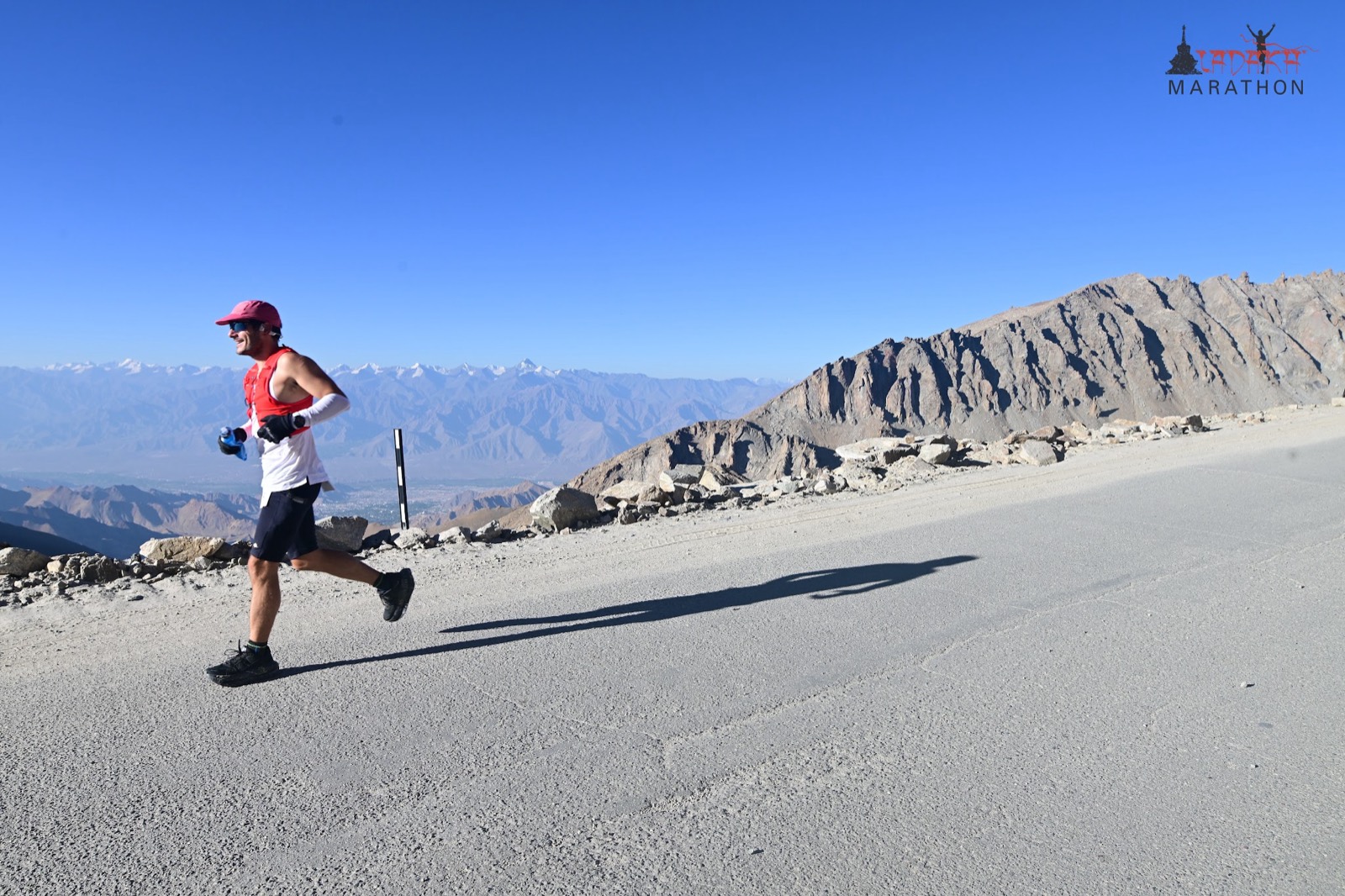
That buffer looked better than it was. Sub-8 still required 5:25/km for the remaining 25.5 km, including stops. I needed to accelerate after a four-hour climb and the first long descent.
I averaged 6:07/km over the next 12.1 km. By Mendak Mor, nine minutes ahead had become 2:33 behind.
The descent had stopped feeling like a chance to bank time. It was now a matter of keeping my legs moving and keeping my stomach from doing a backflip.
By then my legs were feeling the long descent. I had stopped taking gels because of stomach cramping and was pausing to refill and settle my breathing.
Garmin estimated about ten minutes stopped overall, roughly half after South Pullu. I needed to allow more time for those stops in my checkpoint targets.
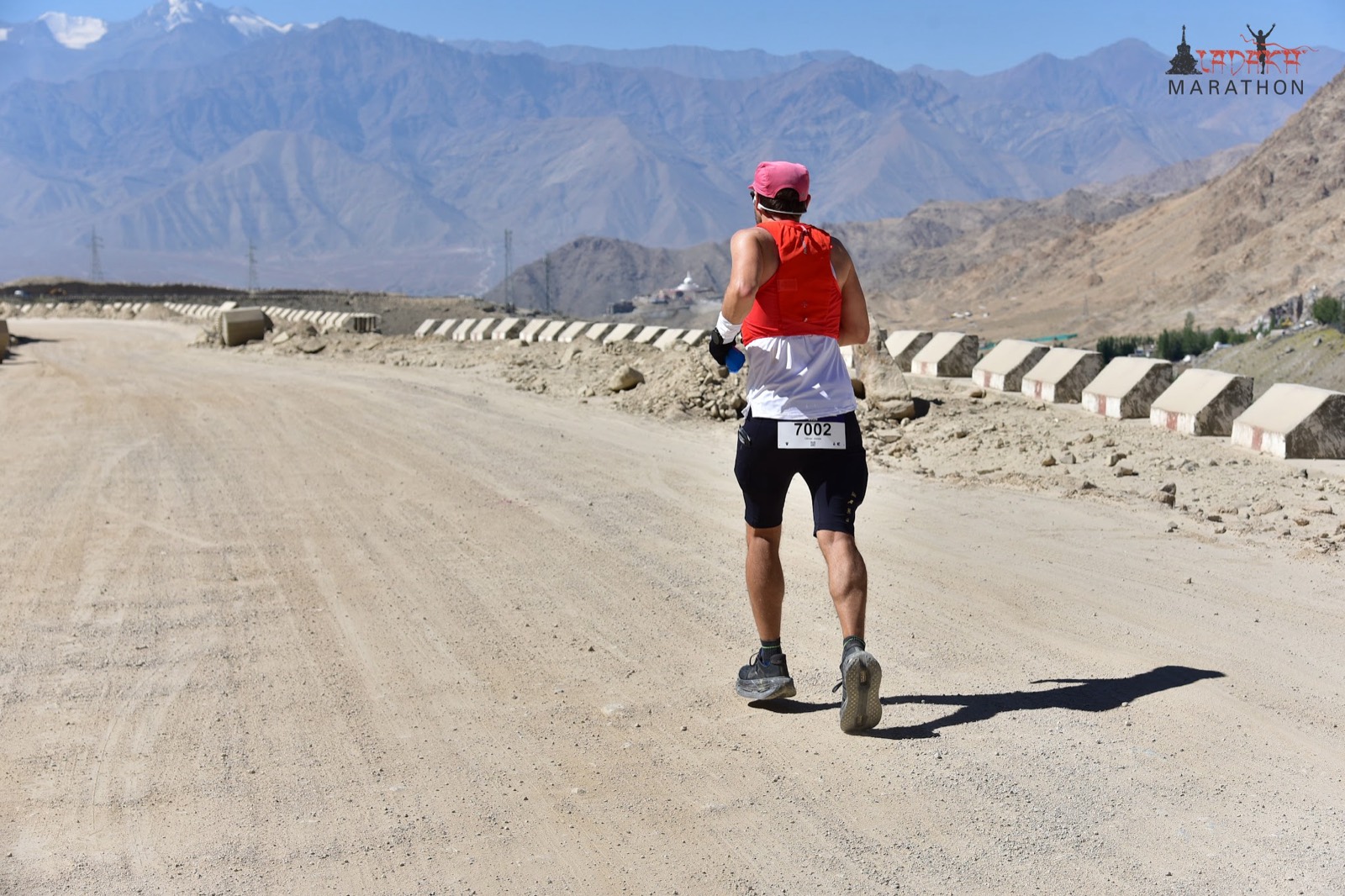
I picked up to 5:51/km over the final 13.4 km, but my schedule called for 4:58/km. That was no longer realistic.
I could still find a bit of speed, with the final full kilometre around 4:53/km on Garmin. One quick kilometre wasn’t going to recover the time I’d lost, though.
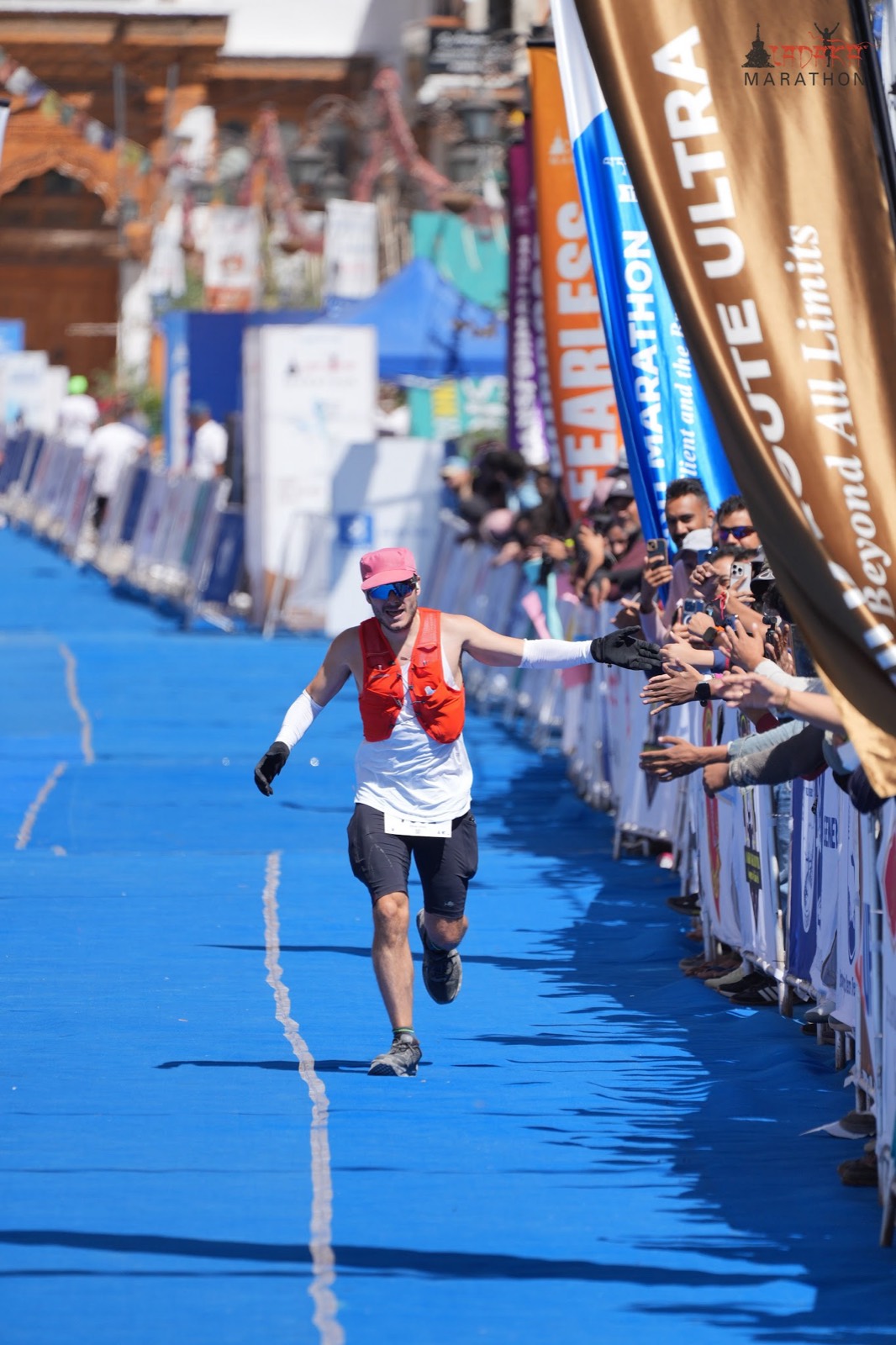
I crossed the line in an official time of 8:14:17, placing 14th in the men’s field.
I planned an Unived Elite Gel 180 before the start, then roughly every 15 km, with Steadfast Carborance in a 500 ml bottle. In the cold I drank according to thirst and what my stomach could tolerate.
By the summit I had taken three gels, including one before the start, and drunk two carb bottles. Each bottle held 60 g of carbohydrate and each gel 45 g. The in-race intake worked out at roughly 50 g an hour during the climb, plus the pre-start gel.
At the summit I swapped in the pre-filled bottle. On the descent, the thin air and stomach discomfort made another gel feel risky, so that bottle was all the carbohydrate I took over almost four hours. Intake dropped to about 15 g an hour.
That puts the race average at roughly 30 g an hour after the start. I also sipped plain water at most aid stations after Ktop, but did not record how much.
I lost more time later in the descent. Going almost four hours on one carb bottle may have been part of that.
I was worried that more food would make me vomit. The drink felt like a thick slurry on this course, so next time I would test a different concentration and smaller gel portions.
The sub-8-hour jacket will have to wait.
I don’t think the answer is to attack the climb harder. I was already ahead at the summit. I need stronger downhill legs and a way to keep eating when another gel feels like a bad idea.
Full Strava workout: Khardung La 72K A Plan

