

Guru Prasad BV finishes the 122 km Silk Route Ultra 2026 from Nubra to Leh over Khardung La in 21:51:14, nine minutes inside the cut-off, after nearly quitting at 75K.

I am a self-trained runner. For several years my week has been three run days alternating with three strength days, plus one rest day. My SRU training began in mid-February 2026, about seven months out.
Unlike my Khardung La Challenge (KC) preparation, I recognised that SRU is not simply “KC plus another 50K.” The extra time on feet, the fuelling demands and running for almost an entire day need a different approach.
| Period | Weekday runs | Weekend long run |
|---|---|---|
| March | 2 × 10K | 13–18K |
| April | 2 × 10K | 21–28K |
| May | 2 × 15K | 30–40K |
| June | 2 × 15K | 40–50K |
| July | 2 × 16K | 40–50K |
| August | 2 × 16K | 30–50K |
Weekday sessions included tempo, intervals, progressive runs and fartlek, while the weekend long runs were mostly easy.
Elevation became an important part of the preparation. My home, around Kanakapura Road and Turahalli, gave me easy access to uphill training. Other notable runs included:
I also wanted to experience a 100K+ event before SRU, since my longest run until then had been the 72K Khardung La Challenge. This led me to register for the Goa Ultra 120K.
| Race | Date | Result | Notes |
|---|---|---|---|
| Intentionality Ultra 50K | 28 June | 5:14 (50K PB) | Controlled pace of 6:00–6:30/km, dropping to ~7:00/km over the final 5K |
| Bengaluru 10K | 5 July | 46:10 (10K PB) | No speed training for months; 22:46 first 5K, 4:30 and 4:06 for the last two km |
| Bengaluru Ultra 50K | 26 July | 5:26 | Run as a training run at ~6:30/km, two weeks before Goa |
| Goa Ultra 120K | 8 August | Stopped at 62K | Humidity, monsoon rain and strong sun, made the conditions quite tough; A training race is useful only if it contributes to the main objective. I chose to stop at 62K rather than turn a training race into an injury or recovery problem just before SRU. |
Because of flight disruptions at the previous year’s Ladakh race, I arrived in Leh early, on 29 August. At approximately 3,500 m, the altitude was noticeable immediately, even while handling luggage. I took the first day easy, and the following morning did an 8.5K walk/run on the Leh–Manali Highway.
I gradually introduced elevation runs after reaching Leh. Next came a 10K run to Shanti Stupa that included uphill running and short hill repeats. Completing it well gave me confidence that I was adapting to the altitude.
I then completed two high-altitude training runs over Khardung La Top (approximately 5,400 m). On both, I power-hiked the climb, brisk-walked above 5,000 m, and switched to a 70:30 run to walk below that altitude.
| Route | Distance | Time | Nutrition |
|---|---|---|---|
| South Pulu – K-Top – South Pulu (start ~4,850 m; 10K up, 15K down) | 25K | ~4:10 | Bananas, solid food at an aid station, gels, electrolyte water |
| North Pulu – K-Top – South Pulu | ~30K | ~5:08 | Granola before; bananas, apples and gels during; electrolyte water and salt tablets every 10K |
The second run was especially useful because it covered the actual SRU/KC course, and it gave me a taste of the heat I could expect later in the race.
During a trip to Nubra, I did a recce of approximately 80% of the SRU course, so the route was familiar by race day. I then packed drop bags for Khardung village, Khardung La Top and South Pulu.
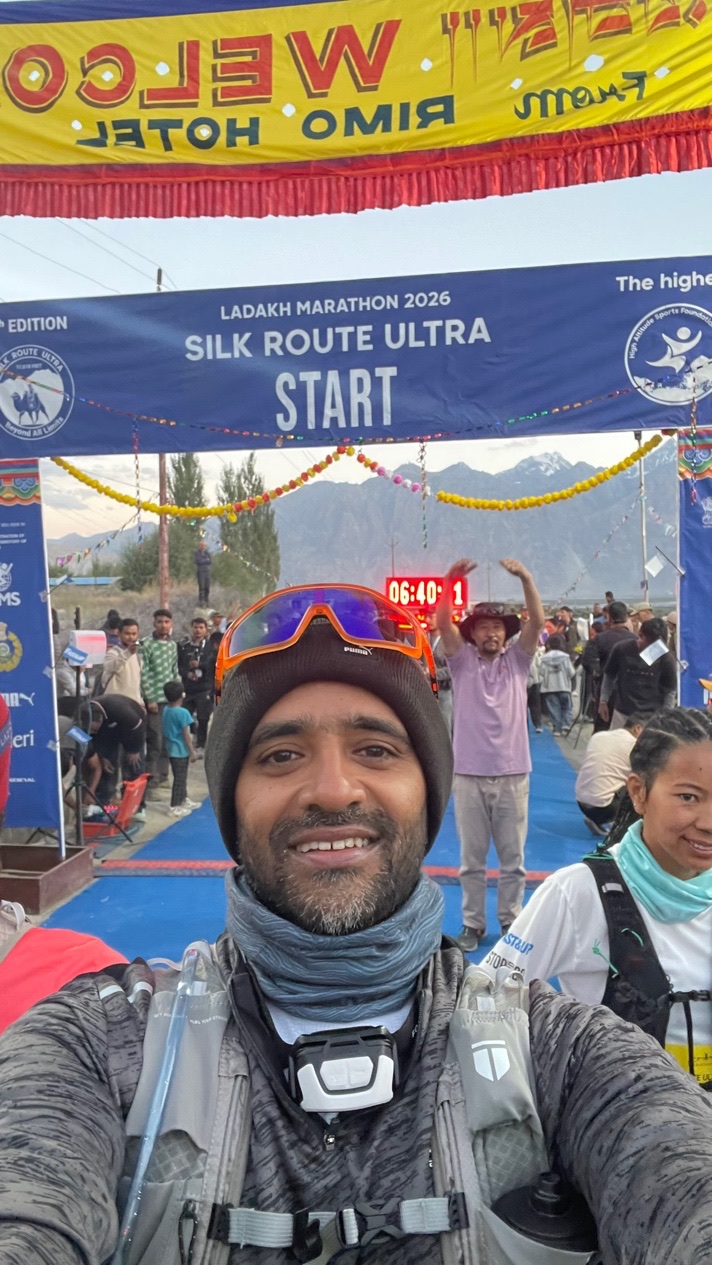
At the start in Kyagar.
SRU starts from Kyagar in the Nubra Valley, approximately 50 km before the Khardung La Challenge start.
The 118 runners handed in drop bags at NDS Stadium in Leh the previous morning and were taken by bus to Kyagar.
On race day, with a 7 PM start, I kept the morning deliberately easy. I passed the mandatory medical check (SpO₂ 97%, heart rate 65 bpm, BP 130/90), had an early, light lunch and tried to sleep in the afternoon before the final briefing. At the start line, my strategy was simple: trust the training.
| Checkpoint | Distance | My time | Cut-off | Buffer |
|---|---|---|---|---|
| Khalsar Army Camp | 27.6K | 3:40 | 4:00 | 20 min |
| Khardung village | 50K | 7:29 | 8:00 | 31 min |
| Khardung La Top | 82K | 15:03 | 16:00 | 57 min |
| South Pulu | 97K | 17:54 | 18:30 | 36 min |
| Mendak Mor | 108K | 19:41 | 20:00 | 19 min |
| Finish, Leh | 122K | 21:51 | 22:00 | 9 min |
The race started at 6:59 PM.
The first 15K was relatively comfortable, with rolling terrain. After Tirit village, however, the course became a difficult, trail-like section with uneven roads, darkness and a three-kilometre climb. My pace dropped from approximately 7:30/km to 9:40/km on this section.
I reached the first cut-off, Khalsar Army Camp, with 20 minutes in hand.
This is where the major climbing began. As planned, I switched from running to brisk walking. The terrain became increasingly isolated, and the temperature dropped as night fell and the altitude increased. I held around 10:00/km while brisk walking.
At Khardung village (50K), with a 31-minute buffer, I changed shoes, ate solid food and took a short break, restarting around 3:05 AM after approximately 30 minutes.
This section was almost entirely about managing effort and altitude. I held approximately 12:00/km at first.
At North Pulu, 67K into the race, I had completed more than half the distance and still had approximately 11 hours left.
I did not rely only on gels for a 22-hour ultra. At alternate aid stations, I ate solid food such as sandwiches, bread with peanut butter, boiled potatoes, chikki, bananas and watermelon.
I also carried approximately 2 litres of liquid carbohydrate, which I drank periodically. I took electrolytes at the aid stations and a salt tablet approximately every 11–12K.
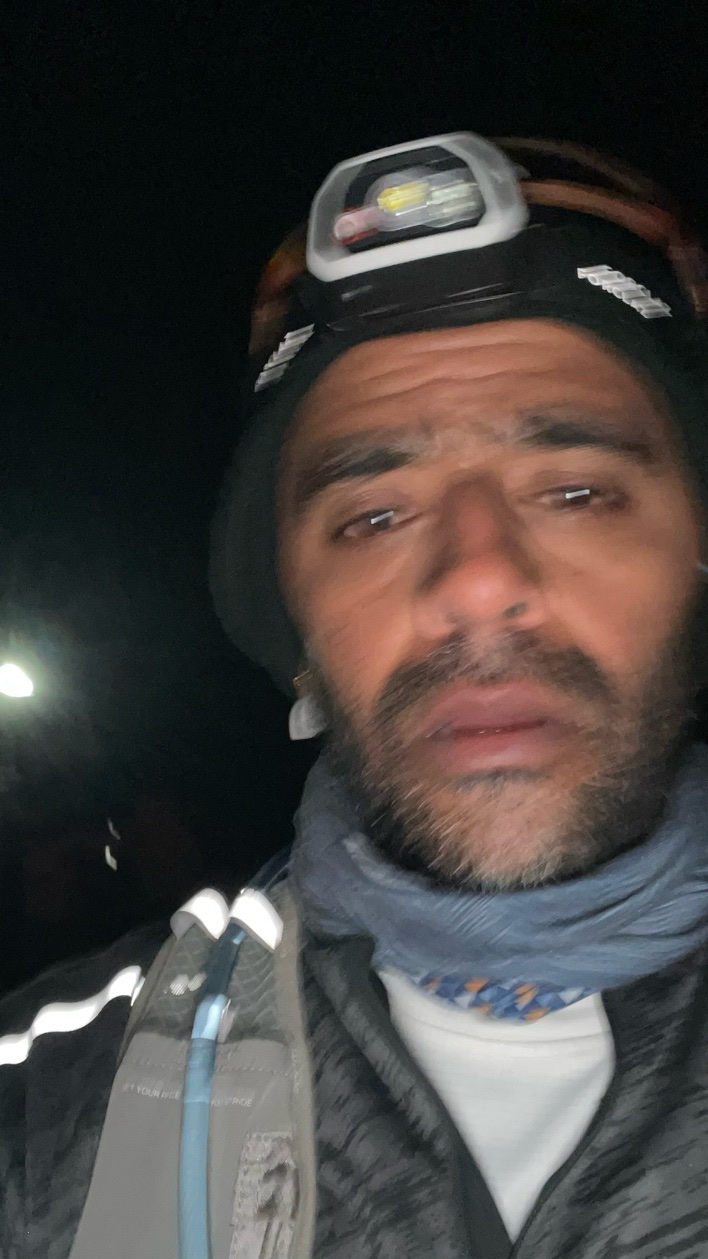
On the night climb towards Khardung La.
Around 73–75K, the race became extremely difficult.
My walking pace had slowed to around 13–14 min/km. At approximately 75K, I sat down by the roadside and seriously considered quitting.
A medic checked my SpO₂, which was 77%. The medical team considered this acceptable given the distance and altitude, but I was mentally ready to stop.
Another runner, Jahnnavi, reached me and strongly encouraged me not to quit. After seeing another runner being evacuated for medical attention, I reassessed the situation and decided to continue.
Instead of thinking about the remaining distance, I changed my approach to one kilometre at a time until K-Top. My pace had slowed to around 15–16 min/km, but I was moving again.
I reached the Shiva temple around 80K and then continued towards Khardung La Top. I crossed K-Top in 15:03, almost an hour inside the cut-off.
I had hot soup and fluids at K-Top and grew more confident that I could finish within the overall cut-off.
My strategy remained to avoid running until I was below 5,000 m. The two high-altitude training runs had helped me identify exactly where I could safely switch from walking to running.
Below 5,000 m, I switched to an approximately 60:40 run to walk, targeting around 9:00/km. By this point, however, the sun was strong and fatigue was building.
By South Pulu my buffer had shrunk to 36 minutes. There I swapped my warm layers for a T-shirt, arm sleeves and a sun-protection cap.
This became one of the most critical sections, with only 1.5 hours between the South Pulu and Mendak Mor cut-offs.
I was already dealing with chafing between my thighs, and I later developed chafing under my arms too. A fellow runner noticed I was struggling and offered me his lip balm to use on the affected areas. It reduced the friction enough for me to continue.
I crossed Mendak Mor with only 19 minutes to spare.
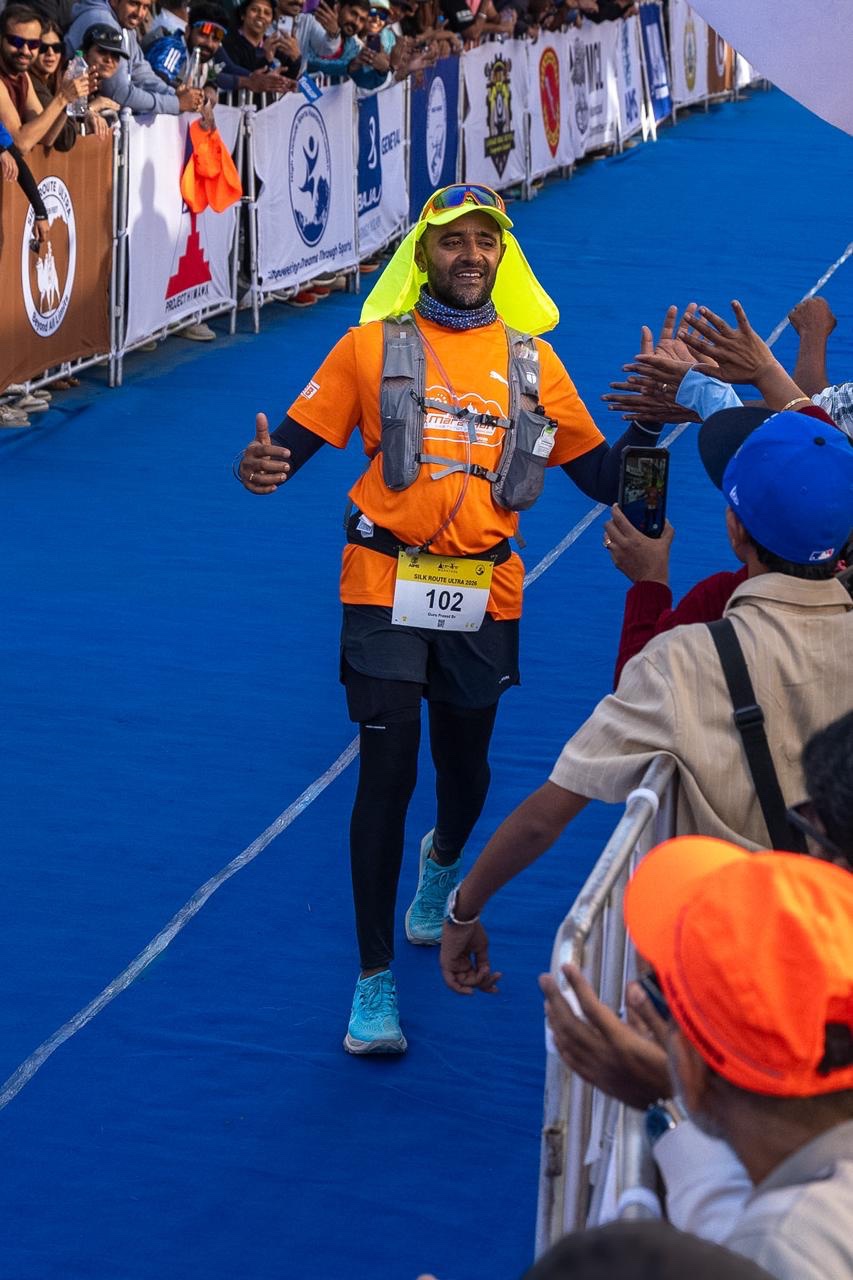
High-fives along the blue carpet in Leh.
The final 14K was physically exhausting. My stomach had become increasingly uncomfortable after a race’s worth of electrolytes, boiled potatoes, sandwiches, bananas and so on. I reached a point where I could barely drink without feeling that my stomach would throw it back up. I knew that if it did, my race would be over.
At the same time, the temperature was above 35°C. I could no longer keep up a run-walk strategy. I walked at approximately 9:40–10:15/km, occasionally running for 200–300 metres. With approximately 5K to go, I had only 56 minutes left. With approximately 30 minutes remaining and the last stretch mostly downhill, I went back to a run-walk strategy.
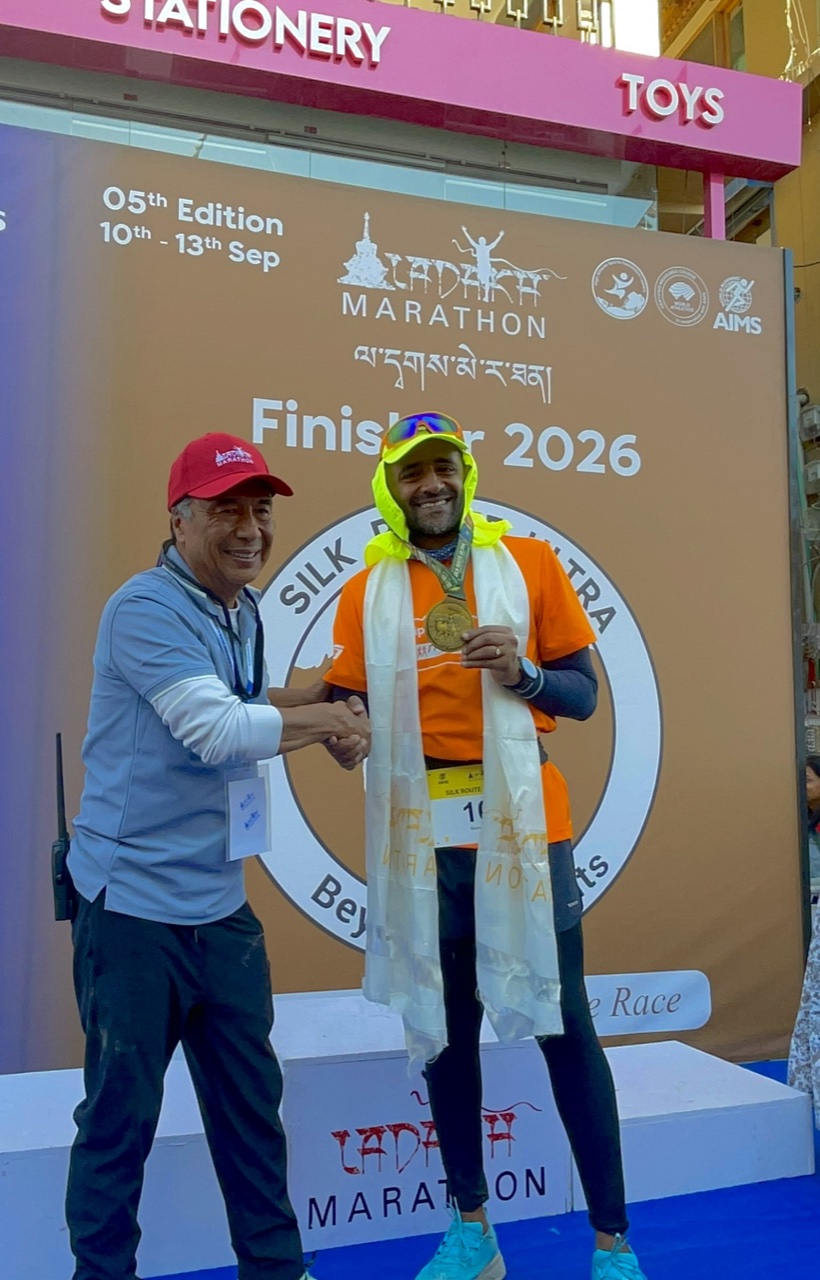
Finisher 2026.
In the final kilometre, the cheers of the crowd through Leh made the struggles of the previous 21+ hours fade away, and the blue-carpet welcome through Leh market was incredibly emotional. Just about 100 metres from the finish line, I saw my wife and son. I could not hold back my tears. I went straight to my wife and hugged her, and my son joined us in the embrace. After everything that had happened during the race, that moment meant more than the finish itself. I crossed the line in 21:51:14, nine minutes inside the cut-off.
Standing there, I felt that perhaps we don’t really conquer these mighty Himalayas. The mountains have to accept us and allow us to finish. In front of these magnificent mountains, one can only remain humble.
The SRU preparation reinforced for me that an ultra of this distance cannot be approached simply by increasing weekly mileage. Of everything in the seven-month preparation, the two high-altitude practice runs were particularly valuable. They helped me understand where to walk, where to run, how my body responded above 5,000 m and what nutrition worked for me.
The race itself reinforced another important lesson: in a race like SRU, cut-off management is as important as pace management. I kept checking the buffer I had, and the race was effectively a continuous exercise in managing it.
The other major lesson was fuelling for a 22-hour effort. Gels alone are not enough. I combined gels, liquid carbohydrates, solid food, electrolytes and salt tablets. By the later stages, however, everything I had taken in also contributed to my stomach discomfort, which is something I would approach differently in future.
Finally, the race reminded me that the body can keep moving even when the mind says it cannot. At around 75K, I had mentally quit. Breaking the remaining distance into small targets allowed me to restart and eventually reach the finish.

